Friday, 27 September 2019

198- Minding Our Own Business and Spiritual Life

Question

“You do wrong to find fault, and to try to make everyone see things from your point of view. We desire to be as little children. Now, little children do not know what is best. Everything is right in their eyes. Let us imitate them.”

This quote, above, is from St. Therese on being little. Is she is saying that it is better to keep one’s opinion to oneself? How does this balance with trying to give advice to help people, as I thought she did with some of the Novices?

Answer

First, let us see if the quote is an original quote:

This quote comes from the book written by her sister, Céline (Geneviève), after Therese's death, called: “Conseils et souvenirs” ("Advice and Memories"). This book is not a primary source, but one can reasonably accept the quote as coming from Thérèse. The book is not often read today. But still, I don’t see how or why we would deny this thought to Thérèse.

Understanding Thérèse's Advice


Let us try to understand it. She was in charge of the Novices, teaching them all the time, being extremely vigilant with them! As you can see, she has been caught out doing what she seems to deny to others: giving advice, spotting something that is not right in one of her novices.
The first stage of the answer is to observe what is the duty of state. It is not the responsibility or duty of a nun (who is not the Prioress or the Mistress of Novices) to pay attention to other nun's behaviour (unless it is visible and serious). Her duty of state asks her to be just a nun, totally dedicated to God and paying attention to Him by looking inwardly.
So Sister Thérèse, as having the responsibility (and not the title) of Mistress of Novices, spotted a young novice putting her nose in other nuns’ business, and not paying attention to what God is asking of her. Thérèse points out the fact that we human beings can’t know what is happening in the heart of our brothers and sisters, hence the strong commandment given by the Lord: “do not judge”, the reason being that we can't see into the workings of the heart. Or in other places in the Bible we read: who knows what is in the heart of a human being (see Jeremiah 17:9)?! So to invite the nun to humility and to focus on her task (to be there for God) she advises her to imitate little Children. Thérèse here is doing her duty of state. It wasn’t the nun’s duty of state to find fault in other persons!

One can add two similar pieces of advice:

1- A nun (here not a novice) was scandalised and was suffering because of what was happening in another Monastery. Thérèse on the contrary was very calm and focused on God. Surprised, the nun asked Thérèse how come she could be so calm and was not concerned by what was happening in that other monastery. Thérèse's reply was that this was not their community and that it therefore couldn't in any way trouble her.
One can easily remember the "pagan" philosophical advice, which was very early on adopted by Monasticism:

Don't worry about what you can't change.
Worry only about what you can change.

In fact, we can't change any human being. We can change only ourselves.

2- St. John of the Cross, in his advice given to a religious (see Minor works) says that the monk has to live in the monastery as if he were alone with God, paying attention only to God. Of course this advice today can very easily be felt to be harsh and not even correct, or worse still: against charity etc.

If, instead of boldly criticising a saint of this stature, we try to understand what he says we will find his advice to be very evangelical. The Lord himself, as stated above, is asking us to mind our own business and never judge our brothers or sisters - again, unless it is our duty and responsibility, i.e. unless it is our duty of state (being a parent, a superior, or a spiritual director, etc.). The fundamental reason is: we don't see the human being's heart

On the other hand, I hear the objection: it is true that if we see our brother committing something serious the Gospel asks us to talk to him or her and invite them to repent (Fraternal Correction see Mt 18:15-18). And later, if they don't repent, we are asked to report it to the Community. But at the same time the Lord asks us to focus on our own sins, business, problems: "Why do you look at the speck of sawdust in your brother's eye and pay no attention to the plank in your own eye?" (Luke 6:41)
We should focus on what we can change! This is our primary duty.
Let us also admire the continuation of the advice:
"You hypocrite, first take the plank out of your eye, and then you will see clearly to remove the speck from your brother's eye." (Luke 6:42). The Lord however seems to retain the possibility that later, having greater clarity, one is able to "remove the speck"; He never explains how.


In fact, when the hypocrisy (the double standards) fades and goes, when the powerful light of the Holy Spirit sheds its insights into our very depths, we discover our nothingness, and we discover the fact that the only exit or solution for us, when face to face with God, is to rely purely and utterly on His Mercy. When the "hypocrisy" goes, after having focused for years on removing the big plank from our eye, we discover that our main duty is to forgive, to exercise mercy on our brothers and intercede for them.

Thérèse gives this advice to a nun: God doesn't want us to be judges of our sisters but agents of God's mercy toward them. God understand our weakness. We can excuse them, find excuses for them. Have a merciful attitude. We can in fact imitate God.

Referring even to the greater Monastic tradition, and the Desert Fathers, we read in their stories that an Elder saw a young monk committing adultery, but remained in peace. Another young monk, who saw the whole thing, was scandalised and troubled, and was surprised to see the Elder remaining peaceful. He asked the Elder, challenging him: didn't you seen the whole thing? The Elder answered: no.
The story here could seem very confusing to many. But each one of the short stories and advice of the Fathers of the Desert bears a lesson, and here is the lesson: do not to lose your inner peace. Why? Because the work of God can only be achieved when one is at peace! Being troubled caused by being scandalised doesn't allows to fulfil God's will and bear  good fruits.
So what do  you do? You choose a higher value (i.e. peace) over a lower or even a sinful one: forfeiting one's inner peace. Again, it is the Lord's advice: "You hypocrite, first take the plank out of your eye, and then you will see clearly to remove the speck from your brother's eye." The monk preferred to shed tears over his own sins than to spend one minute noticing a grave sin committed by his brother and being troubled by it.
It is possible that this logic won't dawn on many. Time and humility will tell.

When Saint Paul writes to his disciple and spiritual son, Timothy, and gives him advice for the organisation of the Community (see first letter to Timothy). He asks the latter not to appoint as Leader (Bishop) somebody who has been recently converted, because such a person is often still reacting under the influence of the Old Man. As a consequence humility will be lacking, violence will still be there, harsh judgement, etc. Humility and holiness are still a long way from where he is. The experience of God's Mercy and of one's nothingness hasn't sunk in yet. The experience of perceiving that we are all in the same box and that we all need His Mercy and that the only exit for us is his Mercy is not there yet.

We live in a world where everybody thinks they know everything: each person thinks they know about politics, economics, history, etc. Each person seems to have an opinion about everything, people judge their superiors very easily, the Pope for example is constantly being judged and criticised by many and even condemned. This is utterly bad and sinful behaviour. We are not focused on what we can change: ourselves! We do not mind our own business! God will judge each person, God is the judge. We are not. Sometimes we might be called to report something we have noticed to our superior, the one who is in charge, ok, fine, but after reporting it, we should completely forget about it: it does not depends on us, it is not our duty of state, it is not our own business. Otherwise we will spend 80% of our energy on things that are not part of our duties. Once reported, the responsibility falls into the hands of those in charge and not on us! God will not condemn us. We have reported; that's it. Now we can be at peace, it is not our duty anymore.


Summing up

We need to remember that we have two worlds (sometimes called "forums") or two areas in our life: the internal one and the external one. The external one is the world in which we live, people who surround us and we meet, the external events. The internal one is the secret of our heart, of our thoughts, of our conscience and of our relationship with God. The two worlds are not separated but often we pay attention rather to the external one only. All our acts come from our internal world. The visible acts are the ones which cross the line and become visible, noticeable to others, and the other ones, remain in our heart and no-one sees them. This fundamental distinction helps us discern two areas in our duties and two areas wherein our Peace lies.


We can distinguish two aspects in our duties:

a- The external ones: the duties of our state of life (single, married, consecrated) and the duties of our work. ('external forum' duties: they are often public and verifiable by others.)
b- The internal ones: our spiritual life, and our responsibility to answer Jesus' Call and grow spiritually everyday. ('internal forum' duties)

God's will manifests itself to us in two forms: internal duties (our spiritual life) and external ones. Both duties are important and necessary. We often forget our internal duties, i.e. our spiritual life.


Also, since we have talked above about the importance of having peace in our heart, we can distinguish two types of outcomes regarding peace:

a- The external one: we are not promised necessarily to have peace in the following areas: our community, neighbourhood, family, work place, congregation/order, city, country. Our passive thoughts (Temptations). God allows them for our own good in order to strengthen us spiritually. "Lead us not into temptation" doesn't mean keep at bay all challenges and trials. It means, give us the grace to be victorious over temptation when it comes.
We often don't have peace in these external areas because life on earth is not a "paradise" but a type of warfare which challenges us to grow spiritually and as human beings.
b- The internal one: peace with God, peace in the heart, and peace in our active thoughts. Our goal should be necessarily to reach this peace in order to accomplish both our duties, inner and outer. One has to be very vigilant in this regard. We can't accomplish God's duties, our external duties, if we don't have vital inner peace. Of course it doesn't come easily, and one needs to make an effort of conversion. But the paradox is that one can be totally at peace and live in a very difficult outer situation where there is no peace. On one hand we are vigilant to keep the peace in our heart, or regain it, and on the other hand we work and fulfil our external duties.

As we can see only the internal one should be sought after and kept in order to do God's will.
Of course external trouble around us doesn't give us licence to join in, rather we should try to be peacemakers (Rm 14:19: "Let us therefore make every effort to do what leads to peace and to mutual edification."). But if we fail, it is still ok, we are not supposed to succeed always because the freedom of other persons and situations doesn't depend only on us.
It is true also that sometimes we feel in our conscience that God is asking us to witness to the truth, be witnesses to Jesus (and it could create trouble without meaning to); this has to be done with discernment. We can witness to the truth but be unable to convince others about it, and even less to force them to accept it.
Often, despite the fact that we seek peace, we find that there are always difficulties, struggles, misunderstandings, trials. Even   if we have done all that we can, we can't change the situation we can't change others. If we still have doubts we can always consult our Spiritual Director.


I think all the above needs long extensive moments of prayerful silence face to face with God.

Wednesday, 4 September 2019

197- Old & New Man Functioning


The video below shows us something not far from what we just saw. The neural and hormonal difference between pleasure and  happiness. Very interesting.


Wednesday, 8 May 2019

196- Chastity and “Union with the Will of God”

The Deep Aspect of the Crisis of the Church

From time to time, Monique and I meet. She comes to my office and we talk about Carmelite Life, about Blessed Father Marie Eugene OCD. She is, in fact, a member of the Institute he founded: « Notre Dame de Vie », which has a totally Carmelite spirituality.

Apart from asking me from time to time to give a talk on Fr. Marie Eugene, we talk about many things. Of course, the Church and Spiritual Life are very much at the heart of our discussions. We might start by talking about Amnesty International (where she has worked for many years) and might move on to talking about Brexit; Monique is very much down to earth, compassionate and a fervent advocate of many causes. But we always come back to Fr. Marie Eugene. She knows that I am preparing my PhD Thesis on Fr. Louis Guillet OCD (1902-1992), a companion of Blessed Fr. Marie Eugene, so we have plenty of stories to share.

She often asks me the question: “how did you come to know Fr. Marie Eugene?”, and I start to talk about the French Carmelites of the South of France, and how much I owe them, and how much they gained from Fr. Marie Eugene. We could talk for hours.

Then suddenly, today, Monique asked me this direct question: “What do you think about the crisis the Church is undergoing?” I was convinced that she meant the child abuse horror. And I started to say that it was more widespread than was apparent and that this crisis affected only a very small number of priests or religious. She stopped me and said: “no, I am talking about the abuse of the nuns!”

In fact, two months before, on the French-German TV channel Arte, she had watched a programme where different sex scandals between priests and nuns had been exposed. Something horrific and extremely shattering. Monique is convinced it is very widespread in the Church.

I vaguely remembered it; after the Pope alluded to it when he was on his flight back from the Emirates, I had looked it up. I have to confess that I hadn’t watched the French TV Programme Monique mentioned! Also, knowing the milieu, I considered this type of scandal to be limited, in numbers and in areas (communities). Monique, however, was adamant that it wasn’t. Bottom line: Monique was very shocked since having watched the programme, and stated: the Church now has reached the bottom of the abyss.

While talking to her, the analysis I responded with was very clear-cut: at the heart of this issue is what I consider to be the core of the problem (at least for this type of scandal): chastity. What is chastity? Is it something we decide of our own will power? Is it something we learn from our youth? Admittedly, society doesn’t help that much nowadays in this area. Is it something that depends on the Grace of God? If so, to which extent? Is it an acquired grace that once received keeps us safe and at peace? Is it a constant battle? What are the means we offer to the seminarian, to the young nun, to any human being (because we are all called to chastity…) to reach chastity? Are we able to generate chaste persons? Do we have the “know-how” for this? Based on what?

For many years now, I have been personally involved in Formation (Religious, Nuns, Seminarians,…) and since I have listened and searched to see how this issue is being addressed in many places in the Church, read many books (at least in my early years), I take the opportunity here to briefly give my point of view.

In my humble opinion, chastity is the normal result of spiritual growth (I am talking here about a rather balanced person and not a deeply wounded person). When the love of God, the love of Jesus takes deep root in our heart, starts to transform it, starts to really fill the void in our heart and emotions, then chastity starts to take root in us. It is not necessarily the first issue we need to sort out in our life, but it is there, a part of it. Let us see what is at stake.


Falling in Love with Jesus

“Falling in love with Jesus” is something that only the Saints talk about. You will rarely see or hear a person today talking about “falling in love with Jesus”! The Church’s daily life doesn’t seem to point to this reality.

Paradoxically, if we delve a little into the life of any saint, this aspect strikes us immediately.
Look at St. Therese of the Child Jesus, Claire of Assisi, Catherine of Sienna, Teresa of Avila, Gemma Galgani… and the list is very long; observe them in their daily life. These women fell in love with Jesus deeply, to the point that they considered Him as being their Spouse! A real Spouse my dear friends, not just a symbolic expression, a consolation price! Not a “photocopy” of human love, but the original love! It is real love, and Jesus is positively REAL! Here lies the difference between the teaching of the saints and the daily life of the Church.


For the average Christian this language (“falling in love with Jesus”) is simply alien! You would be regarded with derision by people in general, as if in fact you were insane.

Indeed, it is alien! But for the saints, this is normality… their daily life. In exactly the same way as you would fall in love with a man or a woman, they fell in love with Jesus! All of us are called to have this experience. This heart that God gave us is made in the image and likeness of Jesus! Only Jesus can fill it. I can still hear Father Guy Merlin OCD, Provincial of the Carmelites of the south of France, saying in the late 1980s: “it is normal to allow the young religious or monks to be a bit “romantic” in their initial steps of the religious life. Otherwise it is not possible to commit to religious life. Later this love will grow stronger and deeper.”

When we fall in love with Jesus, our emotions, our hearts, are involved in this love. We commit ourselves to Him, serve Him, search for His will. To fall in love, however, is not just about emotions, it is about commitment, daily faithfulness to the will of Jesus! Look at St. Therese of the Child Jesus in her early years, in her daily life, how she loved Jesus!

Even married persons are called to experience this love! This is why the Church distinguishes between “Civil Marriage” and the “Sacrament of Marriage”! The latter involves this love of Jesus! Hence it is called “sacrament” … sacrament of Jesus…. If loving Jesus is not the initial core in the life of the bride and the groom, why bind themselves to something that can’t be broken? It is pure folly, especially today. I do not negate Marriage as seen by the Natural Law (Civil Marriages for instance), which also should be exempt from divorce, but please give me the means to reach this holiness, give me the help of the grace of God, in order to make it work. Natural Law alone cannot guarantee the absence of divorce, even if it states it.

Let us return to our point! Let’s examine Teresa of Avila: she spends almost twenty years as a nun without giving her heart totally to Jesus! She is wearing the habit, there are no formal grave sins in whatever she does, for example, in appreciating “spiritual” friendship and talking to friends about God and prayer, but her heart is not totally given to Jesus! This lesson alone is fundamental in order to help us understand both St. Teresa of Avila, all the Saints and Spiritual Life.

Total commitment to Jesus entails giving Him not only our mind and our will, but also our emotions, our thirst to be loved by other humans, and to love them! Our entire heart is made in the image of Jesus, not half of it! We, however, tend to split our heart into two halves: the upper half we destine for God. And the lower half is for a human being, human affections and emotions. We fail to realise that all our heart should go to the One who is God and man in the same Divine Person.

Jesus waited twenty years for Teresa! He sent her many signs, invitations, all sorts of graces, warnings! She remained deaf! She searched for the love of human beings instead of believing that Jesus, the incarnate God, was and is capable of filling her human heart, her emotions, of making her fall in love with Him! That He was her Treasure, the real Prince Charming!

It took her twenty years to realise that her enormous capacity to love and be loved could only be filled by Jesus!

It took her twenty years to give Him her heart, without conditions, no strings attached, no search for human affection or consolation.

It took her twenty years to believe that it is not only possible to fall in love with Jesus but that that was the only way to proceed.

It took her twenty years to understand that her vow of Chastity meant that her heart was called to be totally, radically and unconditionally given to Jesus!

Try and see… you will never regret it!

As much as Jesus can be “ferocious” in asking for everything, absolutely and positively everything, so much will He treat you as a real Queen and give you the experience that no “prince” can give you on earth! Try and you will see!


How Can This Happen if I am a Man?

The only difficulty - and it is quite a sizeable one - is that for a woman it is easier to love Jesus, but for a heterosexual man, loving Jesus who has the human nature of a man, is something quite difficult at first sight. How then can a man, a seminarian, a young religious fall in love with Jesus?

Keep in mind though that both men and women have a feminine side and a masculine side!

In certain cultures, men don’t allow this feminine side to express itself. Not physically of course but just spiritually, inside of themselves. They would find it very difficult. Our Lady comes here to our rescue. Isn’t She the best and most perfect disciple of Jesus? Yes! If we contemplate her in the Annunciation, isn’t She the best incarnation of the feminine? She is receptive, docile, silent, surrendering totally herself to God. Can’t we, males and females, take her as our role model for the feminine side and allow Her to grow in us, and in us and through us fall in love with Jesus? Try it and you will see!
In fact, Christianity starts with Mary, because it is with Her and through Her feminine side that we can fall in love with Jesus! Let Her teach you and show you the way. Let us contemplate and imitate Mary in the Annunciation.

Christianity also “ends” with Mary… because it is in this way that true love will grow and become virile, true virtue, built on the grace of God will grow in us and take deep root. Mary at the foot of the Cross has a “male” (virile) strength that defies Jesus’ enemies. By contrast, all false virility abandoned Christ after having said: “I will follow you wherever you go, and I am ready to die for you”.

It is by totally committing to Jesus and not allowing any loss of emotional energy, that we can allow the Love of Jesus to grow in us. It is by loving Jesus in our neighbour, but more so, in our enemy, that the love of God in us becomes strong. Love the person you love least in your community or surroundings. Love this person with the help of Jesus and his Holy Spirit. Love this person “because of Jesus”. Love Jesus in this person. Experience the power of the Holy Spirit in you, how He pours His Charity into your heart! Love your brothers and sisters heroically. Don’t choose who to love. Spend more time with the people you can’t bear. Smile at them, pay attention to them, pay attention to Jesus in them. This will boost your spiritual growth and make you reach in very little time what Teresa of Avila calls: “the union with the will of God” (please see her book: “Interior Castle”, Fifth Mansions.).


Talking about Chastity

It is in this new state of “Union with the Will of God” that our emotions are submitted to the power of the Grace of God in us, that our will is solidly established in the will of God. This state offers us the experience of a first liberation and allows us to love freely, i.e. with greater ease. At the same time, we have a unique experience of the Love of Jesus that starts to grow. And soon, it will start to grow exponentially.

In the “Union with the Will of God”, the “train” of chastity is put on the railway tracks. Does this mean chastity is acquired once and for all? No. Chastity will constantly remain a “constant dependence on the Grace of God”, till the end! Remember, where does St. Teresa of Avila talk about King Solomon and his final turpitudes? In the Seventh Mansions, in Spiritual Marriage! We are never safe, but at the same time we need to acknowledge that the “union of will” is an important threshold. This is why St. Teresa of Avila says:
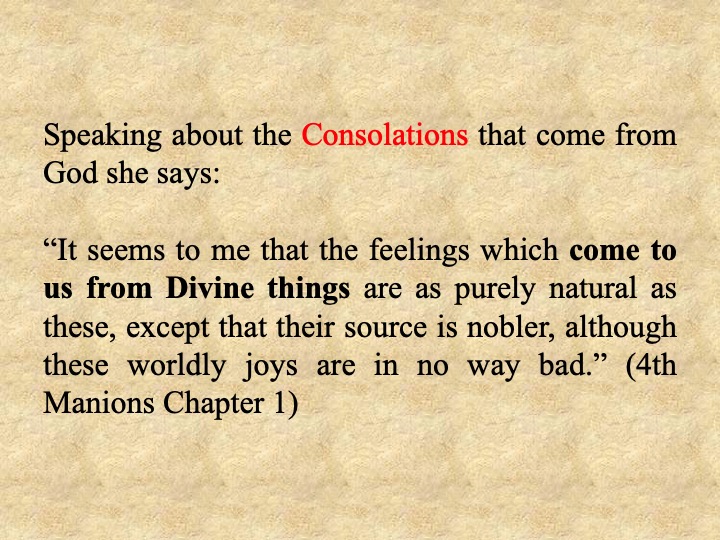
“I confess to you that we shall find this much harder, but it is of the greatest value and the reward will be greater too if you gain the victory. But you must not doubt the possibility of this true union with the will of GodThis is the union which I have desired all my life; it is for this that I continually beseech Our Lord; it is this which is the most genuine and the safest.” (“Interior Castle”, Fifth Mansions, III,5)

If we can’t offer to the young men and young women who consecrate their lives to Jesus the true way that leads to the “Union with the Will of God”, can we really continue to give Formation thus? Isn't it better to seek out those who have the know-how and can help? Do we want more scandals in the Church? Despite the many other reasons for them, these scandals have a common cause: emotions and sexuality that are searching for their true object to love (Jesus) and don’t find anybody showing them how to reach at least the “Union with the Will of God”.

We cannot “protect” the heart and emotions of our young priests from temptation and from falling into scandalous situations with only sets of exterior rules or solutions, or some psychological methods. Of course, prudence and a set of rules of behaviour are necessary and should constantly be implemented. But all this will never be enough, and these individuals might become frustrated because their emotional thirst is still there. They will remain vulnerable because of human weakness and a deep thirst for love. By the nature of their mission they will interact with people: they will be exposed to temptation. What they really need is to learn the art of meeting the Risen Lord, of loving Him and of falling in love with Him! The “protection” of our future Priests and future Nuns comes from within, from a transformed heart, filled with the love of Jesus, from a quenched desire, from a heart overflowing with the Love of Jesus, a heart that has been kindled and which is burning with the Love of God.

We need to take serious decisions here!

Formation in the communities and seminaries should be “mystical” and not only and first psychological. Otherwise it is doomed to fail. Unfortunately, in many places, if we look closer, we will find that the true leader of Formation is Psychology, or a spirituality that has as a main “judge” or “leader”: psychology. I am not saying that there is no spiritual life, or no liturgy in the different houses of formation. Plus, Psychology in itself has nothing wrong in it and it is needed in certain cases. What I am saying is that Psychology cannot lead: it offers us the Grace of God, but it cannot help us fall in love with Jesus, it cannot offer us real transformation from within, triggering a journey that will allow us, God willing, to reach this first great liberating point called “Union of Will”.

There is and will always be a great need for Formators who are experts in spiritual life, who know what the grace of God is waiting for, what it can achieve in us and who know what it means to grow to reach “Union with the Will of God”. In fact, we need Formators who know about real chastity, who can send in mission men and women who have their heart and emotions protected, because it is overflowing with the love of Jesus.

Offering a regular time for prayer to the seminarians or the young religious should be complemented by a renewed effort, namely, a proper Spiritual Formation that shows the way, helps trigger spiritual commitment and the reception of abundant of graces, which is a necessity not something to be left at random or managed in an amateur way. In the houses of formation, one needs to greatly strengthen Spiritual Theology in general and Spiritual Formation in particular. In order to ensure proper Spiritual Formation it is important to have not only a fervent spiritual life, but also to ensure professionalism, it should be based on the proper science of a renewed and practical Spiritual Theology, experience of real spiritual life, knowing how it works and its means, so as to be fruitful. Otherwise one can have future problems. It is important to know how to ensure steady growth using practical means in order to attain the “Union of Will”. This aspect is of utmost importance in order to promote a healthy and holy life for the consecrated. We need to stop and ponder on our responsibility in the Church when we are about to receive a young man or a young woman who wants to be consecrated to the Lord. We need to ask ourselves: do we really know how to form? Do we have the know-how and expertise for real Spiritual Formation? Otherwise, our careless decision to receive them, “counting on God” to do our job instead of we ourselves, is a very grave act of irresponsibility. One should call a spade a spade!

Many superiors send some of their candidates to be formed in Spiritual Theology, or “Spirituality”, in order to prepare them to become Formators. This is true and it is a necessity. But if Spiritual Theology, as it is taught today, fails to explain how to “Ensure a Steady Growth”, how to reach “Union with the Will of God”, fails to explain what constitutes the powerful means of prayer and how to discern and choose them, how to really prepare ourselves to receive the Grace of God, how to discern, we cannot really consider that the future Formator is really formed! We are back to square one and the real problem persists!

Many people speak about spiritual life, many people give talks, many many do pray. But is this bearing fruit? And if not, why aren’t we questioning ourselves? If we don’t see the relationship between spiritual growth and chastity, where are we going? If we don’t know how to ensure this growth, why do we receive candidates?!

When the child abuse scandal became public, we were forced to acknowledge our failures, apologise, and change the behaviour and the laws. It took various big scandals to bring about change. Even worse: we were forced to change because of public opinion and because of Civil Law! Shame on us would say St. Paul (see 1 Cor 6). The Formation process has also been positively improved because of what the scandal revealed! We are trying to avoid having future priests who could be paedophiles. We are trying to have superiors aware of the gravity of such acts.

Now, is this the only problem? There is a wider and, in a way, deeper problem that affects all consecrated persons, and the whole people of God, because it is a human issue: what do we do with our heart, emotions, and sexuality? Can the Grace of God help here? How? What are the means we need to use in order to change things? Do we know them? Are we experts in them? Or, are we still hiding from the real problem as we did with the child abuse issue in the past?

I do not think we should stop at some (or many) cases of sexual and emotional abuse of Nuns. This is only the tip of the iceberg of our emotions and sexuality. The question of Chastity should be addressed. It is not at all an easy problem, but it has to be addressed. Not superficially, but in-depth, with a great knowledge of what the grace of God can and cannot do.

Many leaders in the Church would feel very uncomfortable with what I am saying here. We had the same discomfort in the 1970s and 1980s when priests’ paedophilia was just hinted at. We didn’t want to hear about it! (we couldn’t face it!) Now the scandal of the abuse of the nuns is in the public domain! Do we still want to hide behind another uncomfortable or unpalatable fact? Until when? Until what? It is ourselves who are main the cause of great scandal to the people of God and to the world!


Jean Khoury
29 April 2019, St. Catherine of Sienna

PS A few years ago, in French and in Italian, I offered a commentary on the Encyclical letter of Pope Benedict “God is Love”, explaining the above. It constitutes the third part of my book on the Prayer of the Heart. “La prière du Coeur à l’école de Marie” or “La preghiera del cuore alla scuola di Maria”. I hope to be able to translate it into English. But the above is a good summary of it.

See the following video on loving Jesus with all our heart:


Please have a look at “Ensuring Steady Growth” Formation Course here (leaflet of the course here):


Wednesday, 10 April 2019

195- Meditating the Passion and Lectio Divina

What is the difference between “Meditating the Passion of the Lord” (MP) and practising Lectio Divina (LD)?

MP is taking one of the four accounts of the Passion, reading it, pondering, praying on it. It is therefore based on the Sacred Text like LD. It’s immediately obvious, too, that on Palm Sunday and on Good Friday our LD and MP coincide. In fact, during the Palm Sunday Mass and during the Celebration of the Passion of the Lord on Good Friday, we have as a Gospel reading the entire account of the Passion.
Equally significant is that both LD and MP are said to be powerful. Also, both rely on a reading of the Sacred Text. In a way, therefore, they seem very similar. How is this relationship derived?

The relationship between LD and MP is in fact complex. Both are fundamental forces: vital, powerful and therefore unavoidable. Let us see in which sense they are so:

1- LD is listening to God and putting his Word into practice. In this sense it encompasses the core of the message of the Gospel. It is the core of any prayer: “Not everyone who says to me, 'Lord, Lord,' will enter the kingdom of heaven, but only the one who does the will of my Father who is in heaven.” (Matthew 7:21).

2- MP can be said to perform the Ephphata, that is, the opening of our inner capacity of hearing God’s Word. It is on the Cross and through His Passion that Jesus saves us and therefore opens what was closed by the disobedience of the first Adam. With the Passion, everything starts to make sense in our life because it is the starting point of our new life in Christ. So, in this sense, MP opens the way for LD.
It is necessary to be aware, too, that Isaiah 53 has a central place in the New Testament. It is a prophetical text, given many centuries before the Lord’s Passion, but was perceived by the Apostles and authors of the New Testament as talking about Jesus, and describing his Passion. This perception is the pure gift of the Grace of God, an opening in the mind performed by the Holy Spirit, allowing us to “see” in this text Jesus during his Passion (see Luke 24:44-47). This unique experience that only the believers have (see St. Paul below) is the corner stone of the New Testament. We can’t stress this point enough (see also Acts 8:26-40).

St. Paul states that only faith removes the veil that stops us from seeing Christ in the Old Testament: “We are not like Moses, who would put a veil over his face to keep the Israelites from gazing at the end of what was fading away. But their minds were closed. For to this day the same veil remains at the reading of the old covenantIt has not been lifted, because only in Christ can it be removed. And even to this day when Moses is read, a veil covers their hearts. But whenever anyone turns to the Lord [by Faith], the veil is taken away.”(2 Co 3:13-16)

3- The account of the Passion of the Lord is the core of the Bible. It contains the most dense and powerful pages. It is the Holy of the Holies of the New Testament and of the entire Bible. Some exegetes even stated that some Gospels (think of Mark’s) are like a long introduction to the Passion and the Passion.
It is in the Passion of the Lord that the maximum point of the Love of God is manifest. Isaiah 53 exemplifies in fact the core of our piety and paradoxically the summit of the manifestation of God’s love for each one of us. When St. Paul contemplates the Cross, he says: “he loved me and died for me” (Ga 2:20)!

4- It is still important to underline the fact that each week can be said to be a holy week that leads to Sunday, i.e. the Resurrection. Some mystics lived the Passion every week, showing us the deeper spiritual meaning of each week and what happens in it. They reveal its ascending movement: from the Passion and Death to the Resurrection of the Lord. The application of the Salvation realised by Christ 2000 years ago is happening everyday. This is why St. Paul says: “I am glad when I suffer for you in my body, for I am participating in the sufferings of Christ that continue for his body, the Church” (Col 1:24).

5- In Lent and mostly during Holy Week, we are called to practise MP, live the Passion and benefit from its powerful grace. 

6- The wisdom of the Church makes her decide not to centre the entire Liturgical year exclusively around the Passion. So, throughout the year we have all the other Mysteries of Christ (Advent, Christmas, Easter…): hence we are not in Lent throughout the year. Hence the rich variation in the daily readings. Hence LD. LD is focused on the daily readings that follow the different phases of the Mysteries of Christ's Life. In each tide of the Liturgical year we face a different facet of Christ Mysteries. Each one shows his great love, compassion, mercy and the joy and pain at times which they bring.

7- When we read the Passion and meditate upon it, whenever we feel a word or a verse is touching us, we stop and dwell in it, so it has time to touch us, and communicate to us the Power of Salvation. The Passion then becomes actual or real for us; we see Our Saviour saving us, we receive His Love and Salvation, Mercy and Forgiveness. We become contemporaries of the Passion. We might weep over our sins or just out of the unbearable love Jesus is giving us. Isn't this a powerful LD? (MP is a particular form of LD.) MP is where Jesus acts directly in us, where the Words of the Passion touch our substance and burn us, heal us. We are filled by the grace of God almost without our collaboration other than just going through His Passion. Aren't we in it? Part of it?

8- If LD is the most powerful type of Prayer, what is then MP??! If LD is the most powerful type of prayer, the Passion is the most powerful LD.

So, as we see, we can't separate LD from MP. MP is an LD. MP opens the way for LD. All LD is a contact with the Holy Spirit through whom Jesus communicates Himself. The Passion is that communication at its most intense.

_____________

On Meditating the Passion of the Lord: