Continuation of 41: Transfiguration (3/4) and St. John's Gospel
The Assumption
First, in a few words, I would like to address some aspects of the Assumption of Mary into heaven with her body.
Evil is not touching her body. Death (as consequence of Evil, sin, the first sin) doesn’t have a grip over her. But not only that. If on one hand we know that Jesus ascends into heaven and that He sits "at the right hand of the Father”, on the other hand, we can say that Mary, without dying, “ascends” into heaven. She doesn’t die, she just crosses the barrier. We can as well say that she sits at Jesus' right hand.
We can say that Jesus is victorious in Her, in the sense that Mary is experiencing the total effects of the Resurrection of the body of the Lord in an exceptional way: her body is now (before the final Resurrection) admitted to be close by the body of the Lord who is seated at the right hand of the Father.
Since Mary is the archetype of Jesus' follower, we can say that the Church, and each one of us is, in a way, in Her, already victorious. This is why she is said to be "our hope". We hope to reach the point were she is. She already reached the final destination, with her body.
Since as well we are invited to receive Mary as our Mother (John 19), our Mould, and receive in us her immaculate capacity to say "yes", to believe, to follow Jesus, and become "like her", "for Jesus", we may say that the fact that she now is at the right hand of Jesus, in heaven, this gives her (and us, in her) a totally different status and "power" (or "influence" if you prefer).
There is no place closer to Jesus, right now, than Mary's one. In this sense, He is totally victorious in her and, in a way, she is "equal" to Him, in the sense that she loves Him as He loves her.
Note: see what saint John of the Cross, in "the Living flame of love", says about the possibility of "equality of love" for us already on earth. Very important!
Cana's wedding
Now, let us go back to the Transfiguration and its very personal formulation in his Gospel by saint John (see previous posts).
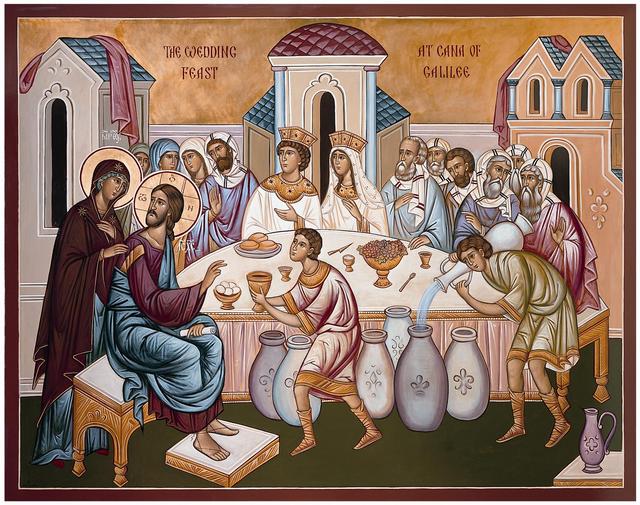
This equality between Jesus and Mary, or Mary's status in front of Jesus is presented to us in Cana (John 2:1-11). It might not appear at a first glimpse, but if you give it a close and very long consideration, you'll discover it yourself.
After years and years of pondering about what happened and all the Graces he continued to receive from God, and all what he received from Mary, it seems that John re-visiting, re-saw that simple wedding (Cana’s) he attended.
He saw through it, like through a stained glass, many many deep things, to the point that he decided (certainly inspired by the Holy Spirit) to make it as his programmatic event, that gave the whole structure to his Gospel, aiming of course toward the Cross, Death and Resurrection.
Let us ask for the Help of the Holy Spirit: through the simple human wedding, the Holy Spirit showed him that "other marriage" that happens between the real Groom and the real Bride (Mary). That "other marriage", secret and sacred, happens the day of the Resurrection. Nobody saw it but John wanted to mention it in a very respectful and discrete way.
That "Marriage" reaches, in a way, a new completion the day of the Assumption. They meet, finally, equally, with their bodies. They “sit” at the same level, with no change anymore. The final victory is expressed here in the person of Mary.

This victory has total influence on us.
Let us accept and explore that "new world order", that “wedding” of another dimension.
The Assumption
First, in a few words, I would like to address some aspects of the Assumption of Mary into heaven with her body.
Evil is not touching her body. Death (as consequence of Evil, sin, the first sin) doesn’t have a grip over her. But not only that. If on one hand we know that Jesus ascends into heaven and that He sits "at the right hand of the Father”, on the other hand, we can say that Mary, without dying, “ascends” into heaven. She doesn’t die, she just crosses the barrier. We can as well say that she sits at Jesus' right hand.
We can say that Jesus is victorious in Her, in the sense that Mary is experiencing the total effects of the Resurrection of the body of the Lord in an exceptional way: her body is now (before the final Resurrection) admitted to be close by the body of the Lord who is seated at the right hand of the Father.
Since Mary is the archetype of Jesus' follower, we can say that the Church, and each one of us is, in a way, in Her, already victorious. This is why she is said to be "our hope". We hope to reach the point were she is. She already reached the final destination, with her body.
 |
| Mary's Coronation |
There is no place closer to Jesus, right now, than Mary's one. In this sense, He is totally victorious in her and, in a way, she is "equal" to Him, in the sense that she loves Him as He loves her.
Note: see what saint John of the Cross, in "the Living flame of love", says about the possibility of "equality of love" for us already on earth. Very important!
Cana's wedding
Now, let us go back to the Transfiguration and its very personal formulation in his Gospel by saint John (see previous posts).
This equality between Jesus and Mary, or Mary's status in front of Jesus is presented to us in Cana (John 2:1-11). It might not appear at a first glimpse, but if you give it a close and very long consideration, you'll discover it yourself.
After years and years of pondering about what happened and all the Graces he continued to receive from God, and all what he received from Mary, it seems that John re-visiting, re-saw that simple wedding (Cana’s) he attended.
He saw through it, like through a stained glass, many many deep things, to the point that he decided (certainly inspired by the Holy Spirit) to make it as his programmatic event, that gave the whole structure to his Gospel, aiming of course toward the Cross, Death and Resurrection.
Let us ask for the Help of the Holy Spirit: through the simple human wedding, the Holy Spirit showed him that "other marriage" that happens between the real Groom and the real Bride (Mary). That "other marriage", secret and sacred, happens the day of the Resurrection. Nobody saw it but John wanted to mention it in a very respectful and discrete way.
That "Marriage" reaches, in a way, a new completion the day of the Assumption. They meet, finally, equally, with their bodies. They “sit” at the same level, with no change anymore. The final victory is expressed here in the person of Mary.

This victory has total influence on us.
Let us get a closer look at Cana: Mary says: “they don’t have wine”. She doesn’t say: “we don’t have wine” because she is (sitting at his right hand) victorious (see image above). She has the Wine, in total quantity and quality. We, poorly, name that: "intercession". It is infinitely much more.

It is first: Union. There is no barrier between Jesus and her. Who can understand the union between Jesus and Mary? Since she is pure, He fills her totally, there is no space in her not occupied by Jesus and His Spirit. Linked to union, there is love = exchange of the Holy Spirit.
It is secondly: Influence. She has a powerful influence over Him. She can want; He fulfils. Difficult for us to understand that consequence of the total transformation of Mary's being in Jesus. But one can try to understand by seeing what already the saints can experience, through the descriptions made by saint John of the Cross and saint Theresa of Avila of the final stages of holiness. And then, if the saints can get all that, this means that the "Mother of all the saints" can get much more. Wouldn't you agree?

It is first: Union. There is no barrier between Jesus and her. Who can understand the union between Jesus and Mary? Since she is pure, He fills her totally, there is no space in her not occupied by Jesus and His Spirit. Linked to union, there is love = exchange of the Holy Spirit.
It is secondly: Influence. She has a powerful influence over Him. She can want; He fulfils. Difficult for us to understand that consequence of the total transformation of Mary's being in Jesus. But one can try to understand by seeing what already the saints can experience, through the descriptions made by saint John of the Cross and saint Theresa of Avila of the final stages of holiness. And then, if the saints can get all that, this means that the "Mother of all the saints" can get much more. Wouldn't you agree?
Since she is filled by His Grace, she always asks things according to His Will. But
still, her “agenda” is: "taking the side" of us humans.
Let us accept and explore that "new world order", that “wedding” of another dimension.
The
servants (us) must still listen to Him (“do as much as He’ll tell you to do”
(John 2))… but now, with "new ears". Hers.
They
will deal with water.
Wine
will appear.
They make a human effort (water), helped with the ordinary initial grace, and, through Mary's help/faith, the "new wine" appears. They couldn't even ask for it, they didn't know what it is!!
Thirdly: She
has the "new wine". Constantly. She knew the "new wine" will appear. She had no doubt. She has the "new wine" already, therefore what she is asking for in Cana is not for herself (even if she is totally grateful to Jesus, in anticipation, for her own salvation).
John is writing his Gospel very late in his life, much after the Assumption of Mary. This means that he can as contemplate even better Mary in this "position" and can tell us about her with greater depth. With John, don’t
you see her sitting, body, soul and spirit, at His Side? Jesus' "door" is totally and constantly opened for her. She has total access to Him. This is as well His will.
It is a fact.
Try to contemplated her, beside Him, you’ll see that “she has the new wine”. All the new wine. Any time. All the time.
The Transfiguration
Fourthly: did you notice that for the Transfiguration, we have a powerful, almost inhuman, event, that scares the 3 Apostles, and that for Cana, it is much more gentle. For the Transfiguration the Eternal Father speaks. For Cana, Mary speaks. Both point out toward Jesus. Both remind us of Moses, coming down from the Mountain, mentioning the Words of God (the two tables of the Covenant), and that the people of God have to listen to them and put them into practise.
- The Father says: "here is my only begotten Son, listen to him".
- Mary would say: here is my son, listen to Him. She actually says: "do whatever He asks you to do" (see John 2).
(* "shows" : guides us toward) I am in awe. John seems to have humanised the Transfiguration. Determined to offer it to everybody, through Cana he seems to have made it more accessible, more possible: he saw through that simple wedding that happened in Cana.
More on Cana
Still, Jesus won't call his mother: "mother".
He'll do something better. He'll call her "Woman", "Ishsha".
"Ishsha" (Mary) is taken fro Ish (Jesus).
When for the first time the word "Ishsha" (woman) appears in the Bible? And who uses it for the first time?
"And Adam said, This is now bone of my bones, and flesh of my flesh: she shall be called Woman (Ishsha), because she was taken out of Man (Ish)." (Genesis 2:23) Mary is the "New Eve".
That was for the first creation (Genesis 2).
For the "new creation", through Redemption, for the "New Day" that God made (the Resurrection) at Cana, "the third day" (see John 2:1), the New Man calls the one who resembles him and can help him (Genesis 2:18): Woman, Ishsha.
Mary is "bone of his bones" and "flesh of his flesh". The First being to come out of the side of Jesus on the Cross in TheWoman, the New Eve.
This description of Mary goes far beyond what we can imagine!
The Transfiguration
Fourthly: did you notice that for the Transfiguration, we have a powerful, almost inhuman, event, that scares the 3 Apostles, and that for Cana, it is much more gentle. For the Transfiguration the Eternal Father speaks. For Cana, Mary speaks. Both point out toward Jesus. Both remind us of Moses, coming down from the Mountain, mentioning the Words of God (the two tables of the Covenant), and that the people of God have to listen to them and put them into practise.
- The Father says: "here is my only begotten Son, listen to him".
- Mary would say: here is my son, listen to Him. She actually says: "do whatever He asks you to do" (see John 2).
The Father shows* us His own Son • Mary shows* us her own Son
(* "shows" : guides us toward) I am in awe. John seems to have humanised the Transfiguration. Determined to offer it to everybody, through Cana he seems to have made it more accessible, more possible: he saw through that simple wedding that happened in Cana.
More on Cana
Still, Jesus won't call his mother: "mother".
He'll do something better. He'll call her "Woman", "Ishsha".
"Ishsha" (Mary) is taken fro Ish (Jesus).
When for the first time the word "Ishsha" (woman) appears in the Bible? And who uses it for the first time?
"And Adam said, This is now bone of my bones, and flesh of my flesh: she shall be called Woman (Ishsha), because she was taken out of Man (Ish)." (Genesis 2:23) Mary is the "New Eve".
That was for the first creation (Genesis 2).
For the "new creation", through Redemption, for the "New Day" that God made (the Resurrection) at Cana, "the third day" (see John 2:1), the New Man calls the one who resembles him and can help him (Genesis 2:18): Woman, Ishsha.
Mary is "bone of his bones" and "flesh of his flesh". The First being to come out of the side of Jesus on the Cross in TheWoman, the New Eve.
This description of Mary goes far beyond what we can imagine!
(End)


+of+02100_83_marriage_cana.jpg)