Showing posts with label Jesus' Prayer. Show all posts

Monday, 8 August 2016

158: Holding your Rosary during the Prayer of the Heart 1/2

We have two ways of praying the Rosary:

    1. As in Lectio Divina: contemplating the different Mysteries of Jesus' life, with Mary's eyes. This is the classical usual way of meditating on the mysteries of the Lord’s life.

     2. As in the Prayer of the Heart: immersed by Mary in Jesus’ Being. This method, can be used during the Prayer of the Heart, and is a more simple, deeply contemplative way of praying the Rosary. Even if it is less known, it is not of lesser importance.

Just as the Mass has two parts and neither excludes the other with both of equal importance, so also it is with the Rosary and both these methods should be used.
In previous posts (82 and 83) I explained the existence of these two ways of praying the Rosary. In this post I would like to speak more about some aspects of saying the Rosary during Prayer of the Heart. If you want to know more about the two methods, please read posts: "Two ways to say the Rosary" I in Post 82 (please click here) and II in Post 83 (please click here). When in this post I will mention the word “rosary” it will allude to the physical rosary and not to the classical prayer we know with the 4 sets of mysteries.


Distractions


In a previous post, Distractions during “Prayer of the Heart”, we mentioned that during the Prayer of the Heart, in order to reduce the influence of the distractions, it is advisable to pray the decades of the rosary after having made the offering of oneself to Jesus, and placing oneself in the hands of Mary. Here the "hands" are very literal; while your heart is raised in prayer, we are holding the rosary which Mary herself has given to us.
Why and how do we do this? First, we will look at the physical rosary itself and how we should view it and use it.


Holding your own rosary

It is advisable during Prayer of the Heart to hold our very own personal rosary, not one belonging to someone else. A rosary is a personal religious item. In one of her apparitions to St Bernadette, Our Lady noticed that Bernadette wasn’t holding her own rosary - in fact someone else had lent her one. Our Lady noticed this and asked her: “where is your rosary?”

Some people have a fanciful collection of rosaries: one for this, one for that, etc. It is better to unify our habits in our prayer life adopting the simplicity of having only one and just keeping and using the same rosary.


Characteristics of Choosing a Rosary

A good choice would be if our rosary had the following characteristics:
Simple: no excess of size, ornamentation or medals attached to it. It is not its price or its beauty that matters, but the real use we make of it. It is usually blessed by a Priest, and as well blessed and made ours by all the prayers said using it.
Discreet: it is between you and God. No noise (as some are quite noisy), not flashy. One with wooden beads and solid string is quite discreet. Some can have very small beads making it more convenient to carry in a pocket.
Solid: many do break, especially during the night, so it is better to choose one with nylon (or similar) strings and strong beads.


The Meaning of Holding a Rosary in your Hands

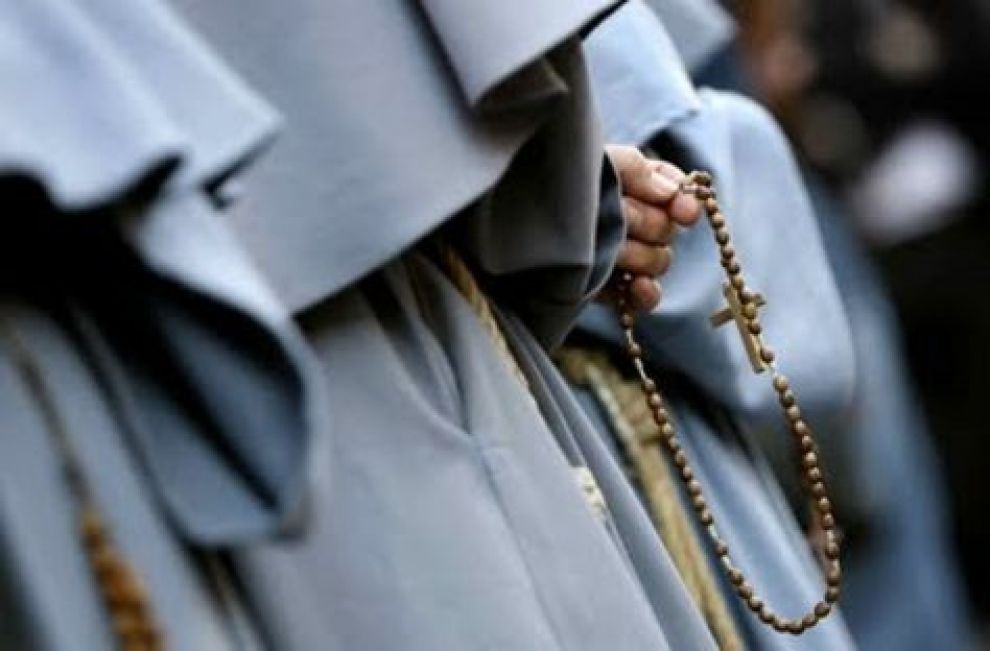
What does it mean to hold our rosary physically in our hands? It expresses:

1- A sincere outright dependence on Mary, knowing that we have recourse to her prayers, her fire, and her intimate knowledge of the wisdom and discernment of Jesus.
2- It is our personal Rosary and not that belonging to anyone else. Our body prays. It grounds us.
3- It is comparable to physically holding Mary's hands. The Rosary is Mary’s prayer given to us. It is Her way of praying with the quality of the fire of her love.
4- It is like receiving the "Good Soil", the "New Wineskin", the "New Heart of Flesh" and deciding to use it in order to love God. As long as we are here on earth, with our human condition, our body participates in our prayer and we pray as a unit: body, soul and spirit. We are not three persons, or three beings, we are one being, one person, and our body is part of our prayer. Even at the highest point of our prayer - i.e. the point that is touched by God, our spirit - we are one unit. Therefore, we cannot totally neglect the presence of our body. So holding physically our own rosary is a humble but important part of our prayer. It acknowledges that God's action and intervention in the world reaches the most humble part of His creation; the Lord has affirmed that even a hair from our head doesn't fall without God knowing and seeing it (see Gospel Mt 9:30). Therefore by physically holding the rosary, our body confesses that God embraces all that He has created through His Incarnation. All the created world belongs to God. Although we are not angels - heavenly beings - but humans, we are the earthly "mediators" of the work of sanctification, acting for and with Jesus, our real true Mediator.


What is the Meaning of the Beads?

Using the rosary during the Prayer of the Heart, the beads can be seen as:
- Roses sent to God, by the hands of Mary.
- Impulses of Divine Pure Love (by the hands of Mary),
- A more modern comparison we can say that the beads (saying one "Hail Mary") embody our acts of love for God and that they are like: "sparks” of divine energy" sent to God. Remember the ineffable groans of the Holy Spirit praying in us (Romans 8:26 "In the same way, the Spirit helps us in our weakness. We do not know what we ought to pray for, but the Spirit himself intercedes for us through wordless groans.").
For instance, every time we say one "Hail Mary", in fact we send an impulse of love, we make an act of Love, we send an arrow of Love to God. When we say to the Mother of God: "Pray for us sinners" in fact we are asking her to lift us up to God, so our prayers which come from God, through Mary return to God. Lifts us up Mary, so we can love God with your own capacity of Love, with your own Fire of Love.


Pitfalls

There is a danger of transforming the physical holding of the rosary or the rosary itself into idolatry by unconsciously falling into mechanical repetition and not internalising our relationship with Jesus, generating true prayer. The rosary is not an idol or a talisman. Mary’s hand is not an idol. Even Jesus’ body is not an idol. We aim for the entire Jesus, who is God. Only He is God. Holding the Rosary is like holding Mary’s Hand. It doesn’t generate prayer. What establishes the contact with God is the fact that we offer ourselves to Jesus in the Hands of Mary.
Holding the rosary in our hands essentially facilitates the silent quiet repetition of the Hail Marys.
Holding it tighter will not increase the intensity of our prayer.
It should not become too tense or stressful for the hand. We relax and rest in God during the Prayer of the Heart. We abandon ourselves (letting go) to God and in God.
Whilst our body participates in our prayer, it is the heart that prays. God is Spirit. It is in Jesus and in the Holy Spirit that we pray truthfully.


Conclusion

While praying in the company with others, when sincerely they pray to Our Lady, when they hold their Rosary in their hand, when they ask her to "pray for them" (“Pray for us sinners”), I always notice a powerful boost in the connection with the Lord: immersion in Him and the outpouring of the Holy Spirit.

(See the continuation 2/2 next post)

Note: The Eastern Churches' Rosary (Called чётки - chotki) is used essentially for the Prayer of the Heart - also known as the Jesus Prayer.  It is composed of 33 knots (the years of Jesus' life on earth) or 11 (1/3 x 33) or 99 (3 x 33) knots. In fact the above-mentioned method uses of the the Western Rosary in the same way the Eastern Churches do with theirs.
The repetition of the the Hail Mary goes with the natural rhythm of our breathing. Not faster, not slower.

Please remember to subscribe to this Blog so you can receive the posts directly to your email.

Monday, 21 September 2015

126: St Teresa of Avila 5/16: The Particular Help of the Grace of God

In her teaching on the Prayer of the Heart, in Chapter 14, paragraph 6, St Teresa says something really striking: For many purposes it is necessary to be learned; and it would be very useful to have some learning here, in order to explain what is meant by general or particular help (for there are many who do not know this) and how it is now the Lord's will that the soul should see this particular help (as they say) with its own eyes; and learning would also serve to explain many other things about which mistakes may be made. (Life 14,6; see as well 3Mansions 1,2; 5Mansions 2,3) She will then explain that in order to practise the "prayer of recollection" we need to use the "general help of the Grace of God” that is being constantly given to us. And in the "Prayer of Quiet", we receive the "particular help of the Grace of God” that is supernatural (4Mansions 1,1) and infused.

The essence of what St Teresa wants to say, in other words, is that by not knowing the difference between the 'General help of the Grace of God' and the 'Particular help' of it, people fail to gain many graces and do not progress in their spiritual life! What surprises the reader is that while on the one hand it is a bold statement, St Teresa on the other hand does not seem to stop and explain this vitally important distinction. It is true that superficially this statement and apparent lack of explanation is somewhat puzzling. But the more one studies St. Teresa in depth and applies this distinction in its entirety, the more one starts to notice that in fact she does explain this golden difference, an explanation that will shed a great light on the issue of “contemplation”.

Note: It must be remembered that last century, during the renewal in Spiritual Theology, a huge debate arose on the nature of Contemplation: on the one hand one group said that contemplation was acquired (through our own efforts) while on the other hand another group said that it was infused (given only by God, when He wants, the way He wants, to whom He wants). The two groups fought fiercely, through the medium of journals, and the fight ended in the late 1940s early 1950s not out of having found a clear practical answer to the question but through the sheer exhaustion of the fighters. This was a sad day for the Church because we still yearn for a clear, substantial and practical definition of Contemplation; it is so essential for the Church's life. This is why Teresa of Avila is of the utmost importance.

In fact all her teaching on the Prayer of the Heart rests on the knowledge of those two modes of functioning of the Grace of God. This distinction between the 'general' and the 'particular' help of the Grace of God is simply decisive. In this light, then, what St Teresa of Avila calls in her writings 'Prayer of Recollection' is in fact the best way to 'use' the 'general help of the grace of God.' This effort of recollecting ourselves will immediately invite a reply from God. These replies will vary in intensity and depth, but all of them ('supernatural recollection', 'prayer of quiet', 'prayer of union', 'ecstasy',...) are different forms of the action of the 'particular help of the grace of God' in us.
In fact, the teaching on the Prayer of the Heart that she offers is an illustration of the practical aspect of this great truth and distinction in the Theology of Grace.

It has to be recognised that we desperately need this practical teaching, presented in an scholarly way.

A simple example to explain it will suffice. In the Gospel, a fundamental requirement for holiness is to receive the Holy Spirit. He is the third Person of the Trinity, and to receive Him and be guided by Him is a basic necessity. Even more than this is the fact that He is the One who, par excellence, incarnates Jesus in us. He first incarnated Jesus in Mary, true, but subsequently, day after day, He incarnates Jesus, step by step, in us! Indeed, Christ invites us to ask for the Holy Spirit. He even explains to us that praying the Our Father is equivalent to asking this of the Holy Spirit (see Luke 11:13 as a continuation and explanation of the Our Father).

Practising the Prayer of the Heart with this in mind creates an appropriate inner 'space' , in order to receive the Holy Spirit and to expose ourselves to His purifying and transformative action. This action of the Holy Spirit in us is what Theology calls 'the particular help of the Grace of God'. More significantly, this action is the direct and personal action of the Holy Spirit within us, - a sanctifying action. We need this action of the Holy Spirit and Christ invites us to ask for it all the time: ask, and it will be given to you (Luke 11:9).

We believe that any action and movement by the individual towards God is also a Grace. But there are various forms of the Grace of God. Asking for the Holy Spirit itself requires a grace (please see St Thomas Aquinas, Summa Theologica, I-II Q.109 a. 6). It constitutes a preparation for this Grace, or if you prefer it is a 'cry' for the Grace to come.

The next question to address, then, is the difference between the grace that prepares us (that helps us to ask for the Holy Spirit) and the Holy Spirit himself (the 'particular help of the Grace of God')? The difference is enormous and it solicits our free will:

If we start at the beginning we see that the general help of the Grace of God is always present in us, always offered by God to us and is constantly in us waiting for us to use, and if we fail to make use of it nothing supernatural will take place in us as a result. It could be compared to the blood coursing through the veins in our muscles! The blood is present in them, given to them, but it depends on us to activate our muscles! There is no need to ask God to give us the 'general help of his grace', we only need to humbly acknowledge its presence within us! It is there, constantly given, constantly available, within a hand's reach! This is why we see in St Teresa's explanation of what she calls the 'Prayer of Recollection' (see chapters 26, 28 and 29 of Way of Perfection) her enormous insistence on the fact of deciding ourselves, with determination, to start to practise the Prayer of the Heart with recollection definitively playing a regular part when doing so, until it becomes a new habit in us. When we do our part, we do it with the 'general help of the Grace of God'. It must be recognised that St. Teresa insists very much on repeating the acts of recollection so that it becomes a new habit in us, because she inherently knows (and states it) that it is given to us and that it is the will of God that we practise it.

The immediate effect of this is to make it seem as if we are getting closer to a friend who is extending his hand, waiting for ours to shake. This is what God does: his hand is constantly extended, waiting for us to use the 'general help of his Grace', present in our soul, waiting for us also to extend our hand and to express to Him our desire and choice. God stands at the door of our freedom. He never forces the door, never violates our freedom, the handle of the door being on our side alone. Rather, He awaits patiently to see us express our choice by an act: He waits to see our hand reach the mid-distance in order to take it in his! Extending our hand towards Him, putting our hand (our will, our freedom, our life, our heart) in his, then, is an act that leans on the 'general help of the Grace of God' and without this act, normally there is no meeting between God and us.

One of the main reasons for the existence of a teaching on 'Mental Prayer' is to show the individual the part that is his in order for the meeting (communication) with Christ-God to take place! God respects our freedom and awaits at the door of our freewill: Behold, I stand at the door and knock; if anyone hears My voice and opens the door, I will come in to him and will dine with him, and he with Me. (Revelation 3:20) This is the reason for the Lord often insisting on the necessity of 'asking', 'seeking', 'knocking' at God's door, simply because He respects our freedom and waits for us to express it by the offering of ourselves to Him, by our asking, insisting, being determined to be present to Him, offering ourselves entirely into His Hands! If this is not the case and we do not move towards him, He will stand still and will continue to wait! He will not invade our personal space in order to grab our hand and shake it! No, this is not God's way.
This is why we are often warned and advised by St Teresa to be acutely aware of this!
So I say to you, ask, and it will be given to you; seek, and you will find; knock, and it will be opened to you. For everyone who asks, receives; and he who seeks, finds; and to him who knocks, it will be opened. Now suppose one of you fathers is asked by his son for a fish; he will not give him a snake instead of a fish, will he? Or if he is asked for an egg, he will not give him a scorpion, will he? If you then, being evil, know how to give good gifts to your children, how much more will your heavenly Father give the Holy Spirit to those who ask Him? (Luke 11 :9-13)
Our way of expressing this would be: 'Ask [for the Holy Spirit] and [He] will be given to you', as if the Lord is saying to us: 'use the 'general help of my Grace', that is constantly given to you in order to 'ask' of Me. I can't force you, I need to see your decision and choice first. Then I will be able to give you my Gift, the Holy Spirit, my direct and personal action in order to transform you.'

It is significant to note that 'asking', which means to use the 'general help', is in fact something that implies involving all our being! When the blind man of the Gospel, seated on the side of the road, asks the Lord to heal him so he will be able see, he was not wasting his time, doubting, or closing himself to the action of the Holy Spirit! On the contrary, he was doing it with all his being, all his strength! It was a matter of life and death for him. It was he, it must be recognised, who so well expressed his desire and signified his will.

To sum up then, it can be seen that the whole structure of our relationship with God, during our prayer time but even throughout the day, leans on the distinction of these two types of Graces. It must also be noted that the one type is Grace par excellence, while the other prepares us for it, opens us to it and draws us toward it. In like manner, God's Hand takes ours and shakes it! The Supernatural movement of God is activated and the intervention of the Holy Spirit takes place. Without this occurring there is no real prayer, no real contact with God! Without it, dealing with God is like dealing with a very remote Being, from far away! By great contrast, when the Holy Spirit gives Himself to us (and this should happen every day), contact with God takes place and what we live belongs really to another realm, a new world, totally designed by God.

125: St Teresa of Avila 4/16: The Way of Contemplative Prayer


To make a start, a keen sense of challenge must fill those aspiring to grow closer to St. Teresa and her method of praying!

In the last chapter we ended by mentioning Prayer of the Heart, or to give it the other names by which it is known: 'Contemplative Prayer' or 'Mental Prayer' or 'Silent Prayer' or the 'Jesus' Prayer'. St Teresa is perceived by the universal Church as a Mistress of Contemplative Prayer, and of prayer life in general. This was Pope Paul VIth 's intention when he declared St Teresa 'Doctor of the Church' in 1970, in particular as in most of her books she talks about 'Contemplative Prayer'. What, therefore, can she reveal to us concerning this form of prayer ?

The Prayer of the Heart embodies the core of her new life in Christ after her second conversion. She is now more constant in practising it, plus, she is very vigilant in practising the virtues. In fact, in a decisive confession around the time of her conversion she received a piece of excellent advice from a knowledgable priest: first, to lay a solid foundation for her practice of the Prayer of the Heart, i.e. to practise virtues as we will be seeing in the coming chapters.

Before her conversion she had read the Third Spiritual Alphabet of the Franciscan Francisco of Osuna (1497 – c. 1540), where he speaks about the method of recollecting ourselves while praying in order to get closer to God and receive his Grace. But one has to say that without her conversion, the practice of the Prayer of the Heart was impeding the divine waters to gush forth from the fount of its source, and therefore she was left to rely almost solely on her own strength. However, the reality must be faced that without Christ and without His Grace, especially in a matter like the Prayer of the Heart, the human being can do very little – in fact almost nothing.


After her conversion, after by the Grace of God having understood that all her heart had not been given to Christ, after having been turned by the Lord towards Himself and Himself alone, Prayer of the Heart began to flow more freely. The next challenge now had to be faced. In the Scriptures God asks us to pray incessantly (1 Thessalonians 5:17 and Luke 18:1-8), and the Rule of the Carmelite Order also states it: 'Each one of you is to stay in his own cell or nearby, pondering the Lord’s Law day and night and keeping watch at his prayers unless attending to some other duty.' (§ 10). But how can one pray incessantly? To take time to meet the Lord personally, 'heart to heart', eye to eye, is essential in order to receive the Living Water of his grace. One needs to go to the Divine Well – Christ - in order to draw the Waters of the Holy Spirit.

St Teresa's practice of the Prayer of the Heart then became more determined and regular, and because of the fervour generated by the Gift of herself, Christ started to pour into her grace upon grace (John 1:17). In the beginning of that new journey, however, and for a long while afterwards, she lacked the understanding of what was happening within her! The manifestations of the Grace of God in her were unusual, new! Visions, ecstasies, feelings,... The fears she endured were indescribable! Moreover, she unfortunately mentioned her experiences to some indiscreet people, each interpreting it according to his own thinking, while many feared she was being misled and that it was the work of the Devil! Admittedly it is well recognised that the devil can present himself in the shiny clothes of an angel of light (see 2 Corinthians 11:14). The issue was further complicated by the spiritual trends in Spain at that time, as embodied in, for example, the Alumbrados, literally translated as the Enlightened, not to mention the trouble generated by Luther in France which only served to exacerbate the situation. The Church in Spain had to contain all this in order not to deviate from the purity and orthodoxy of faith. Teresa, consequently, suffered immensely by not understanding what was happening to her! But all this trial was beneficial: what was happening to her paved the way for many after her and her suffering was in the service of others!

Furthermore all the meetings she had with the greatest theologians of her time opened a way for two other graces to manifest themselves in her: first, understanding and recognising what was happening within her, what type of graces she was receiving, and secondly discerning and expressing what was happening within her! In this way, her experience instead of being isolated became, day by day, an experience for the Church, valid for others! As mentioned in the first chapter, it is very tempting to think that what she experienced is valid only for the few in number, or worse, uniquely for her! This is in fact the challenge her experience and teaching brings to us! It is certainly a new area, and the first reaction can be at times defiance and fear, the fear of change being deep-rooted in mankind. And it is more than a mere change, it is cataclysmic! Sadly it is more comforting to say to oneself: what she says is not for everybody! By contrast, in fact, the majority of what she describes, if looked at under a magnifying glass, encapsulates what the Lord desires to give to everybody. The magnification can be frightening, but in fact it induces more acute vision! Some, admittedly, will be fearful just because of the unknown! The fear of opening a Pandora's box and not knowing how to close it again, or better still, how to 'control' what is happening! A more positive approach is to have greater trust in the Lord!

While practising Prayer of the Heart, and often after having received Communion (the link between will be enlarged upon later), St. Teresa started to receive powerful graces. The more she continued in this direction, it must be mentioned, the more she consulted Theologians, and the more God made available to her the best of the theology of her time in a condensed form (a one to one consultation), at the service of Spiritual Life! In fact she herself stresses these were not the half-knowledgable theologians or priests, which she states did much harm to her formerly and whom she now strongly advises are to be avoided! God alone can appreciate the difficulty of this science, Spiritual Theology as it is called today.

Spiritual Theology embodies the essence of St Teresa's Doctorate. It is the most useful science and the most necessary one for mankind and for his efforts at holiness. But it is the most difficult science because it presupposes a conjunction and integration of two other qualities: first, personal spiritual experience of the Graces of growth God wants to give us and two, discernment between what comes from God and all the rest. In total, these three qualities (Science, Experience, Discernment) harmoniously blended in time, contribute to the formation of a Master of the Spiritual Life. Seen from a practical viewpoint, this science implies inevitably a personal involvement in the Theologian or the Master: the personal practice of spiritual life and the reception of the graces that come with it. Teresa often endorses this in her writings, when she reiterates that the person who has experienced the influx of these graces will readily understand what she has been expressing!

It is valid at this point to question whether the others who have not had this experience will derive any benefit at all. Admittedly it will be more difficult for them to understand her, because without the Grace of God one cannot understand or internalise the account of the experience of a Grace! But, what is to be hoped is that those who have not had the experience will trust Teresa and so will be allured to practise her what she is putting forward in order to receive what she describes. In the final analysis, experience here is fundamental. The presence of 'experience' in St Teresa's teaching is one more reason to think how she is so attractive to the modern mind, one avid for experience. She is a true witness of the risen Lord telling us how He earnestly desires to meet us and she explains, in addition, what to do in order to have this experience! For her, this is the core of christian life.

However, what exactly does experience imply? It implies having two things at least: first, the practice of the Prayer of the Heart, and secondly, the practice of a life of prayer, which she calls in her writings, the work of the virtues. 'Prayer' and 'prayer life' cannot be separated, just as the New Wine and the New Skin (Matthew 9:17), or The Divine Seed and The Good Earth (Matthew 13:8).

One cannot fall into a 'spiritual schizophrenia', where on the one hand one claims to practise the Prayer of the Heart and on the other hand one does not listen to Jesus and does not follow Jesus by doing his will during the day. This is exactly what the Lord warns us to do various times in the Gospel: If anyone loves me, he will keep my Word, and my Father will love him, and we will come to him and make our home with him (John 14:23). In this verse of St John everything is summarised: we have the Prayer of the Heart (we will come to him and make our home in him) and Prayer Life (keep my Word ) whereby we put into practice the Lord's Words. The same logic is to be seen in His other piece of advice: Not everyone who says to me, ‘Lord, Lord,’ will enter the kingdom of heaven, but the one who does the will of my Father who is in heaven.(Matthew 7:21). A similar way of thinking is the case concerning the two parts of the Mass. In fact not only does the 'Liturgy of the Eucharist' not stand alone, but also we do not attend Mass for the second part of the Mass only, i.e. to receive Communion. One goes to Mass to receive Christ the Living Bread in his twofold forms: first, as a Word uttered by Him and put into practice (the liturgy of the Word) and secondly, in Communion with Him (receiving the Body and Blood of Christ).

St Teresa often states in her writings that if we practise this form of 'schizophrenia' (of course she does not use the word), i.e. practising only the Prayer of the Heart while neglecting the work of the virtues by giving ourselves fully and faithfully to the Lord during the day, we will remain like 'dwarfs', an expression she actually uses, implying no growth, no transformation, no becoming closer to full Union with Christ. This means that we are deluding ourselves! It is our determination to listen to Christ and to put his Word into practice that allows the deployment of the Powerful Graces of God during the Prayer of the Heart. Let us make a mental note here that it is because of her conversion and determination to follow Christ with all her heart that the Living Water of the Graces of God started to flow in Teresa abundantly!

The virtues she wants us to practise and grow in are actually stated in the Gospel and are not a new invention of hers: humility, fraternal love, detachment from creatures and from oneself! One can easily notice that these three virtues she focuses on are in direct relationship to the three evangelical counsels respectively: obedience, chastity and poverty!
All this, then, deals with the concept of experience.

Now, what about discernment, the third important quality to develop within ourselves in order to have a solid spiritual life? According to St Teresa, discernment is received progressively, while 'walking the walk' of spiritual life. In order to do so we need to understand first that our Main Guide in the journey of growth is the Holy Spirit. He is our true Spiritual Master as St John of the Cross states clearly: we need therefore to entrust ourselves totally to Him, to listen to Him from within and be guided by him constantly. Not only this, but one needs His guidance while being in the hands of a Spiritual Guide during Spiritual Direction. Spiritual Direction (or Spiritual Accompaniment) is the main place where discernment is transmitted to us, throughout the weeks, months, and years. Without discernment it is simply impossible to grow in Spiritual Life, because the obstacles are countless! The necessary humility leads to the understanding that the Holy Spirit who talks to us directly and generates in us the experience of God, is the same Spirit who talks to us in and through the Church. A particular need here is the Act of Faith, an openness to the extension of the logic of the Incarnation in the Church, whereby Jesus leaves his authority to the Church.

The Jesus Christ who calls us is the same Jesus Christ who guides us in and through the Church. But here too prudence is very important: into whose hands do we entrust ourselves is the question. As expressed in the Catechism of the Catholic Church 2690, 'according to St. John of the Cross, the person wishing to advance toward perfection should take care into whose hands he entrusts himself, for as the master is, so will the disciple be, and as the father is so will be the son.' And further: 'In addition to being learned and discreet a director should be experienced. . . . If the spiritual director has no experience of the spiritual life, he will be incapable of leading into it the souls whom God is calling to it, and he will not even understand them.'

This is an important reason for St Teresa of Avila who considered it to be a huge grace in her life to have had, as well as the many excellent and knowledgeable priests and religious, St John of the Cross as her spiritual guide.