Showing posts with label Spiritual theology. Show all posts

Saturday, 7 August 2021

209- A New Vocation in the Church: “Spiritual Formator”

Mary Shows the Way

The intention of the following text is to present in a succinct way a Function or Vocation in the Church that does not as yet exist as such: that of the Spiritual Formator. Some of the tasks involved in this function, like Spiritual Direction, Teaching Spiritual Theology… have been and are still realised by some persons in the Church. But never all the tasks of the Spiritual Formator. For instance, being a Master of Novices in a monastery or a formation house does not coincide exactly with being a Master in Spiritual Life. In fact, the Master of Novices is also in charge of the formation into religious life and he is not necessarily trained to become a Spiritual Formator. However, despite the existence of some of the tasks, performed by some members of the Church, there is no formal ad hoc preparation of Spiritual Formators.

Up to the present day we do not have a function or vocation that realises all the necessary tasks of a Spiritual Formator or Master in Spiritual Life. We do not have a specific training and formation for it.

The following text is meant to present the actual state of things and to outline the nature of this vocation and its function in the Church. It further suggests that what should follow would be to offer a journey of training for potential candidates for three to five years at least.

Being a Spiritual Formator in a way is a blend of an intellectually very well-formed person in philosophy, human sciences, theology, and spiritual theology, with a long and solid experience in Spiritual Life. For many years this person will have been a disciple to other experienced people, thereby allowing him or her to receive the needed discernment. This blend of intellect, experience and discernment, plus a Call from Jesus for such a ministry, constitutes this new vocation in the Church.

In addition, we can say that Vatican Council II reminded us that striving for Holiness is not the monopoly of the Consecrated life. As a consequence, there is a need to form and support all the persons who hear this call for Holiness but do not belong to any school of spirituality. Formation in Spiritual Life should be a specific ministry in the Church offered to all, with expertise and professionalism. There is a pressing need to prepare ministers for this function.

To reiterate, the need now for Masters in Spiritual Life, or Spiritual Formators, is more than ever necessary. In fact, this function has as its main task the formation of all the persons who receive Jesus’ Call to go deeper in their spiritual life, so that they become properly capable of handling their own growth and of responding properly to the call to Holiness and fullness of love.

Teaching the practical means to empower Christians, so that they can respond fruitfully to the Call to Holiness, however, cannot be done in an amateur way. It is a very sacred task to train Spiritual Formators and it requires all the effort from the Church to fill the void this absence leaves.

It goes without saying that such vocation and service in the Church goes alongside a much-needed renewal in Spiritual Theology and a concerted effort to produce a common Body of Teaching for the Prophetic Function of the Church, in charge of the spiritual journey from the Second Conversion, i.e. Jesus’ Call, till the end, namely, the fullness of love.

Here are twelve important points to understand and properly promote this vocation:

1- Spiritual Formator, as we define it, means a person capable of forming others in Spiritual Life. Formation is much wider than specific tasks or ministries. Essentially, a formator is a person capable of giving courses in Spiritual Life, following up a person for the implementation of the Spiritual Teaching, (Spiritual Tuition), and offering a more in-depth Spiritual Direction. It goes without saying that if properly trained other easier tasks will be performed at a higher and professional level: talks, short and long retreats. In sum, a formator will be capable of teaching, forming, understanding spiritual life, and will also be capable of a high-quality discernment in the different issues faced by spiritual persons, the obstacles and problems of spiritual life.

2- Many persons do perform some of the above missions in the Church but often they are offered in a fragmented and diluted form. Being a “Master in Spiritual Life” essentially combines three qualities well blended together: science, experience and discernment. A degree in Spiritual Theology doesn’t make the person a Spiritual Formator. Experience and discernment are needed and need to be led and formed.

3- The function (the job) itself of “Spiritual Master” doesn’t exist in the Church. If some missions in the Church like “Master of Novices” or “Retreat Guide” (eg: leading the Spiritual Exercises), or the Ancient Elder Monk, are quite close to it, they are not exactly the same and today no formal preparation in the Church for such a mission is offered.

4- “Spiritual Formation” is needed in the Church in all areas of the Prophetic Function: Monastic Life, Religious Life, Secular Institutes, New Movements in the Church, including individual lay persons striving toward a deeper spiritual life and holiness.

5- The weakness and fragmentation of the different spiritualities in the Church has led to a lukewarm consecrated life. The division into different schools of spiritualities has reached a point of fragmentation which prevents the Church from having a fundamental core pedestal for Spiritual Life and Spiritual Formation. A common Doctrine for a deep Spiritual Life is needed before finding ways for legitimate diversification in Spiritual Schools. Note: Spiritual Theology today is rather weak, diluted and fragmented. This has had negative repercussions on Spiritual Formation in the Church. For renewal to occur serious commitment is of the essence, people needing to dedicate their lives to it.

6- Having leaned essentially on fidelity to a Monastic Rule or to a Style of Life or a Horarium to become a saint, made many think that this is enough and that there is no need for a proper Spiritual Formation. Consequently, people have lost interest in Spiritual Theology and its role in Spiritual Formation. This has also led to a weakening of spiritual formation, its dilution and lack of development. Devotions, local habits and rites end up replacing robust spiritual life and giving the wrong impression that these are means of true sanctification.

7- The inner workings proper to spiritual life still constitute an invisible inner world often classified as difficult to describe and apophatic, leading to the conviction that there is no teaching and formation for spiritual matters, with the result that any common effort to develop spiritual formation is abandoned. This has led to allegedly relegating Spiritual Life to a private sphere -an inner forum- leading finally to ignorance, fragmentation and dilution of spiritual life. It is an error to think that Spiritual Life cannot be expressed. The thousands of written pages by St. Teresa of Avila and St. John of the Cross are here to show us the way.

8- The idea of focusing all our energy on the pursuit of God and Union with Christ and the fullness of His love becomes secondary or left to personal private effort. The reality of knowing how to maintain and ensure a steady spiritual growth is really non-existent. The need for a healthy spiritual emulation and support in spiritual growth has just not been met.

9- In order to realise this mission, the Church needs to form individuals in all walks of the Prophetic Function, to become professional Spiritual Formators, capable of facing such a difficult, complex, difficult mission.

10- Spiritual Formator, or Master in Spiritual Life, emerges and stands alone as a specific vocation in the Church that deserves all our attention and effort. Its influence on the Church, especially over the Prophetic Function will be immense. Progress in Spiritual Life will allow the lives of many persons engaged in the Spiritual Journey to reach completion and to bear amazing fruits for the Church and the World. It is very difficult to measure the fruits of the implementation of such a vocation.

11- In order to achieve this formation, one needs to offer a complete training in: knowledge/ science/ doctrine, in discernment, and in the practice of this vocation. The Church needs to offer a free space and time for each person to learn, practice and discern as it does with Religious and Seminarians in their first years of formation. This is why we call it a new “Vocation” in the Church, and also a new Function in the Church. But it is not necessarily binding as to formal consecration. One can go back to his or her diocese and serve or become part of the School of Mary. It is not a formal consecration as we know it today – one remains free.

12- Offering a residential possibility for this formation is a necessity. No other formal obligations or missions should be assigned to the person. Full freedom to be formed and trained should be given. Three years is a reasonable minimum time to have the basic formation. Further formation can be given leading to a Master’s Degree within two more years.

As a result of these twelve points, we need to concentrate all our efforts on training persons who have the call to serve their brothers and sisters as Spiritual Masters.

Jean Khoury

6th August 2021

Transfiguration of the Lord


Tuesday, 29 October 2019

199- Letter for a Young Person Called to Work in the Field of Spiritual Life

How we Become "Masters in Spiritual Life"

“Working in the field of Spiritual Life” means one or more of the following activities:
- Teaching Spiritual Life (Spiritual Theology)
- Offering Formation in Spiritual Life (Masters of Novices, Masters in Institutes,…)
- Offering Personal Tuition in Spiritual Life
- Offering Spiritual Direction.

Dear B,

I would just like to clarify something important regarding how we are enabled to fulfil the mission of teaching, forming and guiding in Spiritual Life, according to the Catholic Tradition. You certainly intuit it or have even heard me talking about it. First, I want to remind you of the conditions to become a master in spiritual life, then I will give you a specific warning.

I- A reminder of what you already know: what makes us Masters in Spiritual Life is a prudent blending of three capacities (see this in St. Teresa of Avila):

1- Science (Degree in Spiritual Theology).
2- Personal Experience of God (intense spiritual life, receiving manifold graces related to our spiritual growth, practising Lectio Divina and Prayer of the Heart).
3- Discernment that comes from discipleship: many years of personal tuition/supervision and Spiritual Direction from a very knowledgeable master.

When the three are combined under the supervision of the Tutor, this helps re-cognise i.e. it makes the connection between two things: a- what was learnt (science, the Degree, the books, the readings, the study) and b- what has been felt or perceived or understood in our experience (or that which is not experienced) of God.

Re-cognising is a very delicate and subtle operation where two “worlds” meet and seem to us to match: on one hand the world of our experience and on the other hand the world of what we read or study. These two worlds are distinct. Re-cognising occurs when we feel that they have met and resonated on a point or more. Re-cognising offers a new understanding of both our experience and the text and roots in us a new knowledge and “judgement” in spiritual matters. The Holy Spirit, Master of Spiritual Life, leads the operation. It is a long process knit together by a multitude of graces which goes towards the formation of the new master.

We realise this operation both consciously and unconsciously. The unconscious operation occurs almost always and consists in the projection of our own experience on what we are reading. We therefore end up by unconsciously filtering and conditioning our reading.
Our own prism interferes unknowingly: it often either reduce or deviates from the real objective sense of what the author is saying.

An important observation: when we talk about “authors” in spiritual life we need to make a very important distinction that many scholars don’t make. It is very common to make the mistake of confusing Saints and Doctors of the Church (or Masters). Of course, Doctors of the Church are also saints and even have an eminent holiness, but they are much more than just saints.
A saint is only a saint and is not necessarily called to teach, lead or explain spiritual matters. This is why St. Thomas Aquinas in a concise way says: “let the saint pray for us and let the doctor teach us”. Even if Saints are writing about their spiritual life or about the graces they have received, they are not teachers or doctors. A “Doctor of the Church” or a “Spiritual Master” on the contrary has received from God extra graces to help him do two things:
a- understand what the graces are all about and situate them correctly on the journey of transformation/sanctification
b- express and explain the graces correctly.

As we can understand therefore, great confusion can result from this delicate, risky but vital operation of Re-cognition. Consulting a Master is very much required here in order to ensure the necessary attention to an accurate process of “re-cognition”. A lot of patience, resilience and humility are needed here. And of course, a great spirit of obedience to God through the Master is a must. 

Of course, it goes without saying that the choice of the Master here is decisive. As Saint John of the Cross puts it: the disciple will become like the master, so we need to pay great attention to the hands into which we are entrusting ourselves.

Three pitfalls are worth mentioning:

1- The obscurity inherent in spiritual life and its consequences: an important component of spiritual life is the difficulty to perceive it, understand it and explain it correctly. Faith, by its very nature, as a theological virtue implies a certain obscurity. Spiritual experience, then, despite the fact that it is an “experience” of what the Holy Spirit is doing in us, remains obscure. This can very easily induce us into error and makes finding the correct understanding and explanation of the experience more arduous. Humility, patience and perseverance are of the essence here.

Spiritual Life is obscure like faith, because God action in us happens essentially in our spirit, which is above our consciousness, “your life is now hidden with Christ in God” (Col 3:3) and any echoes that might fall into our awareness (mind, emotions, senses) must be subject to subtle discernment and correct interpretation. What we feel or don’t feel (soul-emotions-body, i.e. area of awareness) is not necessarily what occurs in our spirit (beyond awareness), while the latter is in fact the cornerstone and measure of progress.

Experiencing the action of the Holy Spirit can generate a very wide range of thoughts, images, feelings and sensations that can be even perceived as contradictory. The spiritual experience is therefore multifaceted and versatile. Not being purely material at least in its source, its description ends up by being rather relative.
Understanding and describing a spiritual experience is difficult also because it is conditioned by the culture, experience and knowledge of the individual: we often re-cognise in our own way! As a consequence, what we read about the experience of others can be interpreted in different ways, some correct and others not.
As a consequence, studying spiritual life, reading various authors and working in the field of Spiritual Formation, is a very sensitive undertaking. Paradoxically accuracy is needed but is altogether difficult to achieve. The pitfall is to transform that long initial lack of precision and tangibility into something certain and final.

The beginner tends to rush into conclusions, by pushing the initial normal lack of clarity and tangibility inherent in Spiritual Life toward assumptions and convictions that are artificial. Intellectual patience is a very important form of charity towards the full mystery of what the Holy Spirit is accomplishing in us. Accepting not to have clarity for long time is necessary. Otherwise we choose part of the truth, and transform it into the whole truth which is the root of any heretical attitude. In Greek, heresy means to choose (part of the truth)!

Another factor of imprecision: People who are meant to work in the field of Spiritual Life need to know that the Holy Spirit is meant to provide them with two graces in order to support this sacred mission: a- understanding the graces received and b- being able to talk about them and explain them (see St. Teresa of Avila, Life 17,5). Not every person or even every saint is meant to receive these two graces because they are only related to the service/ministry. As a consequence, we will often find people (saints for instance) giving an account of their own spiritual state (present, past) who haven’t necessarily received the second and third grace mentioned by St. Teresa of Avila. They will not be necessarily accurate in their understanding and explanation. Therefore, relying on their perception and judgement is not always safe. As a consequence, an extra effort is necessary on our part to understand and explain properly what we read. This factor of uncertainty is normal but has to be taken into consideration always.

2- Confusing levels: spiritual life’s growth could be comparted to an ascending spiral. Seen from above, growth will look like moving in an indefinite circular way. If we take a point on the circle and focus on it, we might think that we have come back to the same point. But a side view of the spiral will show us that it is two different points or levels of spiritual growth.
As an example, Martha and Mary are mentioned by St. Teresa of Avila at least twice, once in the Prayer of Union (4th-5thMansions) and another in the 7th Mansions. An inexperienced eye won’t see the difference.
If watching our own experience and comparing it with what we are reading is done in an inaccurate way (like seeing the spiral from afar, or from above), we will make wrong assumptions, the process of “re-cognition” will deviate. In fact, if we take a closer look, we find to our utter surprise that there is a difference in the spiritual levels or stages. And this often offers a radical difference in the evaluation and judgment of the spiritual state of the person.
Confusing different levels, makes us read a grace or read a person’s experience thinking the person is at a certain stage, while the person is at a completely different stage! Similarities are tempting and we often rush into conclusions.

3- Feeling we can relate while we read a spiritual book: it is not because we read about a grace or a set of graces and feel good about it and can relate to them (like, pleased, feel good) that it means we have reached that level. Illusions are very common.

II- My warning for you:

It is truly the most difficult Mission in the Church: to be involved in the ministry of Spiritual Life. No discussion about that. It is easy to study and pass exams intellectually, one can be brilliant intellectually but quite ignorant and misleading if he or she endeavours to work in the field of Spiritual Life. Intellectual acumen is one part of the ministry. Important, necessary and should be of high quality (solid Philosophy, solid general Theology (especially dogmatic, moral and pastoral theology), and solid Spiritual Theology). No fancy knowledge here! Solid and traditional.
My point for you is the following: of course, having a Degree in Spiritual Theology is something very good, but, paradoxically, the Degree doesn't qualify you. So only focusing on getting the degree is wrong. Worse, being prevented from becoming a master in spiritual life because of the lack of the degree would affect your Call seriously.
It is never never enough to just base everything on Science, on the Degree! More things are needed and can be implemented or strengthened from now onwards.
Again, the Degree doesn't qualify you, it just informs you about spiritual life according to a certain school or way of engineering it today. The Degree gives you an idea of the 2000 years of experience and knowledge of the Church about Spiritual Theology. In a way, it roots you in the Church.
But it never replaces the thousands of hours of personal study (study, not reading) and personal research. It will never replace the advice of a good Tutor in the field. Impossible. It will never replace the hours of Spiritual Direction received. There is the added danger that study can inflate our ego! In Spiritual Theology, true study should deflate the ego and should make one very prudent before making any assumption.
What does the above mean? Am I dissuading you from venturing in this field? No, on the contrary. I am inviting you to do a great deal of work, to study, and of course to get the degree! But I am also saying: don't ever think that the degree is enough! Never! Spiritual Theology is a practical science so without experience and tuition (discernment) it is impossible to teach properly or to form.
Humility, patience and resilience are necessary. Great charity also is of the essence: love for people, loving to help, loving to understand them, and an immense devotion to the Holy Spirit and to Our Lady.
Please don't be prevented by not having yet obtained your Degree. Even if you had a degree, if you were to think that this were enough, that would be a crime! Inherent in Master ship is a sacred triangle: science, experience, discernment, well blended together.
If humility is needed to grow spiritually, humility is a million times more important if somebody feels called to teach (form in) the Spiritual Life. Humility manifests itself in the form of a great spirit of supernatural obedience.
Avoid at all costs a spirit of improvisation, of rushing, of amateur science or discernment. Many people today in the Catholic Church who work in the field of Spiritual Life fall into these categories.
Continue please, but in humility... experience... love. Don't neglect personal Tuition and Spiritual Direction!!

in Mary

Jean Khoury

Friday, 26 May 2017

165: Spiritual Demography of a Parish

Spiritual Demography (from prefix demo- from Ancient Greek δῆμος dēmos meaning "the people", and -graphy from γράφω graphō, implies "writing, description or measurement") is the statistical study and analysis of populations according to the criterium of Spiritual Life. Spiritual Demographics are quantifiable spiritual characteristics of a given population. “Spiritual Demography of a Parish” is the statistical analysis and study of the Spiritual Life of the Faithful in a given Parish.


How do we “measure” and discern the Stages of Spiritual Life?

First and foremost we need to be aware of the existence of a Journey of Growth that starts with Jesus’ Call to follow Him and that leads to Holiness. The Doctors of the Church like St Bernard, St Bonaventura, St Teresa of Avila, St John of the Cross,… studied and presented the different levels of growth in spiritual life and the criteria to establish them. We cannot afford to neglect that effort. It is by having a clear understanding of the stages of growth that we can understand what “Spiritual Demographics” mean.
The Church is Mother and Mistress, and what interests her is to help us reach the fullness of our vocation, in following Jesus to union with him and to the fullness of Love.

The following video explains how we could implement "Spiritual Demography" using the masterpiece of St Teresa of Avila: "The Interior Castle".


The Six-Minute Video

The goal of the following video is to trigger a different way of thinking and planning Pastoral work:

1- It opens the horizon to the existence of an entire journey that leads to Holiness (avoiding the reduction of the individual Christian's spiritual life to two general elements: general random prayers, Sunday Mass, some charitable works).
2- It indicates that each stage in spiritual growth has its own needs, spiritual food and discernment.
3- It takes into consideration, within Pastoral work, the spiritual needs of each person.

4- It offers a greater impulse for motivating people to use the proper means in order to trigger growth.


Objections

Some might object that the different stages of growth of spiritual life are too artificial (excessive compartmenting) or that they should not be used in the discernment of what type of Pastoral to offer (type of teaching etc.).

To these objections one has to clarify some essential points about Spiritual Life:

1- The Church cannot on one hand claim to call everybody to Holiness and not be able to offer any explanation of how to go about reaching this goal: a- description of Holiness, b- an explanation of the stages to reach it c- presenting the practical means to reach it, d- offering the needed discernment to guide the persons in this journey of growth.

2- Claiming that these different stages of growth do not exist as St Teresa or other Doctors of the Church put them to us is a profound mistake as follows:

  1. What is then mortal sin and the need for Christian conversion?
  2. What is the need for an ordered and moral life?
  3. What are the duties of a Christian?
  4. What is Jesus’ personal Call to follow Him? (the Call for holiness becomes clearer at a certain point in one's life! What then is the “Second Conversion”?)
  5. What is a committed Prayer Life?
  6. What is Purification, Sanctification?

These few questions show that talking about stages of growth is not lacking in deep sense. It is just that we are not used to think this way. Hence the vital need for that renewed vision of Pastoral Life.
Pope John Paul II in his Pastoral Letter, “Novo Millenium Enuente” underlined (as mentioned in the video) the need to put holiness as the fundamental plan for Parishes. Very audacious, but coherent and in tune with the Universal Call to Holiness that Vatican II reminded us of.


Articles

In order to understand the different core aspects that are part of the Journey of Spiritual Growth, please find here a series of different articles, each one explaining a needed aspect that complements the explanation given in the Video. They help us make further steps in the study of pastoral analysis and planning.


The use of Spiritual Theology as a science that helps implement this Demography:


Different topics:

- Mapping Spiritual Life (with St Teresa of Avila)

- The Spiritual Journey (last of 11 very important Diagrams to understand the different stages of Spiritual Life in the Gospel).


Thursday, 11 May 2017

Integral Theology

PPROPOSAL

Proposal
for
Integral Theology formation
___
Jean Khoury and I propose to set up an Institute, under the patronage of Mary “Mater Theologorum”, in which Catholic teaching would be presented, in its entirety and with academic rigour, in a way that fully integrates theology and spiritual theology.
Until the early Middle Ages spiritual life and academic theology were inseparable, but have become distanced since then in a way that does harm to both. The combination of academic teaching and formation in spiritual life will make the Institute distinctive and new in the contemporary field.
Courses will be offered at different levels, from short units taught over a few weeks in a parish to first cycle degree level. It would be offered in suitably adapted forms to all those who are looking for formation: catechists, Catholic teachers, RCIA candidates, those being confirmed as adults, parishioners seeking more formation for themselves, parents,  those wanting to go deeper in the spiritual life, novice-masters/mistresses, those seeking formation as Spiritual Directors, and seminarians.
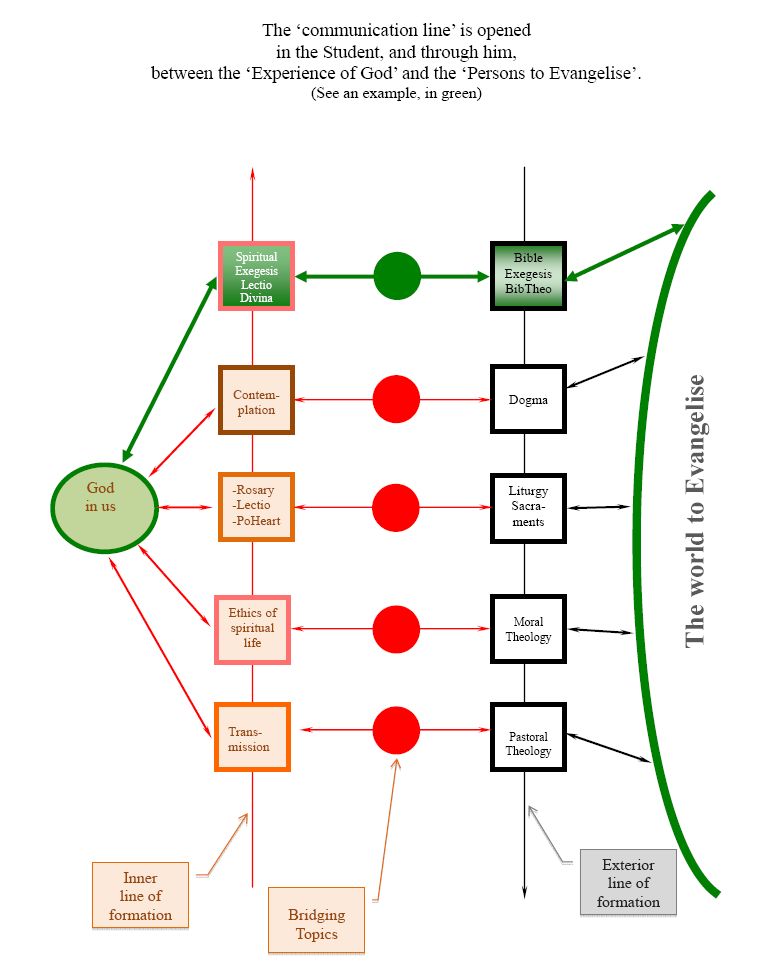
Teaching and formation would be offered in the five areas of: Bible, Dogmatic theology, Sacraments, Moral Theology, and Pastoral Theology For a schematic presentation and examples of how the integration between dogma and spiritual life would be achieved in each area, please see the accompanying sheets.
Validation will be sought for courses from appropriate institutions at each level.
Jean Khoury has a Masters in Theology from the Institut Catholique in Toulouse and the Teresianum, Rome, and is researching a PhD in Spiritual Theology at the Angelicum. He has written books and articles on prayer and mysticism, and is currently teaching spiritual theology at several venues in London and elsewhere. His website is: www.amorvincit.com and he can be contacted on: jeancyrille @ gmail.com
Mgr. Keith Barltrop is parish priest of St. Mary of the Angels, Bayswater, and is a past rector of Allen Hall seminary and director of the Bishops’ Conference Agency for Evangelisation. He can be contacted on: keithbarltrop@rcdow.org.uk
clef
Topics for a Formation in ‘Integral Theology’
____
Introductory course presenting “Integral Theology”.
Course on the “Call for holiness”.
 Inner line of formation
Bridging-Topics
Outer line of formation
  • Theology of listening
  • Lectio divina
  • “Biblical Inspiration” and “Spiritual Life”
  • Christian Contemplation
  • Spiritual exegesis
Bible
  • Exegesis
  • Canon, Inspiration
  • Biblical Theology
  • Experience of the Trinity
  • Experience of Christ
  • Experience of the Holy Spirit
  • Experience of Mary
  • The spiritual experience of the Church
  • Trinity in Spiritual Life
  • Christ in Spiritual Life
  • The Holy Spirit in Spiritual life
  • Mary in Spiritual Life
  • Church and Spiritual Life
Dogma
  • Trinity
  • Christology
  • Pneumatology
  • Ecclesiology
  • Mariology
  • Spirituality of Priestly Gift of the Faithful
  • Spirituality of Martyrdom
  • Lectio Divina
  • Prayer of the heart – Lift up the heart
  • Digesting the Sacraments
  • Rosary
  • “Fruitful Participation” to the liturgy.
  • Liturgy and Spiritual Life
  • Spirituality of Baptism
  • Spirituality of the Eucharist
  • Spirituality of Marriage
Sacraments
  • 7 Sacraments
  • Liturgy
  • Theological Acts (Faith – Hope – Love)
  • Ups and downs in SL
  • Synergy with the Action of the Holy Spirit – Presence of God
  • Moral Theology and Spiritual Theology
  • Confession and Spiritual Direction
  • Perception of sin in the examination of conscience
Moral Theology
  • General MT
  • Special MT
  • Discernment – Counsel – Government
  • Spiritual Direction
  • Spiritual Pastoral
  • Being fruitful
  • The Holiness of the Priest/minister in his ministry
  • Pastoral techniques under the light of Spiritual Life.
  • Pastoral orientations in the light of the Spiritual Journey.
Pastoral Theology
  • Pastoral Theology
  • Evangelisation
  • Canon Law
Mgr Keith Barltrop
Jean Khoury
Pdf version (click here)

Tuesday, 26 April 2016

147: The Importance of Leading a Spiritual Life


The mission of the School of Mary is to teach Spiritual Life to adults giving them the minimum necessary knowledge in order to have a personal spiritual life and allow our personal relationship with the Lord to grow and reach its fullness.


Teaching plays a very important part in allowing a healthy spiritual life to initiate and empower every person. Without that teaching, one remains ignorant of many vital and practical elements of our faith and therefore, unconsciously, are subject to random results in what one is doing in order to get closer to God. The reception of Grace, even with a sacramental life, can remain very limited, or even clogged.

Ignorance is sadly a key factor in that. Why? Because the person is not yet in control of his or her own personal spiritual life. Things are done randomly, just as they come, in an amateurish way. The consequences of this is an “under-life”, a limited life, an under-developed life. Even if the person has some success in their family life or work, deep inside, the core is lacking. His or her Christian life cannot blossom with only the commitment of an hour every week at Mass.

Without teaching there is no awareness. Without teaching one can’t handle properly ones spiritual responsibilities. We are talking here about a teaching that has practical implications, not just mere theory. The practical teaching shows us how to do something, which if we put it into practice will help us receive new graces. Consequently, our spiritual life blossoms like a flower in Spring. On the other hand, if we don’t receive practical teaching, we will not know what God wants us to realise in our life; the gifts He wants to give us because we have not learned how to receive his grace in a fruitful way. Practical knowledge is vital because it reveals our identity and shows us what we are to do. We need to know how to react when God moves us. He needs our cooperation. He will not force Himself on us and we need to have this awareness on how to receive his grace.

Teaching Dogma, Liturgy and Sacraments, teaching Moral Theology is good, but it will never work without a proper spiritual life, and without a practical teaching that facilitates it. The Catechism tells us this. Pope Benedict XV1 tells us this in his first encyclical, Deus caritas est (English: "God is Love" ). This is not new!

‘Great is the mystery of the faith!’. The Church professes this mystery in the Apostles' Creed (Part One) and celebrates it in the sacramental liturgy (Part Two), so that the life of the faithful may be conformed to Christ in the Holy Spirit to the glory of God the Father (Part Three). This mystery, then, requires that the faithful believe in it, that they celebrate it, and that they live from it in a vital and personal relationship with the living and true God. This relationship is prayer. (CCC 2558)

But receiving a new Teaching, new to you, if not in itself, pushes you out of your actual boundaries, out of your comfort zone. Who likes that? Very few people like the experience unless it is for a good reason. Even so, one can find it too pushy. One was living in a blissful state of ignorance but now the sudden arrival of this teaching on spiritual life upsets it! However, one has the opportunity now to control ones spiritual life; one can feel more responsibility for ones his own life and the future, the spiritual future. The more you know, the more you receive, the more God asks you later to give an account of what you received. God is just. He will not ask you to give what you don’t have, or work on talents or gifts that you don’t have or what you are not aware of. But now you start to discover the richness of the Gift of God. You can explore at the same time all what is needed to correspond to His Gift and receive the Graces God wants to give you, now you have more work. You need to move on from the lethargic state you were in to a more pro-active state. Staying still now means one is rooted in Jesus through silent prayer. Wouldn’t we want to remain rooted in Jesus in everything? Advantageously, what is happening is that a deep spiritual life is offered to allow us to remain centred, grounded and rooted in God. This gives a great peace and contentment. Curiously, the majority of human beings don’t find it, do it, so they remain agitated, wandering here and there without a goal. Isn’t it preferable to remain still in your busy life?

This requires effort and is indeed demanding. This is why, many years ago, while teaching, toward the end of one of my courses, a gentleman, attending the same First Level Course of Initiation into Spiritual Life (also called: “Solid Foundations”) said to me in front of everybody: “Jean, why are you teaching us all this? Why are you giving us all this information about Spiritual Life?”

I thought he knew! And he knew! But his question in fact was saying between the lines: our lives now have became more responsible. Do we like that? Oh that state of blissful ignorance, how we miss it! Yes, if God created us without our consent, He will not save us without our consent! (pro-active consent, active collaboration). As a consequence of that Teaching, things are becoming more complex, we need to move and do things! We need to learn more, practise, read!! 

The other day, while teaching the First level Course a lady said to me: “what happens if people don’t know all these things? Can they still receive the Graces God wants to give them? What will happen to them?” 

Hmm… I replied: the aim of this Course is to take the student from a “random” life in the Grace of God to a “responsible” life. Random to Responsible! St Paul says in his letter to the Romans:


“But how are men to call upon Him in whom they have not believed?

And how are they to believe in him of whom they have never heard?

And how are they to hear without a preacher?” (Romans 10:14)


How will they know if they haven’t heard the Good News? This is why the Lord commands us to Evangelise, to Preach, to Teach, to “Form Disciples” for Him. It is not a choice, it is an order: go and preach the Good News! Life is vital. Feeding your children is vital, it is not optional.


One of the greatest truths taught to us by Pope St John Paul II is that every baptised person, by virtue of his or her Baptism, is a missionary. You can see that in his Encyclical letter “Redemptoris Missio”. It is by the virtue of Baptism that we receive the mandatum (order), the “sending in mission”. Let us remember as well that the Priest at the end of the Mass when he says: “Go in peace”, he is not saying: “...that’s it, the Mass is ended, go back to your normal life”. On the contrary, he is saying: “Now that you received Christ in your heart, in your mind, in your will, in your emotions and in your imagination, I (as your Parish Priest, and in His name) am reminding you that now you have a Mission from Christ, to transmit Him to others, starting with your family, your neighbours and your work place!

So, people can’t know what God wants to give them on a daily basis (“Give us our daily Bread”) if nobody explains it to them. There is a “Body of Teaching” dedicated to that: the science of knowing what God wants to give us (God’s Gift) and how we can receive it on a daily basis. If nobody specialises in this Science, if nobody teaches that, we end up by having empty teaching, non edible bread, and our life becomes stagnant. If nobody teaches me, how will I know? If I don’t know, I won’t be able to do anything. I might receive a strong grace from time to time, like once a year during a Retreat, but nothing else! Instead of receiving “grace upon grace” (John 1), discovering the richness of the Gift of God, diving into its immensity, discovering the Love of Jesus and how it fills all dimensions of life I won’t be able to know Jesus, to fall in love with Him, to receive his “Daily Bread”. I will be an “under-developed Christian”.