Showing posts with label To believe. Show all posts

Thursday, 17 May 2018

176- Four Ways of Believing the Church

What should be done when an eminent member of the Church does something that scandalises us? The Creed tells us that the Church is not an optional matter in our life, namely we say: "we believe the Church, One, Holy, Catholic and Apostolic". Paradoxically, however, she can become an obstacle to our faith and growth instead of helping us mature.
Scandal can become a learning curve for us. The outcome depends on our response. Generally, with or without a scandal, we are called to believe the Church when the Church speaks in the name of Jesus. A sin is a sin. A grave sin is a grave sin! This is true. Nobody will ever question this aspect. St Paul himself teaches us that God puts his grace in vessels of clay to help us focus on His Grace and not on the clay vessel. In this sense our Act of Faith in the Church, the manner in which we believe the Church and in what the Church says, has to rely on the Holy Spirit and not on the flesh*.


The Act of Faith has two components: fides qua creditur (the attitude of faith, our manner when making an Act of Faith) and fides quae creditur (the object we believe in).  In other words, in the Act of Faith we have: the subject of the Act (me, the manner and means I use to make the Act of Faith: the manner can be human or divine) and the object of the Act (the contents I believe in).

The Church, seen as the object of our Act of Faith, is not God, but she bears the fullness of God and is meant to lead us to God. This is God's will. She is part of our Creed. She is Jesus' Sacrament, she is the Sacrament of Salvation offered by Jesus to us to communicate Divine Life to us.

As a consequence, when we face the Church we don’t have only one manner of making our Act of Faith but four: 1a, 1b, 2a, 2b (see table). Three are wrong and don't lead to God and His Salvation.


The object of the Act of Faith:
i.e. looking at the Church we focus on:


1- The Clay Vessel

2- The Grace of God
The man-ner we use to 
make our act of faith
a-Leaning on the "Flesh"*
I look no further than at the sins of my brothers and sisters, members of the Church: what gets splashed back in my face is: sins.
I am focusing on the Grace of God in the Church, but I am still using my own limited understanding of these sins. I do not access the grace of God properly.
b-Leaning on the "Spirit"
I am making a proper act of faith but I am still focusing on human beings and I am leaning on them. I am living in false hope.
I am focusing on the grace of God in the Church and I am doing it with faith and am therefore entering into her more deeply, seeing the Saints and the Doctors and going even deeper to her heart: Mary the perfect realisation of it. I am using Her Faith in order to reach the Grace of God and to dwell in it.

We need to learn to discern the one and only correct manner in which to believe (2b, in white) and learn to make the Act of Faith properly in order to succeed in receiving the Grace of God and to grow spiritually.

We are supposed to grow in the Church, like going from one Mansion in the Church to the next, always going deeper until we reach the deepest Mansion, the burning Heart of the Church. The Church in fact is also a path, a way to reach the fullness of Jesus himself. We are tempted to stop at each mansion and stay there thinking that this is it, while the Holy Spirit God, in fact, is constantly challenging us to grow.

At each stage we face obstacles and hurdles, temptations and deceit. They are indirectly a call from God to sharpen our Act of Faith in order to reach the deepest part of the Church.

* "Leaning on the Flesh": our act of faith leans on human motives, using human means, human ways, human thoughts, human goals.

For greater development see here.

Saturday, 25 July 2015

119: The Starting Point in Spiritual Life

Question: Can you please elaborate on “God loves you”.  How should we as humans in a noisy, difficult and challenging world filled with earthly temptations..... feel... the LOVE of GOD, in quantity, quality or in faith? How to internalise it or tailor it to suit the human being, to use it and benefit from it. To see how this love is conveyed, in order to make good use of it and use it to the maximum without distractions and with optimal fruitful capacity. Like the seed that grows in a favourable and fertile soil.
God is God, and the human being is the most imperfect being, who will die with his weaknesses and illnesses.... It is hard to compare "apples" with a "chalice" for example.....
Awaiting your reply .....with deep gratitude.

Answer: Thank you very much R. for your trust and for your question.

God is love”, and “God loves you” are expressions that we are used to. But sometimes it is important to enter more deeply into their meaning.
"To Love" means "to give oneself" to the person we love. Take marriage for example: we are called to love, to give our consent, to give ourselves to the other person. It is the same: love is love, love is to come out of ourselves and give ourselves.
So, when we say: “God loves you” it means that He wants to give Himself to you. He doesn’t give gifts or presents, He wants to give Himself, nothing less.
So this is the starting point!

Now, as you say: "we are busy", "we have noise", outside and inside of ourselves. There are temptations: laziness, tiredness, etc.
But we have good will, and we have the Gift of Faith that we received in Baptism, that guides us toward God, and tells us that since He wants to give Himself to us, receiving Him, therefore, is possible. So, the conflict between our busy noisy life and the Life of Receiving Him in us seems only apparent, but in reality it is possible to receive Him - through a Journey of Growth of course.
Faith received in Baptism is a very little Divine Seed planted in us by God and this Seed - Jesus in us - should become the biggest Tree of the garden.

First and foremost we must see: God wants us, He needs us, He has a divine Desire/Thirst to give Himself to us. He is the one who calls us, not we who do so. He is the one who is searching, day and night, for us. He doesn’t shout in order not to put pressure on our freedom, but he shouts silently… It is important to know all the above.

We are invited to open a way in the sea of our busy life to God himself in order to start do the gardening work: ploughing the soil to introduce oxygen, offering Sun, and watering the soil/seed.
The General help of the Grace of God is constantly given to us to fulfil our part: to ask, to knock on the door, to search for Him. If it is given constantly to us, this means we need to use it, enact it. It depends on us to do so. It is a matter of freewill.

If we are really convinced that there is a Way to receive God, that this is what God wants to do to us and that taking time to receive Him in our life is essential, then we can say this prayer:

Dear God,
I know that you want to give yourself to me,
you know how weak I am, how busy I am, and how noisy is my life,
how I don’t find time to sit down and stay with you,
so please, help me, rearrange my daily schedule
so I can find the right time to listen to you and receive you.”

This small prayer, the prayer of a total beginner but full of good will, is very powerful if it is made with pure intention. After having done this prayer, one has to open his/her eyes to see God starting to fashion a Way, like Moses who opened a way in the sea.
There are two essential parts in this activity of "God to be received", this "Divine Bread" (God himself):
1- one is to sit down and listen to Jesus and put into practice what He says (opening the daily Readings of the Mass),
2- is to sit down and receive Him deeply in us (going back to Jesus' host in our heart, received in the Eucharist).
These two parts, these two activities are vital, because they nourish our Tree, and allow it to grow. They allow us to receive God's love.

These two aspects of the Bread that we need to eat are given to us during the Mass, but even if we attend Mass, we often do not digest the food that we have taken in - we say to you O Lord: "Give us this day our daily Bread"… "our daily bread" is your daily Word that you want to give us to put into practice, "our daily bread" is as well the Fire of your Love and deep union with Jesus received in the Eucharist and taking time afterwards to interiorise Him: His Body, Blood, Soul, Spirit and Divinity.

The Journey starts… as it started with Mary, Jesus’ Mother and His best disciple, the one who had Faith in God's Words. In Her the Holy Spirit formed Jesus… with Her and the Holy Spirit God forms Jesus in us, He allows that Seed in us to grow. God said to us: I want to give you a new heart, a heart of flesh (like Mary’s heart)… So this is as well our prayer:

"give me a heart like Mary’s heart.
Form Jesus in me as you formed it in Her…
or, better, like what Nicodemus said:
as an adult, let me be in my real Mother, Mary,
so Jesus can be formed in me.. (see John 3)".

I hope this helps as a starting point.
Two essential ways/means to receive God’s love can be summed up us: sit down and listen to his Word (open the daily readings) and sit down and receive Jesus deeply in you, like the tree receives the Water. The two highlights of the Mass.

Let me add one point about "feeling" or "not feeling" God. The Living Tradition of the Church says the following: believing (which means to open our heart to the Gift of the Holy Spirit, to God's Love) gives us the experience of this Love - and not vice-versa.
Believe first, i.e. open yourself to receive, then you will see, you will experience.
Faith is an opening of the heart that leads to an experience.
In this "experience" we have different levels, like on a very high mountain:
1- the lowest part of the mountain has houses, streets and trees (senses)
2- the higher part of the mountain, has sometimes lakes (feelings emotions), grass
3- the highest parts of the mountain, have rocks that lead to the highest point (mind, will, memory)
4- The highest part of the mountain is not the one we have just mentioned (number 3), it is the part that lies beyond the clouds. This part of the Mountain can see the sun directly (the spirit, or heart)

In our experience of God, some rays, refracted by the clouds could fall in the parts 1, 2, 3. But in fact the real direct Ray of the Sun, God himself, is given only to the Highest part.
This is why we say that "we live with/in Faith": we know that the Sun shines in that highest part. But that highest part in us, is beyond consciousness, it is "supra-conscious". When we receive Communion we know that we have been touched by His Divinity. Where did it happen? In the supra-conscious part of our Mountain: above the clouds (4). So the lower part says: “I believe!” but in fact it is the experience of that Highest part.
In that experience of God let us not be deceived by what falls into the conscious part (1 to 3), we know that He pours Himself into the highest point of the Mountain. If He gives us some crumbs in 1to3 this is fine, but the Substance of His Being is given to us in 4.

Tuesday, 4 March 2014

96: Why Jesus hides his Divinity?

Question: From the Gospel today why does Jesus appear to deny His divinity? "Why do you call me good... No-one is good but God alone" (Mark 10:17-27).

Answer: Thank you very much for your question. This is an fundamental question which puzzles all who find passages from the Gospel where Jesus tries to keep quiet about his divinity. It became even a “locus theologicus” and has a name: “the Messianic secret”.

In the Gospel, Jesus commands silence in many instances. An example is Mark 8:29–30: "And he asked them, But who say ye that I am? Peter answereth and saith unto him, Thou art the Christ. And he charged them that they should tell no man of him." Jesus also issues commands of silence after miracles and healings, e.g. in Mark 1:43–45 in the cleansing of a leper: "After sternly warning him he sent him away at once, saying to him, 'See that you say nothing to anyone; but go, show yourself to the priest, and offer for your cleansing what Moses commanded, as a testimony to them.'" We could include parables and secrets of the Kingdom of God as in Mark 4:11: "And he said unto them, Unto you is given the mystery of the kingdom of God: but unto them that are without, all things are done in parables."

First there is a difference between denying and not saying or hiding. He is not denying (that would be lying) but he is acting progressively (pedagogically). Jesus' intention is pedagogical. In order to understand how God worked in the History of our Salvation (think of the Old Testament) and in order to understand how Jesus worked we should think of an aspect that Blessed John Henry Newman deepened and presented to us: “development” and “envelopment” as a Divine pedagogy. God never starts by saying things directly, and clearly, because we don't have the capacity to receive things as holy as they are. So he starts by enveloping himself and the deeper truths about him. Exactly like we do with Children: we tell them things in a certain way when they are young and the more they grow, the more they are capable of understanding and bearing what we have to say, so we open wider the veil, increase information, until they are capable of handling the naked reality/truth (the process of development).

Jesus' divinity is not a light matter to be played with or a subject of debate or arguments. It is the most sacred part of God himself and it is not offered up to be ridiculed. It should be handled with great care and respect. It should be handled with purity.

For the pure and the prepared, God reveals Himself as he is. But in order to reach that purity and holiness, we need to be purified through a journey of growth.
This is why saint John built his Gospel as a journey of purification through the 6 signs he offers us (chapters 1 to 11), until we reach the Cross (18-19), and are enable to “enter” into Jesus' Opened Side.
God doesn't give his pearls to the swine. And he advises us not to do so.

Objection: Should we consider a beginner as a “swine”, an impure person to whom we should hide the knowledge that Jesus is God and the necessity to believe in that from day one ?
Answer: Not really, because experiencing his divinity is the first goal in spiritual life and one needs to know it from day one, even if it is not experienced yet. One embarks in the journey. It is more for people who are not opened to receive Faith. (Faith is a Grace)
If we read carefully saint John's Gospel we will notice various aspects arround Jesus' Divinity.
- First we can see that that there are two ways to reach the Discovery of Jesus's divinity: the first way is to start through baptism by the mere initial baptismal belief (the Creed), and, at the end of the Journey, to reach Jesus divinity, by becoming united to him. Saint John of the Cross describes the grace of the Spiritual Engagement as a powerful glimpse of Jesus' divinity. St Theresa of Avila says that in the 7th Mansion, we see what we believed in while within the previous mansions...
The Gospel of St John starts with one of the First apostles' affirmation: Rabbi you are the Son of God (John 1:50-51), and finishes with that amazing affirmation of St Thomas who was allowed into Jesus' side: “my Lord and my God” (John 20:28).
- Second: one can see throughout St John's Gospel that on the journey of purification (the 6 signs), at each stage people respond to Jesus in different ways. You have the ones who believe, but you have as well the ones who don't, who react very humanly, who struggle. This is intentional in John's mind: he shows the journey of purification, the struggles, the obstacles to reach that experience of Jesus' Divinity that he calls: Faith. Faith for him is entering in Jesus, being transformed in Him, and therefore being able to receive the Holy Spirit, God's Life (see John 20:30-31).

We see then the necessity of a journey of purification. We can translate these following words of Jesus “blessed the pure, they will see God” (Mt 5) into a more precise statement: “Blessed whoever will get his heart purified because he/she will See God.” or “your duty is to become purified in order to see God”. This is why the Masters of Spiritual life from the very beginning of their teaching stated that the goal of the monk is to realise his purification (see Conferences, John Cassian). Let us finally remember as well that the journey of transformation/purification makes us similar to God, to Jesus. This is why and how we will be able to see him “as he is” (1 John 3:2).

Conclusion: we can't say that the Lord denies his own divinity, but he uses the divine pedagogy, i.e. he works progressively with whoever is ready and to the others, he speaks in symbols (parables), fulfilling the golden rule: not to give pearls to the swine.
In that passage mentioned in your question, Jesus starts with the understanding of God as he appears in God's Revelation to Moses. Notice that Jesus' answer will proceed progressively: he will question him about his observation of Moses' Law first. Only after his positive answer will he dare add perfection, the Perfection he is bringing to the Law. He acted pedagogically.

Saturday, 22 February 2014

92: St James explains Lectio divina 2

In the second chapter of his letter (James 2:14-26), St James continues to explain to us Lectio divina is.

The act of faith is to receive a word

What is faith? Our understanding today of “faith” might not be the one meant in various passages in the Bible. Plus, each author in the Bible, makes some aspect of “faith” shine. So we might feel that we have different versions of the same topic, but in fact these are only different angles that allow us to grasp better that spiritual reality of faith and of its act.
For many authors of the Bible, faith is an act that allows us to receive a Word from God, and to put it into practice. By this act, we open ourselves to God’s word/message, and we offer for it a space in us (in our existence, in our body, our soul,..), so that that word can “become flesh” in us.
The best example that illustrates the act of faith is Mary in the Annunciation. The Angel of God is transmitting to Mary a Word from God, a Message from God. Mary doesn’t immediately say “yes”, bypassing her mind. On the contrary she makes the effort, with her mind, to understand what that Message clearly means, discovering by doing so, her exact part in allowing the word of God to become flesh in her heart and in her flesh. Only then she says: yes, here I am, with all my being, offered to God, and to this word that He uttered to me.

For this reason, Mary is praised, and Zechariah is blamed. The exact reason why Mary is called “blessed” is because she believed that if God utters a word (a message) He can fulfil his Word : “blessed is she who believed that there would be a fulfilment of what was spoken to her from the Lord.” (Luke 1:45) The Angel Gabriel explains to her the exact point of Faith: “no word [uttered by God] is impossible, to [be realised by] God". (Luke 1:37). The majority of the translations say: “for nothing is impossible to God”, which is not what the text says and is not Luke’s purpose: in fact he wants to explain the mechanism of Faith.

How faith is transmitted to us

By Jesus’ Redemption on the Cross, we receive the Grace of Faith i.e. the capacity to open up to the Word of God. By Jesus’ Redemption, Mary was able to say “yes” to the Angel (see the Mystery of the Immaculate Conception). By Jesus’ Redemption, and through his Plan, he wanted Mary to be altogether our Role model (Archetype of the perfect Disciple of Jesus) and our Mother (the one that generates us into God’s Life). Jesus made Mary and Mary’s “yes” (all her “Yes”) capable of holding our “yes”. By the “Yes” of Mary, we receive the Grace, in our turn, to hear a Word coming from God, understand our part in its incarnation, and say “yes” to it, like Mary, and in Mary. This is the full extent of the Act of Faith. This is why Mary is praised this way: “Blessed are you among women” (Luke 1:42) (we are all, by through her, capable of conceiving God’s will, a word from him each day). What do we conceive? “blessed is the fruit of your womb”: Jesus! This is why “all generations will call her blessed” (Luke 1:48). Because all generations will go to her (as our mother) to draw from her the capacity to receive the word of God (to believe, to have faith).

St James explains the act of Faith

God's word for us is to love God and to love our neighbour. So Faith will entail putting that word into practice. With this understanding of faith, let us read St James’ passage:
“What does it profit, my brethren, if a man says he has faith but has not works/acts? Can his faith save him? If a brother or sister is ill-clad and in lack of daily food, and one of you says to them, "Go in peace, be warmed and filled," without giving them the things needed for the body, what does it profit? So faith by itself, if it has no works, is dead.” (James 2:14-17)

Having faith itself (i.e. having the capacity to say “yes” to a word sent by God to us) is a grace. But exercising faith, is something that is essential. Faith is not passive. It is a grace, a Talent to be implemented, activated, invested in. Imagine Mary not saying “yes” to God, and not receiving him in her! The fact that she is “Immaculate Conception” gives her Faith the capacity to say “yes”, the capacity to “conceive the word” in her heart and in her womb. But if she doesn’t say yes, if she doesn’t use that faith, then nothing will happen. There is no fruitfulness.
If we don’t say “yes” to the word of God, if we do not receive into our life, in our flesh that “word”, if we don’t give it a space in us, what is then “faith”? Have we allowed the grace of faith to be enacted in us?
St James continues: “But some one will say, "You have faith and I have works/acts." Show me your faith apart from your works/acts, and I by my works/acts will show you my faith.” (James 2:18)
The act of Faith is the capacity to receive a word from God, to give it our flesh.

“You believe that God is one; you do well. Even the demons believe -- and shudder. Do you want to be shown, you shallow man, that faith apart from works/acts is barren? Was not Abraham our father justified by works, when he offered his son Isaac upon the altar? You see that faith was active along with his works/acts, and faith was completed by works/acts, and the scripture was fulfilled which says, "Abraham believed God, and it was reckoned to him as righteousness"; and he was called the friend of God. You see that a man is justified by works/acts and not by faith alone. And in the same way was not also Rahab the harlot justified by works/acts when she received the messengers and sent them out another way? For as the body apart from the spirit is dead, so faith apart from works is dead.” (James 2:19-26)
Faith as a grace is something, and the act of faith is something different: it is to receive a word from God and “incarnate” it. “blessed is she who believed that there would be a fulfilment of the word that was spoken to her from the Lord.” (Luke 1:45)

The total gift of ourselves to God

It is true as well, that one has to offer himself totally to God when he makes his act of Faith. Let us contemplate Mary: she doesn’t say an intellectual abstract “yes” to God. She commits totally to Him, she puts all her life into God’s hands, and commits to his Word. This is the condition that will allow the Word of God to come into her heart and into her womb.

In order to see God we need to give ourselves totally to God, and this is purity, a purity that we can enact (with the Grace of God).
If we “loose our lives” by giving it to God, we get everything: God, and all the rest. Seek the kingdom of God first, and all the rest will be given to you for free.

Purity is the condition of success of Lectio Divina: offering ourselves to God, completely, unconditionally,… this is the only way to receive God. If we give everything to him, we get everything (him).

Conclusion

Lectio divina is a real act of Living Faith where we listen to a word coming from God to us, where we offer ourselves to God totally and where God incarnates in us his word. Very much like the Annunciation.

Wednesday, 30 October 2013

How necessary Mary is for our Faith? # 3

Right before his First Sign ("Miracle"), Jesus gave us an important promise, on which all the Gospel of saint John is built:

“Truly, truly, I say to [all of] you,
you will see Heaven opened,
and the angels of God
ascending and descending
on the Son of Man.”
(John 1:51)


Jesus here seems to allude to Jacobs dream, in Genesis: 28:10-22:
Jacob's dream (Catacomb via latina)
"Jacob left Beersheba and set out for Harran. When he reached a certain place, he stopped for the night because the sun had set. Taking one of the stones there, he put it under his head and lay down to sleep. He had a dream in which he saw a stairway resting on the earth, with its top reaching to heaven, and the angels of God were ascending and descending on it. There above it stood the Lord, and he said: “I am the Lord, the God of your father Abraham and the God of Isaac. I will give you and your descendants the land on which you are lying. Your descendants will be like the dust of the earth, and you will spread out to the west and to the east, to the north and to the south. All peoples on earth will be blessed through you and your offspring. I am with you and will watch over you wherever you go, and I will bring you back to this land. I will not leave you until I have done what I have promised you.” When Jacob awoke from his sleep, he thought, “Surely the Lord is in this place, and I was not aware of it.” He was afraid and said, “How awesome is this Place! This is none other than the house of God; this is the Gate of Heaven.” Early the next morning Jacob took the stone he had placed under his head and set it up as a pillar and poured oil on top of it. He called that place Bethel, though the city used to be called Luz. Then Jacob made a vow, saying, “If God will be with me and will watch over me on this journey I am taking and will give me food to eat and clothes to wear so that I return safely to my father’s household, then the Lord will be my God and this stone that I have set up as a pillar will be God’s house, and of all that you give me I will give you a tenth.”"


After having read the text Jesus is alluding to, we need now to understand Jesus' mysterious sentence: "you will see Heaven opened, and the angels of God ascending and descending on the Son of Man". In order to do so, let us first see the meaning of certain words used in this sentence.

Heaven opened
Jesus' side opened is "heaven opened"
What is "Heaven opened" for John? John himself replies to us: "one of the soldiers pierced Jesus’ side with a spear, bringing a sudden flow of blood and water. The man who saw it has given testimony, and his testimony is true. He knows that he tells the truth, and he testifies so that you also may believe. These things happened so that the Scripture would be fulfilled: “Not one of his bones will be broken,” and, as another scripture says, “They will look on the one they have pierced.”" (John 19:33-37)

Jesus' side is the door to "heaven". Jesus' side is opened with a spear. From that "heaven" flow "blood and water", i.e. our nourishment.

"Angels of God"

"Angel" in saint John's vocabulary has two meanings: the first one is literal and obvious: one of God's invisible creatures. The second meaning is "mysterious", symbolical: it means the head of a church, an Apostle, or a Bishop. We have this meaning for instance in the book of Revelation: 
"The mystery of the seven stars that you saw in my right hand and of the seven golden lampstands is this: The seven stars are the angels of the seven churches, and the seven lampstands are the seven churches." (Revelation 1:20) In fact the first part of the book of Revelation is a set of 7 letters to the seven heads of seven churches. "To the angel of the church in Ephesus write: These are the words of him who holds the seven stars in his right hand and walks among the seven golden lampstands [...]" (Revelation 2:1). One wouldn't write a letter to an angel, but rather to the head of a church.
As we saw in a previous post about the structure of St John's Gospel, his goal is to offer us 6 signs + the Big Sign, the sign par excellence, the Cross, in order for us to believe. "these are written that you may believe that Jesus is the Christ, the Son of God, and that by believing you may have life in his name." "Believe" for St John means reach the depths of Jesus, it means "seeing the Crucified Lord", seeing his side open and entering through it in "heaven", and drawing from it "Blood and Water" i.e. Life.

The ladder


The Mysterious ladder Jesus' promise is alluding to is Mary's action in Cana. The New Eve that came from Jesus' side, is the only one knowing the way to His Heart, it is through her "faith" (her capacity to reach His opened Side) that we can believe.


The ladder should be in blue
At Cana, Mary says to Jesus: "They don't have wine". She has the Wine. Mary knows that Jesus is the Redeemer, and how He will redeem us. Mary knows what Jesus will realise on the Cross, when His Hour will come: He will offer the True New Wine (His Blood) for the True and Only Wedding (Him and each one of us). This is why she says to the Servants: "Do whatever He will tell you to do". She shows them the Way (Hodigitria).

This is how St John concludes the First Sign: "What Jesus did here in Cana of Galilee was the first of the signs through which he revealed His Glory; and His disciples believed in him. After this he went down to Capernaum with his mother and brothers and his disciples." (John 2:11-12) They believed in Him, and "saw His Glory" because of Mary, who "sees His Glory" and leads to Him. She transmitted her Faith in Him to them. She is the ladder on which the "Angels" go up and down.

Through Mary's faith we are enabled to climb and reach Jesus' side, drink from His Blood and Water, and draw from them to give the others. Like the servants of Cana: they draw from the "new wine" and give to the ones who are invited to the wedding of the Lamb. "Blessed are those who are invited to the wedding supper of the Lamb" (Revelation 19:9).


When we hear this Promise: “Truly, truly, I say to [all of] you, you will see Heaven opened, and the angels of God ascending and descending on the Son of Man.” (John 1:51) we understand that its first fulfilment is Jesus' first Sign (Cana's Wedding) and the real and only fulfilment is the Unique Sign: the Cross, where Jesus' side, heaven, is finally opened and with Mary our Mother, through her Faith (the divine Ladder) we can climb to Jesus' side, drink from it, and draw from it and come down, and serve our brothers.

"Mary's faith [...] continues to become the faith of the pilgrim People of God" (John Paul II, Redemptoris Mater, 28)

The Six steps of the Ladder

The ladder has 6 rungs or steps: the six signs Johns give us in his first 12 chapters. We need to climb them in order to be purified (the water in Cana was meant for the purification of the Jews (John 2:6)), and be admitted in the Wedding Chamber, with the Groom: His Side.
1st step: Cana's sign (John 2:1-11).
2nd step: Healing the son of the Official (John 4:46-54).
3rd step: Healing of the paralytic (John 5:1-18),
4th step: Feeding the Five Thousand and crossing the sea (John 6),
5th step: Healing the blind man (John 9).
6th step: The Resurrection of Lazarus (John 11).
Remember that in Cana there are six jars! Do you see how Cana holds all the architecture of St John's Gospel?

ascending and descending

The six steps of the Ladder, the six signs that John chose to offer us, as a way of purification, allow us to be transformed by the Holy Spirit, enabling us to reach Jesus' opened side.
Is that all our vocation? just to reach Jesus' depths? No, Jesus himself set us Himself as an example: He not only washed our feet, but invited as to take part in this sacred mission of doing the same to our brothers and sisters: washing their feet. "If I then, your Lord and Teacher, have washed your feet, you also ought to wash one another's feet. For I have given you an example, that you also should do as I have done to you. Truly, truly, I say to you, a servant is not greater than his master; nor is he who is sent greater than he who sent him. If you know these things, blessed are you if you do them." (John 13:14-17)
We draw the capacity to wash from Jesus Himself, being transformed into Him. We draw water and blood from His opened side, and come down, serving our brothers, being, by the Charity of Jesus in our heart, enabled to purify. Not with our capacity, but with Jesus' capacity.

And as well: "A new Commandment I give to you, that you love one another; even as I have loved you, that you also love one another." (John 14:34) As it has been done to us, in order to allow us to ascend and reach His Side, we should to the same to our brothers and sisters.
This is how the Servants (the Angels) ascend and descend on the Son of Man.

“Truly, truly, I say to [all of] you,
you will see Heaven opened,
and the Angels of God
ascending and descending
on the Son of Man.”
(John 1:51)

Monday, 10 December 2012

61: The practical use of the Dogma of the Immaculate Conception #1

The Immaculate Conception of Mary is essential for our daily life and we don’t necessarily see it or use it. Why would the Church proclaim something that is not useful for us? Therefore, a clever attitude would be to dig deeper in order to understand the real daily use of a “Dogma”.


In fact, the “Immaculate Conception” is not a Dogma about Mary only. It is a fundamental element in our “Spiritual Life”. How that?

At the Cross, Jesus gives us Mary (see John 19:26-27), this means that this privilege of Mary has benefits for us, since Mary "belongs to us". In fact, we know that Mary, in the Annunciation and throughout her life said “yes” to God, for herself and for each one of us. (“She uttered her yes "in the name of all human nature". By her obedience she became the new Eve, mother of the living” (Catechism 511))

“Through the centuries the Church has become ever more aware that Mary, "full of grace" through God, was redeemed from the moment of her conception. That is what the dogma of the Immaculate Conception confesses, as Pope Pius IX proclaimed in 1854: The most Blessed Virgin Mary was, from the first moment of her conception, by a singular grace and privilege of almighty God and by virtue of the merits of Jesus Christ, Saviour of the human race, preserved immune from all stain of original sin.” (Catechism 491)

The huge gap that lays between Mary and each one of us is not only at the level of her Conception (from the first moment of her conception she is preserved immune from all stain of original sin) but at the level of its practical consequences: being able to believe. The insistence in the Gospel on the “faith of Mary” versus our “lack of faith” (or better said our “incapacity to believe”) is something really staggering.
Earlier on in his Gospel, saint Luke presents us two annunciations, one that “didn’t work”, and one that did. One was unfruitful (Zachariah didn’t believe) and the other one was fruitful (Mary did believe).
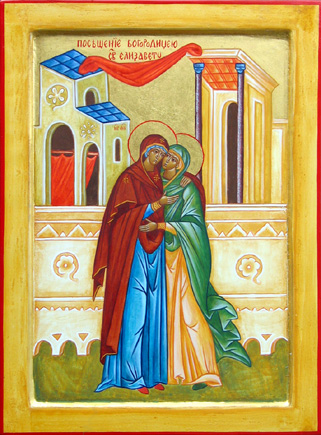
The parallelism is done on purpose, and is very powerful: it is meant as well to be the Portal of his Gospel. The conclusion of this asymmetrical presentation of the “capacity to believe” reaches its high peak when Mary and Elisabeth meet. Not Zachariah this time, but his wife, has a very deep dialogue with Mary where she’ll utter central truths for us who are seeking to believe:
“Blessed is she who has believed that the Lord would fulfil what has been said to her!” (Luke 1:45)
The one who believed visits the one who didn't believe
The Lord said things to Zachariah, he didn’t believe.
The lord said things to Mary, and she believed.

Not only that, but Mary brings us the light of her Faith, and offers it to us: see how she doesn’t remain with the Grace of God she has, on the contrary, she visits her Cousin Elisabeth, and visits each one of us, at home. This is why Mary will utter this very unusual self-praise: “From now on all generations will call me blessed” (Luke 1:48). All the generations will receive her visit, will draw from her unique immaculate faith the capacity to believe. This is not something to be taken lightly!

So, as we see: 1- we notice the huge gap between her capacity and ours. 2- this gap is closed by the fact that the “grace” and “privilege” she received are as well offered to us.

Does Jesus speak about these essential truths? Well yes, but in a semi-hidden way, because it is a “secret”. Why does he “hide” these essential truths? He doesn’t want to give the Pearls to the swine: “though seeing, they may not see;
though hearing, they may not understand.” (Luke 8:10) One has really to want it, to ask for it, to seek it humbly but with full desire.

In order to understand better the “Immaculate Conception of Mary” let us have a look at the Parable of the Sower (Mt 13, Mk 4, Lk 8). This parable is the key parable, in the sense that if we don’t understand it, we won’t understand any parable: “Jesus said to them, “Don’t you understand this parable? How then will you understand any parable?” (Mk 4:13).
This parable analyses the earths: i.e. “our way or receiving” the Word of God, our way of BELIEVING. It doesn’t discuss anything about God Himself, on the contrary, it addresses the human being and his capacity to receive the Word of God and bare fruits. Its goal is to show us how our ways of dealing with God are too short, and don’t reach fruition and that we need to adopt the way of the “Good Earth”: Mary.

In that fundamental parable, Jesus offers us 4 different “earths” (read: “4 ways of believing”) and studies them carefully. The striking thing is that only one earth is capable of bearing fruits (fully believing): the fourth earth, also called the “Good earth”.

Remember: “liturgy” is the way the faithful, throughout the ages, express their own faith. Paying attention to the contents of the Liturgy can bring us precious information about our faith. In the liturgical tradition of the Church (the Maronite and Byzantine rites at least), Mary is called the “Good earth”, the “Earth in which God sowed His Divine Seed: the Son”.

Let us come back to the Parable of the Sower: We can then explore safely the avenue of considering Mary as the “Good earth”.
Remember, for “the act of believing”, the red line between “bearing fruits” and “not bearing fruits” is fundamental. What is the point of starting to believe and reaching completion?
It is a way as well of understanding the “fullness of Grace” that characterises Mary: being “full of grace” allows her to bear fruits, to believe. Only God dwells in the “FULL-of-Grace”, only God acts in her, and His action doesn’t find in her any obstacle, and therefore she can bare fruits.

Now, can we really receive Mary in our heart, in our life, and make use of her own faith?

Saint Therese of the Child Jesus sums up all what we said, and brings it to a genius completion when she said:

“I am not shaken when I see my weakness
The treasure of the Mother belongs to the son/daughter
And I am your daughter, oh my dear mother
Your virtues, your love, aren’t they mine?
Therefore when in my heart will descend the white Host
Jesus, my Sweet Lamb, thinks he reposes in you!...” (Poem 54,5)

You may say to Mary: your faith Mary is mine, therefore I believe not with/through my weak faith, but wit your own faith.

This is why Pope John Paul II said in His Encyclical letter on Mary (Redemptoris Mater RM) mentions the fact that we are called to participate to Mary’s faith (see RM 27) and has this other genius affirmation: “Mary's faith […] in some way continues to become the faith of the pilgrim People of God” (RM 28).


This short text on the understanding and use of the Immaculate Conception is worth being read few times, in order to receive all it’s rich contents.

Re-read, ponder, wonder...
ask, receive and then ACT...


(Continuation, see next post...)