Meditation Articles Raise Questions
My last two articles on Meditation could very well shake your confidence a little, causing you, in fact, to lose a measure of your spiritual self-confidence. Indeed, these articles are meant to provoke thought and consideration.
You might even self-doubt: have I ever gone through a Second Conversion? You might be tempted to say: “Maybe all I have been doing all this time is meditation - the brain can really play tricks on us!”
But let me reassure you here: all your Lectios are not pure brain work. Let us also remember that, in a way, “Meditation” is one of the steps of our actual Lectio Divina (Reading (1): Reading in order to understand what the text says), so that when the supernatural action of God doesn’t work in our Lectio we will be led to feel that we did a Meditation instead. The last two articles I have written, in fact, are capable of creating this kind of "trouble", and some trouble also in general. Hence the necessity for Discernment and not applying one or two criteria without thinking, plus taking into consideration all the other elements that constitute our reality and the reality of Lectio Divina. This has led me to deeply feel the necessity and need to offer a Course on Second Conversion. I consider it is becoming urgent.
To answer the above doubts, we need to remember that we need to accept humbly the doubts that can occur, without panicking. They make us humbler, and it is healthy to stay humble.
But in case you have such doubts, please do remember the powerful Lectio Divinas you have experienced... and many others less powerful.
Recently I commented in a lecture (see the video online) on a chapter from Fr. Marie Eugene where he talked about “Spiritual Growth”. In one of the three sections of the Chapter he states the existence of growth and stages of growth. In the following section, however, he seems to negate all that he has said, in the sense that it is full of “buts”, i.e. difficult to discern…we can make mistakes…it is not all felt… the essential part of the grace of God occurs deep inside of us, so we don’t know…we live in Faith, etc. Then, he finishes this dialectical movement by offering a third section and saying in one word: it is still important to have in mind growth etc. So, self-categorising should be done with great prudence. This Chapter is more for Spiritual Directors – not that we should never read about spiritual growth and spiritual stages as they do help, because they invite us to do things we are not doing, and recognise things in us to correct! Otherwise why did St. Teresa write “The Interior Castle”. My Master, Fr. Louis Guillet, never gave any importance to categorising (i.e. what stage has the person reached, or to tell the person where she is) despite the fact that he knew very well the changes in God's behaviour as regards this person. Why so? Because there is a sort of obscurity that pervades our whole Spiritual Life in general. True there are changes and sometimes drastic ones. But the advice given all along the journey is often very similar: practising Lectio Divina and Prayer of the Heart, humility, love, meekness, duty of state, God’s Commandments, Sacraments,… The very advanced person will still be under all this and having to be vigilant. Certainly, it will be lived differently, but the frame is the same.
Are We Then Changing Anything in the School?
The articles I have written do create a minor upset in the normal bearings within the School. But we stay the same. Why? As I have said above: I am seriously reluctant to teach only Meditation or give advice even to who only practise Meditation, and never to try proper Lectio Divina. I couldn’t deprive a beginner of the knowledge of proper Lectio Divina. Why? Because Christ sooner or later for this person will be at the Centre of their life. Because all our Christian life is “sacramental”, i.e. it has all the visible aspects we deal with every day, and yet we have the invisible grace of God trying to find us all the time and reach us. A Christian person sees through externals, sees the invisible. It is true that there is a stage where the mind will have to do more work, laying the foundations, studying Faith, in order to deepen belief. But, in the end, as “Meditation” is described in the Catechism: it leads to Christ, and Christ is at the Centre of everything, and we are called to be united to Him – even if we are still very far off (before Second Conversion). We have to preach the Truths about spiritual life to everybody! One day, the Truths will become alive in the person! A person has to fulfil the duties of the Mansions where she currently is, and in doing so, the person aspires toward higher realms, or better said: closer intimacy with Christ.
The articles on Meditation in a way, are like completing a teaching initially aimed to start from the Fourth Mansions. It is as if it is offering the first three Mansions (0, 1, 2, 3). By offering a more complete panorama, it sheds a new light, gives more clarity and offers nuances. They help us understand also what happens in a life within the first four Mansions! This is the life of the majority of Christians!!! The Parishioners! This helps you target your Parish audience more effectively, by knowing in advance that you will fail 95% of the time when you teach your Lectio Divina to a simple parishioner, despite all their good will.
The “Second Conversion” Teaching or Doctrine, then, assumes greater importance. As a teacher you already know the main points, which have been mentioned in these articles, and which sum up the teaching of St. Teresa of Avila concerning the first four Mansions (0, 1, 2, 3). They sum up all the core issues of the forty initial years of her life: the key points she had to implement in order to facilitate Second Conversion.
Till now, the unconscious tendency amongst St. Teresa’s commentators, over more than four centuries, has been to consider “Second Conversion” as a pure grace of God that nobody can foresee, prepare for, or even facilitate, like the catalyst in a chemical reaction, and least of all to trigger a reaction! It is a grace! One can’t trigger or merit it! Therefore, why bother studying it, if in the end it is a powerful grace she received while staring at a very small statue of Christ at the Column. This tiny statue shows our Lord and Saviour, naked torso, attached to the column, while being scourged, with his entire torso covered in wounds and blood. To reiterate as St. Paul says: it is God who has mercy on whomever He wants to have mercy! We can’t do anything here but wait! I think that the implicit Theology of the Grace of God that is present in the mind of the majority of the commentators is that since it is a grace that provokes the Second Conversion, we can’t do anything to obtain it. Dogmatically, the position is very seductive and seems perfectly orthodox. I just quoted St. Paul. Indeed, nobody can merit (or trigger) the Grace of the Second Conversion (or any grace). This is simple Theology of Grace. Nobody can normally challenge this position. So, commentators when they tell the story of her conversion, put the emphasis rather on the narrative, rather than on things she should have been implementing! They naturally will quote the account St. Teresa makes of her conversion, the powerful moment when it occurs; they will acknowledge the power of God’s intervention, and the story seems to end there! They seem to ignore that she spent twenty or so years in the sea of the world, struggling, to end by finding Christ and in a resolute way focusing, from then onwards, on Christ.
Who can challenge this? Almost nobody. Except that St. Teresa’s writings don’t seem to give this explanation only, but rather she adds more and opens ways to facilitate the Conversion. Very little is written on her Second Conversion, which is a surprise, especially when you can consult thousands of articles and books written on all sorts of aspects of her teaching!
I personally see in all her writings (not only in her Autobiography where she tells the story in chapters 9 and 23/24, but also in the Way of Perfection and Interior Castle), explanations of very brief indications given in her Autobiography. I think it took her years to understand, implement for her sisters and explain what happened: i.e. why for twenty years she wasn’t totally there for Christ and what should have been done in order to be totally with Him and for Him - at least on her part, using the “General help of the Grace of God” (see Way of Perfection, first half and the first three Mansions, especially the third one, in the Interior Castle, and include the way she shaped life within her monastery (Constitutions)).
When, in chapters 6-9, 23-24 of her Autobiography she speaks about her conversion, St. Teresa gives essential clues, such as the advice given by two different priests. However, the mention of these pieces of advice occurs in one or two sentences at most! By contrast she will need the entire book of the Way of Perfection to explain the true secret that facilitates the Second Conversion and the working of the “Particular Help of the Grace of God”. It has been only during the past few years that I have been given the grace to see the link between the two, because, like everybody, I tended to see her Conversion as the pure work of the grace of God, i.e. she couldn’t do anything anyway, there is no teaching regarding this powerful grace for us, other than just praising the Lord and waiting for His Mercy to shower down upon us – or something as close as this.
Question: Do these two articles on Meditation alter the way we would teach? Should we be speaking to youngsters?
Answer: When I talked to some French children (9-13 years old) last year I gave them Lectio Divina as I usually teach it, with the empty chair, and Jesus sitting there. The result was positive – they got the point. Children are so open! We are not! They are closer to God, to Jesus than we are.
The same result came about also many years ago when I taught Lectio Divina to 14-16 years old. Actually, I would “hate” teaching Meditation alone for as everything is Sacramental in Christianity because God became incarnate, we are invited in Christianity to "see" God through many different means. We are talking to Christians, not to pure Jewish people who have never heard of Christ.
Question: you mentioned in various Courses a passage in St. Paul where he says that when the Jew starts to believe, becomes Christian, the veil that was in front of his eyes is lifted and he starts to see Christ in the Old Testament. (Refer also to 1 Cor 10, where St. Paul makes the point about the Old Testament being “opened” i.e. revealed and tells us about Christ. See also the lesson given to the Disciples of Emmaus and the Apostles in Luke 24.) Is the veil so to speak lifted off the OT as a fruit of Baptism or is it a special grace? Can you clarify? Is it a fruit of general help or particular help?
Answer: It is the Particular help of the Grace of God. But it doesn’t always happen automatically, in the sense that the Teaching on the lifted veil to a Second Converted person (or Baptised) still needs to be given. Remember when teaching Lectio I do remind people of the “opening” that occurs during their baptism! Why do I do so? They are already baptised, so it should be working. No, it can be sleeping! The Seeds of Baptism, in many persons, can go into very long hibernation, especially when we enter adulthood, and is often synonymous with a distancing from faith, the Church, God, and Jesus. Therefore, it is important to revive the grace of Baptism, the awareness of what has been given to us and is buried in us, dormant, and needs awakening. When you teach, you help the Holy Spirit awake this “inner hearing”, or “inner vision” or sight. Remember the doctrine of the Fathers of the Church of the existence of internal spiritual senses: like our five senses, they are new capacities that grow through this awakening and help us see, hear, sense, taste Jesus, through the Holy Spirit. This is an ancient teaching on spiritual life that is rarely taught and when it is mentioned “en passant” in Theology, in Patrology, it is mentioned as if you were talking about a piece in a museum! Now you can appreciate how the Charismatic Renewal is a huge opportunity for the Church, still not perfectly understood theologically and integrated properly into the life of the Church.
Teaching therefore is essential. Reminding people of what they have buried in them, helping the Holy Spirit awaken the inner spiritual sight depends on the Teacher. Often it is not automatic. Things occur when the Teaching is imparted. Mystagogy as practised by the Fathers of the Church is a Sacred Teaching, a Communication of the Holy Spirit. However, who talks about it today? Who implements it today? When? How? With which understanding?
Sometimes – and in the 20th century we had many – Second Conversions are extremely sudden and powerful. Remember one Christmas night when St. Thérèse of the Child Jesus received a very powerful grace that took her from the life of a youngster into adult life. She says that from that day on, growth never stopped, and she reached great heights. A Giant Race she calls it!
Remember, also, Paul Claudel’s Second Conversion, or simply double conversion, first and second. True he was initially catholic, but as an adult he drifted totally, becoming rather an atheist. One day, on Christmas day 1886 he went to follow Christmas High Mass at Notre Dame Cathedral in Paris and came back for the Vespers, when the children’s choir was singing the Magnificat (today there is a commemorative plaque on the floor where he was standing, at the foot of Our Lady on the Column, to the right of the main Altar). He recorded his second conversion thus: “In one instant my heart was touched, and I believed. I believed with such a powerful adhesion, with such a lifting of all my being, with such a powerful conviction that didn’t leave any space for any doubt, that from that moment, all the books, reasonings, randomness of an agitated life, weren’t able to shake my faith, or even touch it.” He entered atheist and came out believing as a fully-fledged catholic would do, in all the articles of the Creed, which seemed to be glowing with their inner truth and more especially the “tearing feeling of the Innocence, of God’s eternal childhood [or youth] an ineffable revelation”.
However, ordinarily, Second Conversion doesn't always happen in a sudden way. It took Teresa of Avila more than twenty years. (When we read the history of the Church, we find that during the three hundred years before St. Teresa was born, the Church, through various Councils tried to reform itself and failed, hence the birth of the Protestant Reformation. It was taking the Church three centuries trying to reform itself and it never succeeded. As if the key to reformation (i.e. Second Conversion) were lost. This is why the first forty years of St. Teresa’s life are a bit like the paradigm of a Church wanting to reform itself and failing. This is why the elements that constitute St. Teresa’s Conversion are of huge importance for the whole Church.
In some lives Second Conversion never occurs. Why? Because certain things should be done beforehand as I have explained and will again explain.
Having undergone her own second conversion and knowing what it entailed, you would think that St. Teresa, after her conversion, would have learned the lesson and would then offer to her daughters of the new reformed Monastery only one option: Second Conversion life and therefore Contemplation. But mysteriously, and for three reasons at least, she tones down her wording and expectations (see Way of Perfection). Her reasons for this were:
1. Contemplation is not always felt,
2. She might have a nun who hadn’t crossed the line of SC, but who was still very obedient and followed all that the Carmelite Rule demanded as well as St. Teresa’s advice, or at least did her best to do so. As long as the nun was “dans les rangs” (“within the ranks”) and was not making alterations or trouble, she would keep her,
3.Grace is always a matter that depends at the end of the day on God. He is free to do what He wants and how He sees things.
Hence, she leaves the door open to a possibility: maybe God doesn’t envisage having to give contemplation to all the nuns, i.e. some are left without it. You will notice also, a few years afterwards when writing the Interior Castle, she deliberately does not start her book with the Fourth Mansions! That would be following the exact hard logic of considering that all the nuns in her new reformed monastery would be at the point of “after Second Conversion”. No, she starts by exposing four other mansions, Mansion zero being outside of the Castle. Then you have the three Mansions inside of the Castle: 1, 2 and 3, and only then, does she start to talk about the supernatural (the Fourth Mansions). Why? Why is she talking to her nuns about the first four Mansions? In fact, she is telling her own story, and allowing for the possibility of some of the nuns being at the Third Mansions at the very least. The Third Mansions are really amazing, because they seem to describe a perfectly committed Catholic. There is no sin, there is fervour to fight against venial sins etc. the person, in fact, is morally sound! Doing his or her duties! Think of an excellent Opus Dei person for instance! This could be a perfect nun in any of St. Teresa’s Monasteries! Indeed, she writes for all these good people.
What About the Third and Fourth Soils?
Some have wondered why in my article I haven’t addressed the third and fourth soils, why I just stopped at the second in the Parable of the Sower and the Seed?
My answer is very simple: I do agree, it seems truncated. I should mention that the third soil is a prolongation or extension of the second soil’s effort. Of course, it deserves an explanation. But it wasn’t the core of my subject and would fit better in an article on the Second Conversion. But the essence of the third soil belongs to the essence of the second soil. Our context, instead, is that of the pre-Second Conversion. While the fourth soil, is the new world of the Supernatural, where God acts directly in us, and where He brings about growth in three progressive stages of development: 30, 60 and 100-fold.
Be Careful not to Push Certain People too early on into Lectio
Alluding to this sentence in the text: “Therefore, one needs to be careful not to push people too much into applying Lectio Divina as taught, or try to “torture” them by asking them to repeat the process and to keep on trying to do so, as this could lead to their even feeling guilty because it is not “working”, a reader wrote: “I list myself as among the tortured...” Some readers thought then that I had given the wrong advice by choosing to teach Lectio Divina and never Meditation.
My answer is: I have never addressed the issue before or considered teaching Meditation because I always considered and took for granted that people whom Our Lady enticed to the Solid Foundation Course came after their Conversion. I left the job to Her.
Plus, my personal experience has never led me to practise Meditation! From day one I was on to Lectio Divina! So, I always thought, why deprive others of the gift of Contemplation and the Grace of God? Why go backwards?
After my conversion I did “Spiritual Reading”, and certainly meditated, and reflected, on my readings, but never refrained from doing Lectio Divina from day one! (But it is true, it was after my Second Conversion!)
I always considered that people who came to the school did so after their Conversion! Hence my “refusal” to go there! My Master, Fr. Louis, considered that a good Carmelite novice nun was beyond it, and that God started quite early on to pour out His Graces (Fourth Mansions).
I do consider also for instance that any person going to a Charismatic renewal group does so certainly after his Second Conversion! So... no need to teach Meditation, or a replacement for Lectio Divina.
Question: “Replacement of Lectio Divina”?
Answer: Yes, if you chose “Meditation” as your way of praying, you are considering that you are not worth “Contemplation”, or, you are before Second Conversion, and therefore, only Meditation is for you. So, in this case, your feeling is to forget about the Lectio Divina as described by the School, and practise Meditation only or, call your Meditation Lectio Divina - which is for me an improper, gloomy situation.
Question: Regarding the question about the School teaching Meditation, is this not something that is already well served by others in the Church e.g. Jesuits? Are those who come to the First Level course (Solid Foundations) not self-selecting i.e. most likely to attend if they have already experienced the Second Conversion?
Answer: I deeply believe in the two branches of the Church, the Priestly (before Second Conversion) and the Prophetic (after Second Conversion). I have to confess, however, that a great paradox exists today: this ecclesiological distinction is present in many texts in the Church’s life and in its structure and management, Canon Law, etc, but the sharp awareness and the consequences for Spiritual Life and Spiritual Theology of this distinction is rather absent. So, if any person outside of the School will hear or read about it as presented and explained in the School, they will need some time to think and ponder, overcoming their initial surprise. This is strange but this is a fact.
It also sheds an amazing light on many issues in the Church. Example: Adult Catechesis is the mission of the Parish, and while being in the Parish, we need to receive this formation. While, once the Second Conversion has occurred, one finds very quickly how short is the food given in the Parish. True that Mass and Confession stay totally solid and nourishing for the soul, but formation-wise, the Parish and the Parish Priest don’t have any qualification to offer the deeper Spiritual Formation that is characteristic of the new life of the post Second Conversion. Every day one has confirmation of this very important ecclesiology point.
Having said this, I deeply consider that all that is needed to bring any of the Faithful to the edge of one bank, right before crossing to the other bank, should be provided by the Parish. So, the first three or four Mansions’ formation is normally provided by the Parish. This includes Meditation.
The School belongs completely to the Prophetic branch of the Church! It opens the “Noviciate room” you find in any Abbey or Religious Order and teaches the richness of the basics of the Spiritual Life of this new life, of this new part of the Journey.
Please see the drawing below that shows that the journey is like one path, but there is like a border-like division between the Parish and the Desert (red line on the diagram).

Think of St. Anthony the Great, called by Jesus during the Proclamation of the Gospel in his Parish to leave everything and follow Jesus! He leaves his parish and heads toward the Desert and becomes the disciple of some monks in a community. He goes from one “economy” to another. One “management” to the other. Both are under the supervision of the Bishop, or the Patriarch. But they are very different.
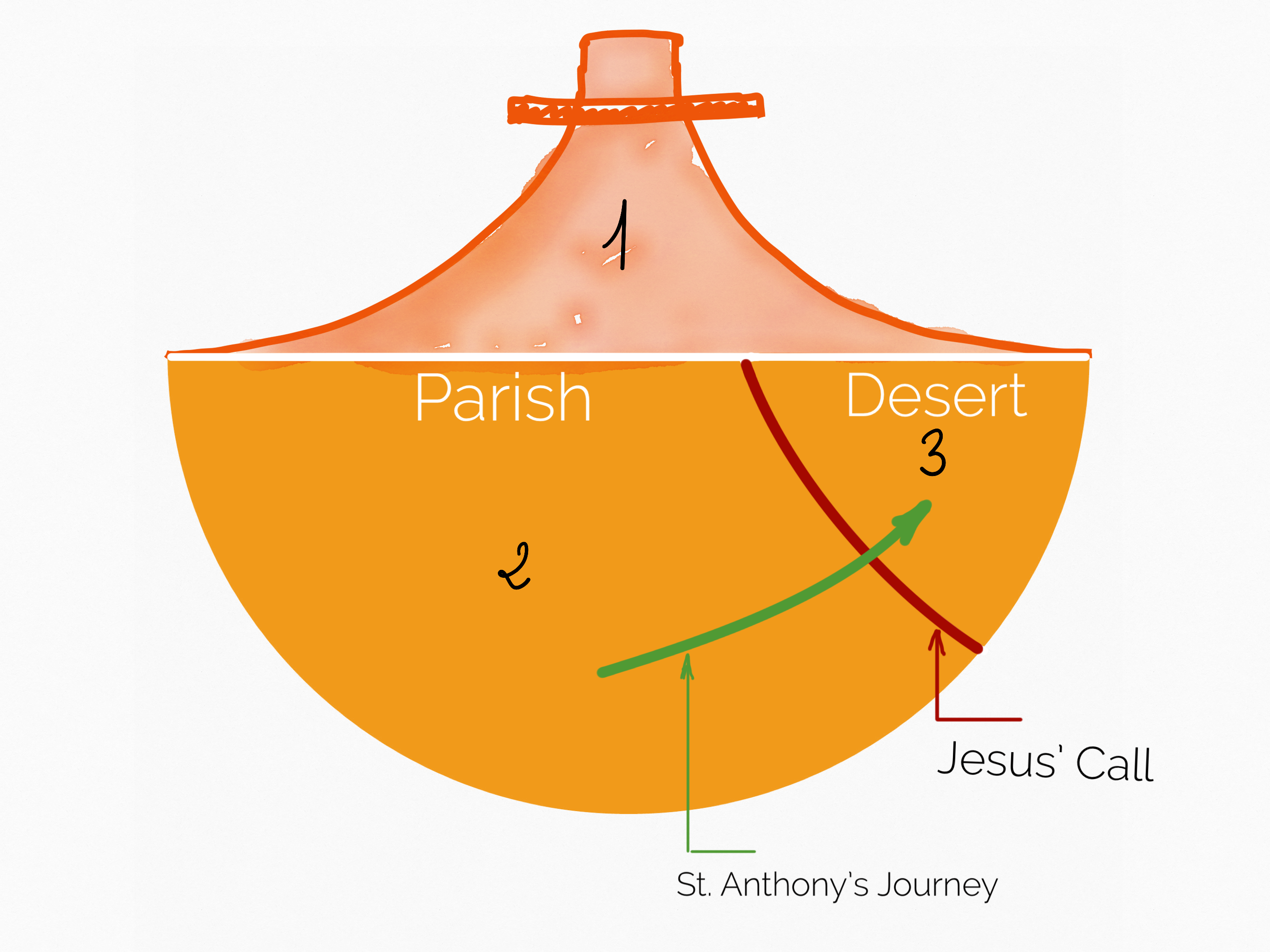
Again, the SOM's mission should be from the Fourth Mansions onwards, when spiritual life begins.
Question: Does the School have the capacity to comprehensively address issues of growth for the earlier Mansions?!
Answer: As mentioned above, I do deeply believe that this is the task of the Parish. It is true also – and we will see it in a clearer way – that the Parish mission is failing to attain its full capacity.
Its mission is not only about teaching some methods of meditation. Implementing “Meditation” is not on its own sufficient to draw Parishioners closer to the second conversion. A comprehensive platform offered by their Parish is needed. It should include also many other aspects: duty of state, moral life, work, growth in virtues, growth in understanding our Faith, commitment in the Parish, ascesis, gift of oneself to the Lord. By this I mean that it's not so much that the School has to change - it’s more that the school should have a new awareness and that this can help with discernment should problems arise, thus for example one could then point people to other courses etc.
Some still think, however, that it is still beneficial to get the teaching from the School in order to know what to do when one reaches the stages further along, so to speak. A big undertaking.
______________