Showing posts with label Word of God. Show all posts

Monday, 4 March 2019

191- Completing the Process of Contemplation

Hi S.,

Please find below my answer to your question regarding Lectio Divina. My answer here is very important since it underlines various important aspects of the practice of Lectio Divina. Some people, unknowingly, don’t implement them and they therefore don’t reach the completion of Lectio Divina. This resembles an “abortion”. Here is your question:

“I just finished an hour of Lectio Divina, and this is what I got from it. The reading about the Blind man of Bethsaida… I never saw it that way…. It revealed my own journey…  Jesus took him by the hand out of the village… maybe things that I was comfortable and used to… He used spittle on the eyes of the blind… From Jesus’ mouth to the blind man’s eyes… Only God’s word can make me see…It was a gradual healing…. For me it meant that God will always finish what He started because He is faithful…. And He said do not even go into the village… in my life now it may mean to avoid occasions to sin and to trust in the new way of praying He is introducing to me, not to go back to the old ways of my life. Jesus healed the blind man outside of the village… meaning, true healing can only come through Jesus but not on our own terms, and not the way we want it to. I’ve never seen that particular Gospel passage in this way…. 
And the first reading about Noah meant process of growth… there are stages… but God will see us through, again He is faithful.
It took me the whole hour to get something from the reading…. Is this Lectio Divina? Am I doing it right?”

Lectio Divina has like three stages in the process of listening:

a- Reading the text and understanding what it says, using our normal intellectual capacity.

b- The supernatural action of the Holy Spirit starts to work in us: the two texts say one thing. (This is led by God Himself)

c- The supernatural light becomes a clear indication for today to do something. (This is indicated by God Himself)

It goes without saying that going from "a" to "b" is a real crossing, because in "a" we are left with the normal strength of our faculties, even if we have faith, but what they reach and achieve is limited. We actually use what in theology is called: the general help of the Grace of God. While in "b", God’s power is communicated to us, the mind (intellect) is lifted by the Holy Spirit from its own ways of functioning to a higher supernatural level. So our mind starts to see God’s loving light with God’s eyes. This is in itself an achievement, because in this case we witness a “miracle” happening to us: the real immediate and personal action of the Holy Spirit who starts to bring the text of the Scriptures to life, it is as if the “Word of God” is being addressed to us personally through the Scriptures. The specific process of (supernatural or infused) contemplation of Lectio is now starting. (This is not to be confused with the specific contemplation of the Prayer of the Heart which is different.)

But the temptation here is to rejoice in this contemplation, delight in savouring it but to bring to an abrupt halt the descent of the Word of God in us thereby aborting lectio, aborting the supernatural Work of God. God’s Word must descend fully, from the highest point of our mind, to the lowest part of our will.
I have noticed that many people just remain at this stage and don’t move forward. Remember the very common way today of presenting Lectio Divina - which is truncated – which seems to allude to the fact that Lectio ends at this stage (a gaze of contemplation): "read => meditate => pray => contemplate". (See stage 8 in the fifteen steps, "Read (3) until I see only one light" which describes this stage and shows that there are other stages after it. Please see here: https://schoolofmary.org/lectio-divina-1-definition-steps/)

From what I have read above, you seem to have reached this stage in the Lectio Divina you did that day. As you can see, you rejoiced in the fact that it is new: "I have never seen it this way". So you are witnessing the action of the Holy Spirit in you. Your mind tastes this newness that God only can give.

There is one further important step at this first stage of listening - the following and last stage being the “Putting into Practice” – that is, having a clear indication of God’s message on how to act. So, the light itself you received and started to rejoice in should continue its journey until it reaches the juncture with your will, that is, it should reach a level of clarity that will allow you right after to put into practice the clear indication given to you by God.

The Turquoise Arrow Stops in General Contemplation
The Blue Arrow Reaches Clarity

How do we reach this stage of understanding clearly what God wants to say to us? How do we reach such clarity while Contemplating? It is by begging the Lord something along these lines: “ok Lord, you started to show me something about my life, "I never saw it this way", "I never saw this text this way", "this is new": but what do you mean by that in practical terms? How do you God (not me) translate it in a practical way?

Beg, insist, until the light that has started to work in you becomes clear, as if God were saying: “S., as a consequence of what I have  just made you see or understand in a general light, look for how this general light is becoming clearer as we talk clear and is ready to become incarnate in you  today. As a consequence, I would like you to start doing this today… 

In this case, the process of contemplation will be orientated properly. In fact, contemplation is not about climbing to the clouds, but it is about going from God (the clouds if you will) to the lowest part in us, in fact it is going in the opposite direction, the direction of incarnation: i.e. a Word given to us from God, starting its journey from high above, going down, crossing our entire being, in a beautiful sacred descent (like what happens to Our Lady during the Annunciation) where the Word crosses our mind, from its upper part to its most practical part, and is about the cross from our mind to our will, generating an act. A sacred act that finds its origins in God and is working in a participation of our mind and will with the thought and will of God.

Once the Word, the Light of this contemplation, reaches this junction between "what I know" (our mind) and "what I do" (our will), it becomes clear and visible, the Word of God is pointing its finger or tip (tip of a sword or arrow), toward a precise point in our Will, asking us for a specific act.

Here come the following 5 steps of implementation (see the last 5 steps in the link mentioned above on the 15 steps), marked essentially by this second and last prayer: “God you showed me what you want me to do, please Jesus help me, give me your Holy Spirit so I can put THIS received Word into practice.” Then you put the word into practice! Lectio then is a Word that became clear and then became flesh in your will, through an act.

I hope this helps.

For further reading please read these three articles, they address this issue on how to go from the beginning of the supernatural action of the Holy Spirit (one light) to the end of the process of listening, that is, understanding clearly what God is asking of us, how the one light becomes clear (from 2 to 3 of the above steps):


Note that your way of doing Lectio Divina here in this case is very common to the way the Fathers of the Church read the Bible. We see it in their Homilies. The temptation then is to transform Lectio Divina into a sort of a “spiritual reading of the Bible”, in the sense of having a “spiritual exegesis” or understanding of the text. There is nothing wrong in reading the bible spiritually, or seeing symbolically how it can allude to different aspects of our life. But this in itself is not Lectio Divina yet as you can see from the above explanations.
Many people today (unfortunately it became a trend 15 years ago) offer their own spiritual meditation on texts from the bible and they call it: “Lectio Divina on the Gospel of Matthew”, or Luke or Job, or Jeremiah…. This is really a deviation, giving us the fruits of a personal spiritual meditation and not inviting each one of us to meditate. But strangely nobody seems to bother. It leaves me speechless! How did we reach this deviation?
We see it even in presentations of Lectio Divina, like the French Wikipedia entry on Lectio Divina. It initially seemed to say that Lectio Divina was about the spiritual meanings of the Scriptures! From a method of listening to God’s Word and putting it into practice, we have transformed it into spiritual exegesis or spiritual personal meditation! How sad!
Lectio is indeed the most powerful way of prayer, the most secure (“it is not the ones who say: ‘Lord Lord’ who enter in the kingdom but the ones who put into practice the word of God”), but also the most difficult and challenging: why? Because it involves real transformation and it tackles our conscious faculties that we use on a daily basis: the mind and the will, our thoughts and our actions!

Tuesday, 25 October 2016

164: Lectio Divina, from the Human to the Divine Author

The Sacramental Nature of the Proclamation of the Word of God

Listening to the Word is epitomised in the word “Manducatio” (Latin) or "Manducation", which is an obsolete word that means "the taking of food", to consume the Word, chew, eat, ruminate, digest, intake.
Manducation” is used in monastic theology, and refers to the full operation of eating the Word of God, the English equivalent being “ingestion”.
This operation is a sacred operation for when Jesus wants to talk to us He gives us a Word. His Words are Spirit and Life, Holy Spirit and Divine Life. Receiving this Word is therefore a sacred operation. In the most recent theological thought and in the Magisterium we often find underlined the Sacramental dimension of the manducatio of the Word of God.
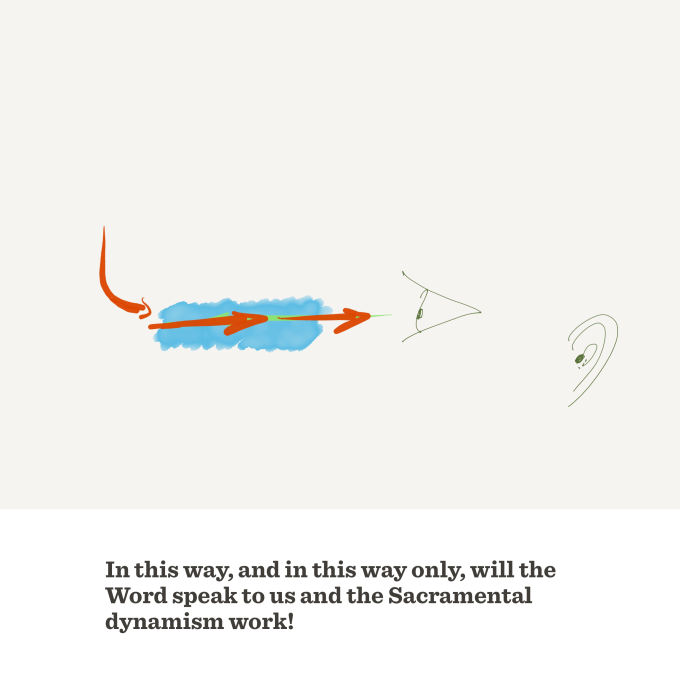
Listening to the Word of God at Mass - during the Liturgy of the Word and thereafter through the Daily Readings – is, consequently, a sacramental operation. In any sacrament, we have at least two dimensions: the visible Sign used (ie. water, wine, oil,...) and the invisible Grace. In the case of the ingestion of the Word of God (liturgically) we also have two dimensions: 1- The letter or literal meaning of the text, audibly proclaimed and 2- The invisible Word that Jesus utters. The Risen Lord, present among us uses one of the words of these texts, or an expression or a verse to talk to us, to say something to us, to give us a Word. The operation is like the Eucharist where the breaking of the Bread of His Word also takes place.

In this sacred operation and sacrament, the golden thread of the Communication of the Grace of God is an intelligible one. The words that are proclaimed are words that we are supposed to grasp with our mind, and the Word that the Lord will pronounce, even if it is sacred, will use our mind, lifting it up, and nourishing it with God's Light and Love. Other Sacraments, the normal seven sacraments - except Confession - have a more reduced use of the mind and a greater use of the symbol (Water, Oil, Bread, Wine,...). These other sacraments (except Confession) may talk essentially more to the depths of our being (the spirit) which is a supra-conscious area (above consciousness) rather than the conscious mind.

The Sacramental Dimension of the Process of Listening to the Word of God

The operation of the manducation of the word of God, having to deal with the human mind throughout, faces various challenges and temptations that can become obstacles. Why so? It is very important to notice that in modern times the Church has to clearly define the co-existence in the Bible of two authors: the Divine Author of the entire Bible who inspired all the words and who inspired only the words that God wanted the human authors to put down, and the said human authors who used their individual styles, capacities, talents, experience in order to write the sacred texts under the inspiration of the Holy Spirit. The existence of the human authors and a correct understanding of the Catholic Theory of Inspiration of the Bible led the Church to impel exegetes to study the human authors, their literary styles, intentions, tools,... in order to fully understand the text.

The science of exegesis was dedicated for more than 150 years to this study. The analysis of the texts with all scientific tools available to understand its letter or literal meaning was deployed with great energy and enthusiasm. As a result many studies and monographic works were written to explain each book of the Bible. All human industry was involved in this endeavour. As a result, often the researcher and writer as well as the reader have the impression of knowing the ins and outs of each book. All this effort can only be praised. It is needed and we can never afford to have the Bible in our hands without using these results, particularly the soundest ones.

Now, if we come back to the sacramental operation of the manducatio of the the Word of God, we will find that two movements are needed: 1- explained in the one described above: understanding the text in its context, understanding the intent of the Author, and the tools and ways he used these in order to express it. 2- the need to lift up the mind, to focus the mind (our inner ear) on the Divine Author, on the Risen Lord who wants to talk to us.

The first operation is realised through the natural light of reason and at the most with the general help of the Grace of God, the general Light of Faith.
The second operation can only be achieved with the specific help of the Grace of God, ie. the direct and personal intervention of the Holy Spirit in us, facilitating the communication (or coming) of the Word of Jesus in us.

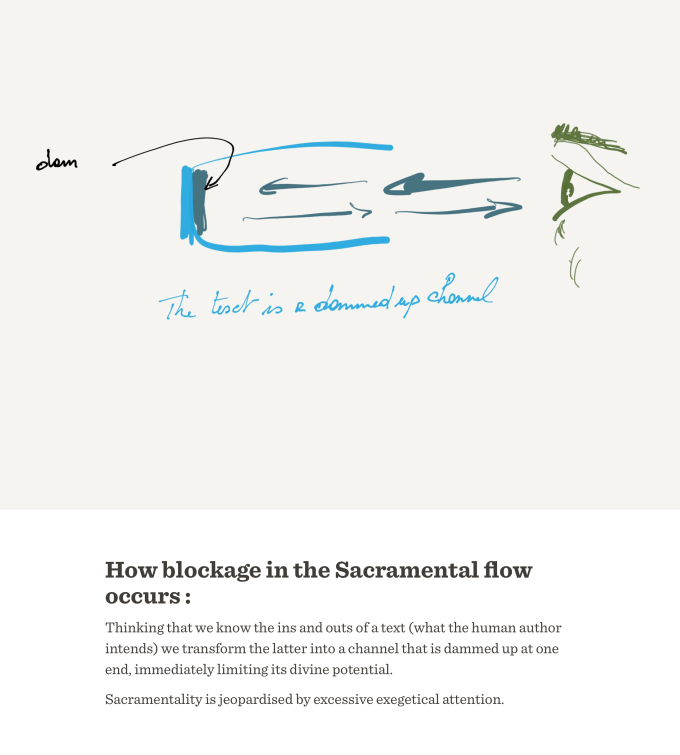
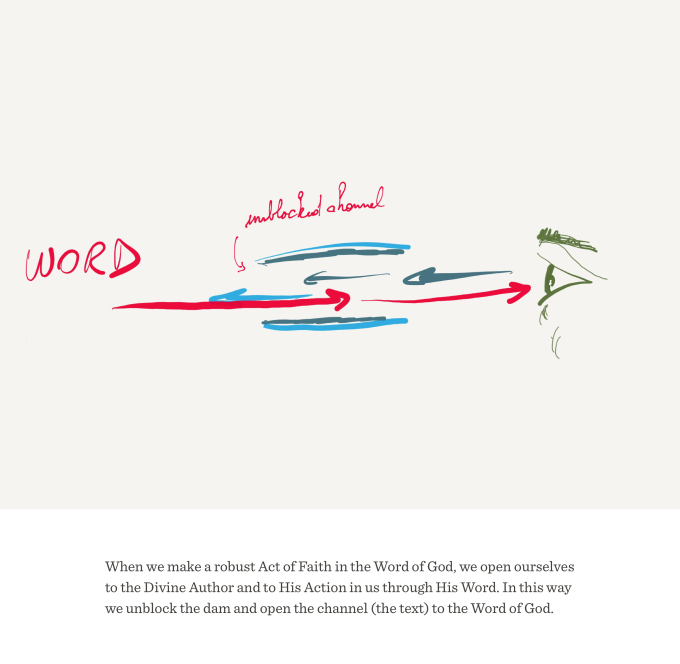
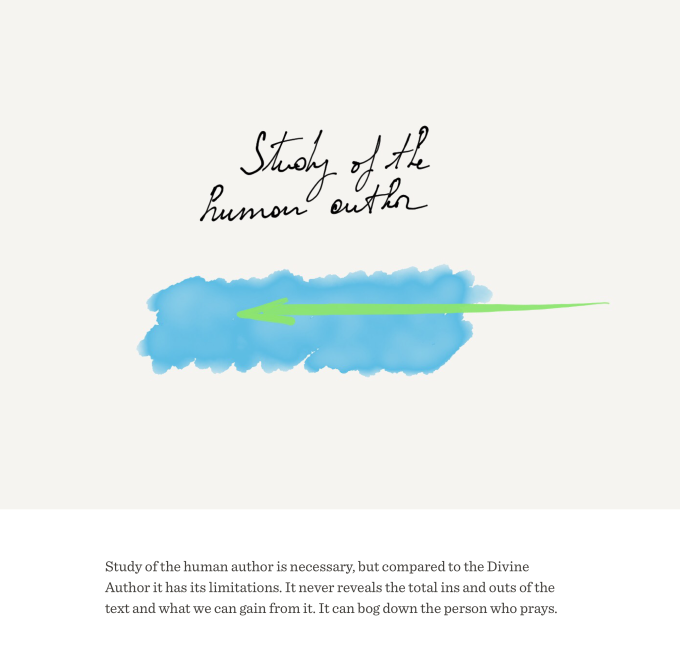
The pitfall that any believer can fall into is to reduce or transform the operation of listening (manducatio) into the first operation: understanding the text, and extracting from it all that a serious intelligent study can offer. After completing this first action and thinking that he knows by then the ins and outs of the text, he or she will hit the "bottom" of the Word (see drawing)... will block the Sacramental operation, will make the text opaque and not transparent.
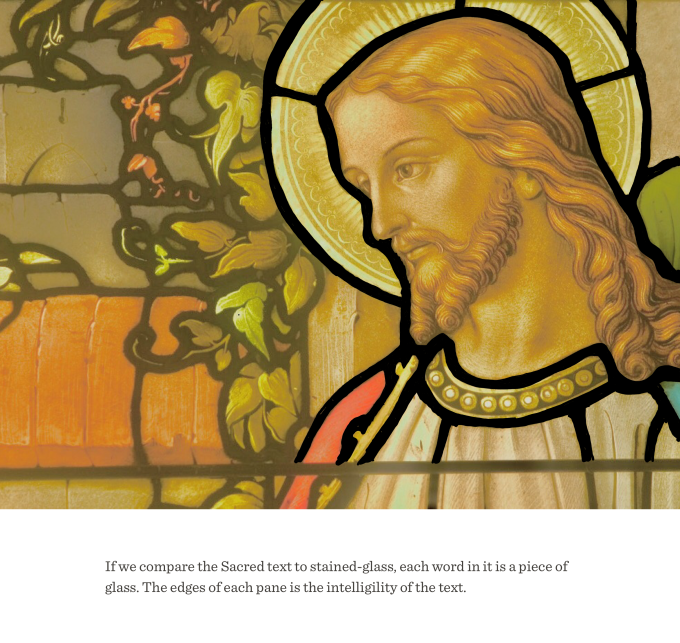
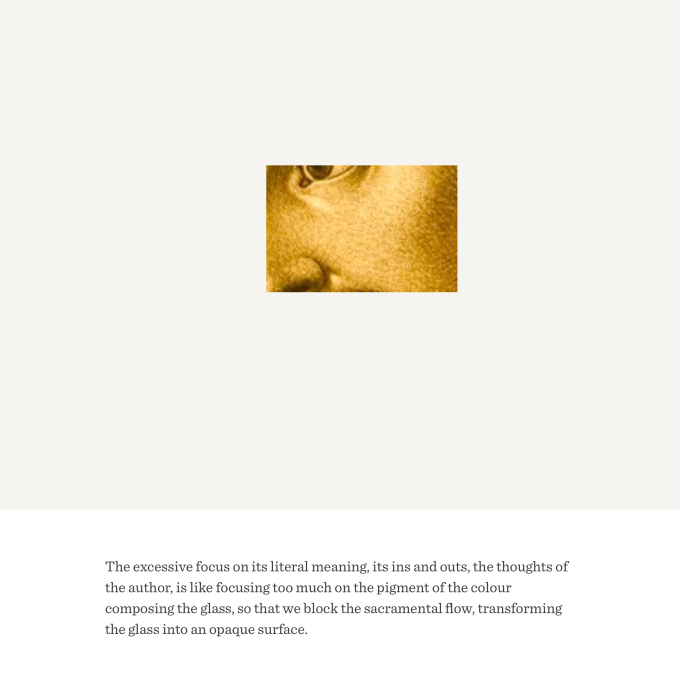
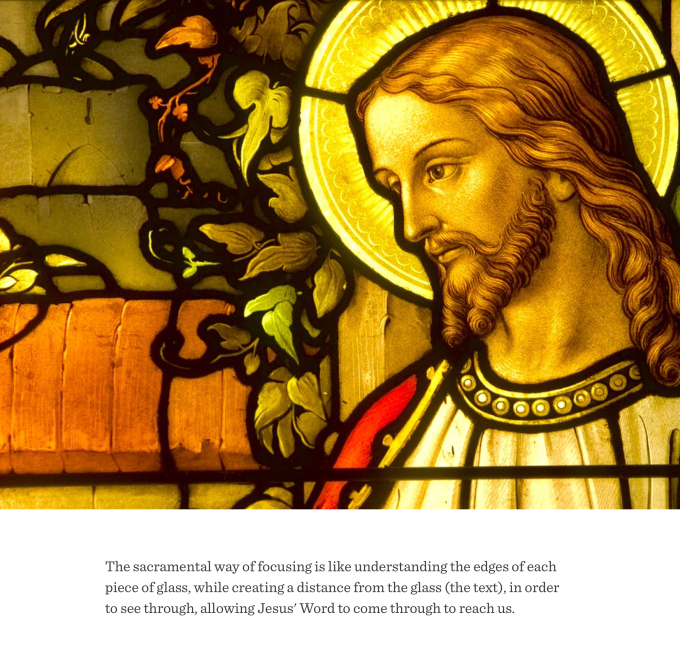
If we were to use the image of stained glass, we can say that focusing on the strictly literal meaning, thinking that we possess the ins and outs of it, is like focusing only on the pigment of a pane of stained glass. There is no vision of the essence of the stained glass, there is no vision of the light that comes through it. The excessive focus only on the stained glass itself, the closeness of our attention to it, makes it paradoxically opaque. It ends up by blocking the Word that comes from God through the literal meaning of the text.

The study of the text in this way, the study of the human author instead of remaining open to God, to the Divine Author, imprisons the human understanding of it, enclosing the text in the human comprehension of the mind. It puts the Divine Author into the shade and makes Him vanish. The sacred operation of listening, ingesting the Word ,cannot take place.
Thus the act of faith in the Word is improperly done, it ends at the bottom of the text instead of ending at Jesus' Mouth so to speak.

Catholic Theory of Inspiration

Here is the correct expression of the catholic theory of inspiration: "For, by supernatural power, He so moved and impelled them to write - He was so present to them - that the things which He ordered, and those only, they, first, rightly understood [use of the mind], then willed faithfully [use of the will] to write down, and finally expressed [art of expressing] in apt words and with infallible truth. Otherwise, it could not be said that He was the Author of the entire Scripture." (Pope Leo XIII, "Providentissimus Deus", 20) It is because the Holy Spirit was capable of elevating their minds and moving them, moving their will, helping them in the art of choosing, that God is the Author.

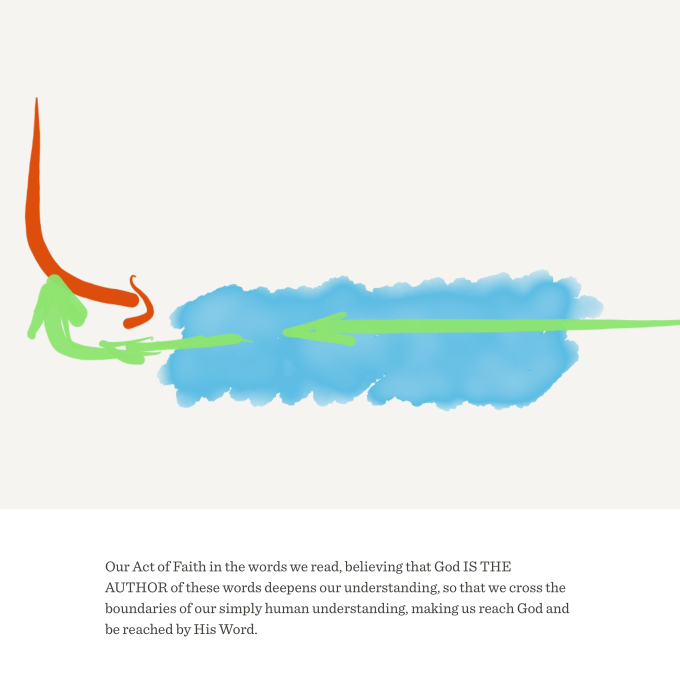
If we understand properly the catholic theory of inspiration, we will understand how the Holy Spirit inspired the human authors, guided their minds to choose the words He wanted, moved their wills to choose them and help their judgement, to choose the words and only those words that God wanted. Understanding properly how God is the Real Main author of the Bible and in which exact sense the human author is author, is to see the exact interaction between the Holy Spirit and the different faculties of the human author, to adjust thoroughly our act of faith in the Word of God that we read, and to show us how it is as bottomless as stained glass is. It shows the exact perspective from which the study of the human author must be viewed as this will determine the contours of the Word of God, and will avoid the “bottom” or basic meaning (see drawing below). In sum, if we study the limits of each piece of the stained glass we are in fact studying its human expression. But it is God from within, or the light from behind, that illumines the Text, makes it alive, makes it Sacramental, ie. under the Power of the Action of the Holy Spirit, here and now, every time the Sacrament is given (every time the Word is proclaimed and afterward “manducated” during Lectio Divina).

Conclusion

When practising Lectio Divina, we need first to understand the text, and we cannot avoid this step. The material aspect of the Word, the text, the material aspect of the Sacrament has to be laid down, explained, understood.
As a second stage, one has to allow a sacramental "distance" with the Text in order to listen through/to, to read through it, exactly as we would do with a beautiful pane of stained glass. After having contemplated the beauty of the craftsmanship, we will need to go back a few meters, lift our gaze to the entire stained glass window and see through it the light, the reflections that it offers to the Divine Light of the Risen Lord. Only under these conditions can the Lord talk to us.

Our Act of Faith in the Word we read could be weakened by attending at length to the exegetical explanations offered by serious studies. We could then have the impression of understanding the text, its ins and outs, and end up by hitting an opaque wall (the bottom of the Sacred Text) instead of renewing our Act of Faith in the Fact that these Words are inspired by God and that therefore their limits are God's limits, that their "bottom" so to speak is God himself, Jesus himself who inspired them and who wants to talk to us.
We are therefore invited to go from, first, a human understanding (at most with the general help of the Light of Faith) to a divine knowledge directly and personally given to us by the Holy Spirit, here and now, that does not come to us aside from the letter of the text, but through it, exactly as the Light does with the Stained Glass. The correct sacramental balance here between the Letter and the Spirit, between the limits that the letter offers (only a contour) and the amazing new depths that God can offer to it here and now, is achieved!

It is never a choice between the Letter and the Spirit. It is a choice not to remain imprisoned in the letter, but seeing that the letter has an opening toward God, allowing the Risen Lord here and now to talk to us.
It is never a matter of twisting the letter to our liking. It is never taking under our control the letter, trying to guess what the Lord wants to say. It is about doing a vigorous act of Faith in God who inspired this letter, and who is present here and now and capable to make it alive today in a unique way, so it becomes real food for all of our being and not a purely intellectual endeavour.

As we can see, the correct understanding of the catholic theory/notion of inspiration with its delicate divine vertical balance between the Divine Author and the human author, offers the only way for a Sacramental Manducation of the Word of God.


If any of the authors is misunderstood, or if the relationship between the two authors is misunderstood, our act of Faith during the Proclamation of the Word and during the Lectio Divina Manducation will be blocked and the Grace of God will not be "triggered" and will definitely not come through.

file_000
file_003
file_001
file_002
file_004
file_005
file_006
file_007

Sunday, 4 January 2015

117: Examining our conscience with the Pope

The 22nd of December, the Pope addressed the Curia (all who work in the Vatican Offices) with a very clear cleansing purifying message, denouncing the existence of 15 sins, bad habits, bad spirits. Not 7, but 15...!
It is a very bold but healthy step. We can only rejoice because of it. But while reading this discourse the first temptation is to think this is only addressed to the Curia. In fact it is valid for all the clergy as well. Second temptation is to forget to pray for Priests. The Pope addresses this point. The third temptation is to forget the most powerful (spiritually powerful) function in the Church: Consecrated People (Monks, Nuns, Religious,...), and this is valid as well for them. The fourth temptation is to think that this analysis is only valid for the persons mentioned above and not for the rest of the Church: lay people. So let us re-read the Pope's words, and think that they are addressed to us (especially all lay persons who work in different ministries (catechesis, Evangelisation,...)). Here it is:


To the Roman Curia on the occasion of the presentation of Christmas greetings (22 December 2014)


PRESENTATION OF THE CHRISTMAS GREETINGS TO THE ROMAN CURIA

ADDRESS OF HIS HOLINESS POPE FRANCIS

Clementine Hall

Monday, 22 December 2014


THE ROMAN CURIA AND THE BODY OF CHRIST

“You are higher than the cherubim,
you who changed the pitiful plight of the world
when you became like one of us”
(Saint Athanasius)


Dear Brothers and Sisters,

At the end of Advent, we meet for our traditional greetings. In a few days we will have the joy of celebrating the birth of the Lord: the event of God who became man in order to save us; the manifestation of the love of God who does not just give us something, or send us a message or a few messengers, but gives us himself; the mystery of God who took upon himself our humanity and our sins in order to reveal his divine life, his immense grace and his freely-given forgiveness. It is our encounter with God who is born in the poverty of the stable of Bethlehem in order to teach us the power of humility. For Christmas is also the feast of the light which is not received by the “chosen”, but by the poor and simple who awaited the salvation of the Lord.

Before all else, I would like to offer all of you – co-workers, brothers and sisters, papal representatives throughout the world, and all your dear ones – my prayerful good wishes for a holy Christmas and a happy New Year. I want to thank you most heartily for your daily commitment in the service of the Holy See, the Catholic Church, the particular Churches and the Successor of Peter.

Since we are persons and not numbers or mere titles, I would mention in a particular way those who in the course of this year concluded their service for reasons of age, or the assumption of new duties, or because they were called to the house of the Father. My thoughts and my gratitude go to them and to their families.

Together with you, I want to lift up to the Lord a lively and heartfelt thanksgiving for the year now ending, for all we have experienced, and for all the good which he has graciously willed to accomplish through our service of the Holy See, while at the same time humbly begging his forgiveness for our failings committed “in our thoughts and words, in what we have done and what we have failed to do”.

Taking this request for forgiveness as my starting point, I would like this meeting and the reflections which I will now share with you to be for all of us a help and a stimulus to a true examination of conscience, in order to prepare our hearts for the holy feast of Christmas.

As I thought about this meeting, there came to mind the image of the Church as the Mystical Body of Jesus Christ. This is an expression which, as Pope Pius XII explained, “springs up and in some way blossoms from the frequent teaching of sacred Scripture and the Fathers of the Church”.[1] As Saint Paul wrote: “For just as the body is one and has many members, and all the members of the body, though many, are one body, so it is with Christ” (1 Cor 12:12).[2]

The Second Vatican Council thus recalls that “a diversity of members and functions is engaged in the building up of Christ’s body too, There is only one Spirit who, out of his own richness and the needs of the ministries, gives his various gifts for the welfare of the Church (cf. 1 Cor 12:1-11).[3] As a result, “Christ and the Church together make up the ‘whole Christ’ (Christus totus). The Church is one with Christ”.[4]

It is attractive to think of the Roman Curia as a small-scale model of the Church, in other words, as a “body” which strives seriously every day to be more alive, more healthy, more harmonious and more united in itself and with Christ.

In fact, though, the Roman Curia is a complex body, made up of a number of Congregations, Councils, Offices, Tribunals, Commissions, as of numerous elements which do not all have the same task but are coordinated in view of an effective, edifying, disciplined and exemplary functioning, notwithstanding the cultural, linguistic and national differences of its members.[5]

However, since the Curia is a dynamic body, it cannot live without nourishment and care. In fact, the Curia – like the Church – cannot live without a vital, personal, authentic and solid relationship with Christ.[6] A member of the Curia who is not daily nourished by that Food will become a bureaucrat (a formalist, a functionalist, a mere employee): a branch which withers, slowly dies and is then cast off. Daily prayer, assiduous reception of the sacraments, particularly the Eucharist and Reconciliation, daily contact with the word of God and a spirituality which translates into lived charity – these are vital nourishment for each of us. Let it be clear to all of us that apart from him we can do nothing (cf. Jn 15:8).

As a result, a living relationship with God also nourishes and strengthens our communion with others. In other words, the more closely we are joined to God, the more we are united among ourselves, since the Spirit of God unites and the spirit of evil divides.

The Curia is called constantly to improve and to grow in communion, holiness and wisdom, in order to carry out fully its mission.[7] And yet, like any body, like any human body, it is also exposed to diseases, malfunctioning, infirmity. Here I would like to mention some of these probable diseases, “curial diseases”. They are the more common diseases in our life in the Curia. They are diseases and temptations which weaken our service to the Lord. I think a “listing” of these diseases – along the lines of the Desert Fathers who used to draw up such lists – will help us to prepare for the sacrament of Reconciliation, which will be a good step for all of us to take in preparing for Christmas.

1. The disease of thinking we are “immortal”, “immune” or downright “indispensable”, neglecting the need for regular check-ups. A Curia which is not self-critical, which does not keep up with things, which does not seek to be more fit, is a sick body. A simple visit to the cemetery might help us see the names of many people who thought they were immortal, immune and indispensable! It is the disease of the rich fool in the Gospel, who thought he would live forever (cf. Lk 12:13-21), but also of those who turn into lords and masters, and think of themselves as above others and not at their service. It is often an effect of the pathology of power, from a superiority complex, from a narcissism which passionately gazes at its own image and does not see the image of God on the face of others, especially the weakest and those most in need.[8] The antidote to this plague is the grace of realizing that we are sinners and able to say heartily: “We are unworthy servants. We have only done what was our duty” (Lk 17:10).

2. Another disease is the “Martha complex”, excessive busy-ness. It is found in those who immerse themselves in work and inevitably neglect “the better part”: sitting at the feet of Jesus (cf. Lk 10:38-42). Jesus called his disciples to “rest a while” (cf. Mk 6:31) for a reason, because neglecting needed rest leads to stress and agitation. A time of rest, for those who have completed their work, is necessary, obligatory and should be taken seriously: by spending time with one’s family and respecting holidays as moments of spiritual and physical recharging. We need to learn from Qohelet that “for everything there is a season” (3:1-15).

3. Then too there is the disease of mental and spiritual “petrification”. It is found in those who have a heart of stone, the “stiff-necked” (Acts 7:51-60), in those who in the course of time lose their interior serenity, alertness and daring, and hide under a pile of papers, turning into paper pushers and not men of God (cf. Heb 3:12). It is dangerous to lose the human sensitivity that enables us to weep with those who weep and to rejoice with those who rejoice! This is the disease of those who lose “the sentiments of Jesus” (cf. Phil 2:5-11), because as time goes on their hearts grow hard and become incapable of loving unconditionally the Father and our neighbour (cf. Mt 22:34-35). Being a Christian means “having the same sentiments that were in Christ Jesus” (Phil 2:5), sentiments of humility and unselfishness, of detachment and generosity.[9]

4. The disease of excessive planning and of functionalism. When the apostle plans everything down to the last detail and believes that with perfect planning things will fall into place, he becomes an accountant or an office manager. Things need to be prepared well, but without ever falling into the temptation of trying to contain and direct the freedom of the Holy Spirit, which is always greater and more flexible than any human planning (cf. Jn 3:8). We contract this disease because “it is always more easy and comfortable to settle in our own sedentary and unchanging ways. In truth, the Church shows her fidelity to the Holy Spirit to the extent that she does not try to control or tame him… to tame the Holy Spirit! … He is freshness, imagination, and newness”.[10]

5. The disease of poor coordination. Once its members lose communion among themselves, the body loses its harmonious functioning and its equilibrium; it then becomes an orchestra which produces noise: its members do not work together and lose the spirit of fellowship and teamwork. When the foot says to the arm: “I don't need you ”, or the hand says to the head, “I’m in charge”, they create discomfort and scandal.

6. There is also a “spiritual Alzheimer’s disease”. It consists in losing the memory of our personal “salvation history”, our past history with the Lord and our “first love” (Rev 2:4). It involves a progressive decline in the spiritual faculties which in the long or short run greatly handicaps a person by making him incapable of doing anything on his own, living in a state of absolute dependence on his often imaginary perceptions. We see it in those who have lost the memory of their encounter with the Lord; in those who no longer see life’s meaning in “deuteronomic” terms; in those who are completely caught up in the present moment, in their passions, whims and obsessions; in those who build walls and routines around themselves, and thus become more and more the slaves of idols carved by their own hands.

7. The disease of rivalry and vainglory.[11] When appearances, the colour of our clothes and our titles of honour become the primary object in life, we forget the words of Saint Paul: “Do nothing from selfishness or conceit but in humility count others better than yourselves. Let each of you look not only to his own interests, but also to the interests of others” (Phil 2:3-4). This is a disease which leads us to be men and woman of deceit, and to live a false “mysticism” and a false “quietism”. Saint Paul himself defines such persons as “enemies of the cross of Christ” because “they glory in their shame, with minds set on earthly things” (Phil 3:19).

8. The disease of existential schizophrenia. This is the disease of those who live a double life, the fruit of that hypocrisy typical of the mediocre and of a progressive spiritual emptiness which no doctorates or academic titles can fill. It is a disease which often strikes those who abandon pastoral service and restrict themselves to bureaucratic matters, thus losing contact with reality, with concrete people. In this way they create their own parallel world, where they set aside all that they teach with severity to others and begin to live a hidden and often dissolute life. For this most serious disease conversion is most urgent and indeed indispensable (cf. Lk 15:11-32).

9. The disease of gossiping, grumbling and back-biting. I have already spoken many times about this disease, but never enough. It is a grave illness which begins simply, perhaps even in small talk, and takes over a person, making him become a “sower of weeds” (like Satan) and in many cases, a cold-blooded killer of the good name of our colleagues and confrères. It is the disease of cowardly persons who lack the courage to speak out directly, but instead speak behind other people’s backs. Saint Paul admonishes us to do all things without grumbling or questioning, that you may be blameless and innocent” (Phil 2:14-15). Brothers, let us be on our guard against the terrorism of gossip!

10. The disease of idolizing superiors. This is the disease of those who court their superiors in the hope of gaining their favour. They are victims of careerism and opportunism; they honour persons and not God (cf. Mt 23:8-12). They serve thinking only of what they can get and not of what they should give. Small-minded persons, unhappy and inspired only by their own lethal selfishness (cf. Gal 5:16-25). Superiors themselves could be affected by this disease, when they court their collaborators in order to obtain their submission, loyalty and psychological dependency, but the end result is a real complicity.

11. The disease of indifference to others. This is where each individual thinks only of himself and loses sincerity and warmth of human relationships. When the most knowledgeable person does not put that knowledge at the service of his less knowledgeable colleagues. When we learn something and then keep it to ourselves rather than sharing it in a helpful way with others. When out of jealousy or deceit we take joy in seeing others fall instead of helping them up and encouraging them.

12. The disease of a lugubrious face. Those glum and dour persons who think that to be serious we have to put on a face of melancholy and severity, and treat others – especially those we consider our inferiors – with rigour, brusqueness and arrogance. In fact, a show of severity and sterile pessimism[12] are frequently symptoms of fear and insecurity. An apostle must make an effort to be courteous, serene, enthusiastic and joyful, a person who transmits joy everywhere he goes. A heart filled with God is a happy heart which radiates an infectious joy: it is immediately evident! So let us not lose that joyful, humorous and even self-deprecating spirit which makes people amiable even in difficult situations.[13] How beneficial is a good dose of humour! We would do well to recite often the prayer of St. Thomas More.[14] I say it every day, and it helps.

13. The disease of hoarding. When an apostle tries to fill an existential void in his heart by accumulating material goods, not out of need but only in order to feel secure. The fact is that we are not able to bring material goods with us, since “the winding sheet does not have pockets”, and all our earthly treasures – even if they are gifts – will never be able to fill that void; instead, they will only make it deeper and more demanding. To these persons the Lord repeats: “You say, I am rich, I have prospered and I need nothing; not knowing that you are wretched, pitiable, poor, blind and naked. So be zealous and repent” (Rev 3:17, 19). Accumulating goods only burdens and inexorably slows down the journey! Here I think of an anecdote: the Spanish Jesuits used to describe the Society of Jesus as the “light brigade of the Church”. I remember when a young Jesuit was moving, and while he was loading a truck full of his many possessions, suitcases, books, objects and gifts, an old Jesuit standing by was heard to say with a smile: And this is “the light brigade of the Church”? Our moving can be a sign of this disease.

14. The disease of closed circles, where belonging to a clique becomes more powerful than belonging to the Body and, in some circumstances, to Christ himself. This disease too always begins with good intentions, but with the passing of time it enslaves its members and becomes a cancer which threatens the harmony of the Body and causes immense evil – scandals – especially to our weaker brothers and sisters. Self-destruction, “friendly fire” from our fellow soldiers, is the most insidious danger.[15] It is the evil which strikes from within;[16] and, as Christ says: “Every kingdom divided against itself is laid waste” (Lk 11:17).

15. Lastly: the disease of worldly profit, of forms of self-exhibition.[17] When an apostle turns his service into power, and his power into a commodity in order to gain worldly profit or even greater power. This is the disease of persons who insatiably try to accumulate power and to this end are ready to slander, defame and discredit others, even in newspapers and magazines. Naturally, so as to put themselves on display and to show that they are more capable than others. This disease does great harm to the Body because it leads persons to justify the use of any means whatsoever to attain their goal, often in the name of justice and transparency! Here I remember a priest who used to call journalists to tell – and invent – private and confidential matters involving his confrères and parishioners. The only thing he was concerned about was being able to see himself on the front page, since this made him feel “powerful and glamorous”, while causing great harm to others and to the Church. Poor sad soul!

Brothers, these diseases and these temptations are naturally a danger for each Christian and for every curia, community, congregation, parish and ecclesial movement; and they can strike at the individual and the community levels.

We need to be clear that it is only the Holy Spirit who can heal all our infirmities. He is the soul of the Mystical Body of Christ; as the Nicene-Constantinopolitan Creed says: “I believe in the Holy Spirit, Lord and Giver of Life”. It is the Holy Spirit who sustains every sincere effort at purification and in every effort at conversion. It is he who makes us realize that every member participates in the sanctification of the Body and its weakening. He is the promoter of harmony:[18] Ipse harmonia est”, as Saint Basil says. Saint Augustine tells us that “as long as a member is still part of the body, its healing can be hoped for. But once it is removed, it can be neither cured nor healed”.[19]

Healing also comes about through an awareness of our sickness and of a personal and communal decision to be cured by patiently and perseveringly accepting the remedy.[20]

And so we are called – in this Christmas season and throughout our time of service and our lives – to live “in truth and love, we must grow up in every way into him who is the head, into Christ, from whom the whole body, joined and knit together by every ligament with which it is equipped, as each part is working properly, promotes the body’s growth in building itself up in love (Eph 4:15-16).

Dear brothers!

I read once that priests are like planes: they only make news when they crash, even though so many of them are in the air. Many people criticize, and few pray for them. It is a very touching, but also very true saying, because it points to the importance and the frailty of our priestly service, and how much evil a single priest who “crashes” can do to the whole body of the Church.

Therefore, so as not to fall in these days when we are preparing ourselves for Confession, let us ask the Virgin Mary, Mother of God and Mother of the Church, to heal the wounds of sin which each of us bears in his heart, and to sustain the Church and the Curia so that they can be healthy and health-giving; holy and sanctifying, to the glory of her Son and for our salvation and that of the entire world. Let us ask her to make us love the Church as Christ, her Son and our Lord, loves her, to have the courage to acknowledge that we are sinners in need of his mercy, and not to fear surrendering our hands into her maternal hands.

I offer cordial good wishes for a holy Christmas to all of you, to your families and your co-workers. And please, do not forget to pray for me! Heartfelt thanks!

[1] He states that the Church, being mysticum Corpus Christi, “calls also for a multiplicity of members, which are linked together in such a way as to help one another. As in the body, when one member suffers, all the other members share its pain, and the healthy members come to the aid of the ailing, so in the Church the individual members do not live for themselves alone, but also help their fellows, and all work in mutual collaboration for the common comfort and for the more perfect building up of the whole Body… a Body not formed by a haphazard grouping of members, but… constituted of organs, that is of members, that have not the same function and are arranged in due order; so for this reason above all the Church is called a body, that it is constituted by the coalescence of structurally united parts” (Encyclical Mystici Corporis, Part One: AAS 35 [1943], 200; ed. Carlen, Nos. 15-16)

[2] Cf. Rom 12:5: “So we, though many, are one body in Christ, and individually members of one another”.

[3] Dogmatic Constitution Lumen Gentium, 7.

[4] It should be remembered that “the comparison of the Church with the body casts light on the intimate bond between Christ and his Church. Not only is she gathered around him; she is united in him, in his body. Three aspects of the Church as the body of Christ are to be more specifically noted: the unity of all her members with each other as a result of their union with Christ; Christ as the head of the body; and the Church as bride of Christ. Cf. Catechism of the Catholic Church, Nos. 789 and 795.

[5] Cf. Evangelii Gaudium, 130-131.

[6] Jesus often spoke of the union which the faithful should have with him: “As the branch cannot bear fruit by itself, unless it abides in the vine, neither can you, unless you abide in me” (Jn 15:4-5).

[7] Cf. Pastor Bonus, Art. 1 and CIC can. 360.

[8] Cf. Evangelii Gaudium, 197-201.

[9] Benedict XVI, General Audience, 1 June 2005.

[10] Francis, Homily at Mass in Turkey, 29 November 2014.

[11] Cf. Evangelii Gaudium, 95-96.

[12] Ibid., 84-86.

[13] Ibid., 2

[14] “Grant me, O Lord, good digestion, and also something to digest. Grant me a healthy body, and the necessary good humour to maintain it. Grant me a simple soul that knows to treasure all that is good and that doesn’t frighten easily at the sight of evil, but rather finds the means to put things back in their place. Give me a soul that knows not boredom, grumbling, sighs and laments, nor excess of stress, because of that obstructing thing called ‘I’. Grant me, O Lord, a sense of good humour. Allow me the grace to be able to take a joke and to discover in life a bit of joy, and to be able to share it with others”.

[15] Evangelii Gaudium, 88.

[16] Blessed Paul VI, referring to the situation of the Church stated that he had the feeling that “through some crack, the smoke of Satan has entered the temple of God”: Homily for the Solemnity of Saints Peter and Paul (29 June 1972); cf. Evangelii Gaudium, 98-101.

[17] Cf. Evangelii Gaudium, 93-97.

[18] “The Holy Spirit is the soul of the Church. He gives life, he brings forth different charisms which enrich the people of God and, above all, he creates unity among believers: from the many he makes one body, the Body of Christ… The Holy Spirit brings unity to the Church: unity in faith, unity in love, unity in interior cohesion” (Homily at Holy Mass in Turkey, 29 November 2014).

[19] Augustine, Sermo CXXXVII, 1 (PL 38, 754).

[20] Cf. Evangelii Gaudium, 25-33.

Monday, 29 September 2014

115: The Angels and the Word of God

We imagine the invisible world as having God (the Father, Jesus, and the Holy Spirit) and the Saints. Seeing the Saints as friends, filled with the love of Jesus, we understand that their friendship, prayer and help doesn't stop with their death.
Sometimes we tend to forget the existence of the Angels, with all their grades, while in fact they have a very important and constant role to play in our life and salvation. If you want to remove the Angels, then not only will you have to remove large portions of the Scriptures and Tradition, but as well, many things will be lacking.
We think that during our prayer the interaction is only about God and us. Our understanding of prayer and “intimacy” with God is thought of as something of a silent and empty world, which only God and us inhabit. Significantly, however, Zachariah was at Prayer when God sent him his Messenger, GABRIEL. Similarly Mary was very probably at Prayer when God sent her his Messenger, GABRIEL.
Intimacy with God is often seen as something exclusive. However, Saint John of the Cross gives us an important answer to this question (in the Spiritual Canticle):

1- The Angels will always continue to be present in our lives, from day one, till the last day, so it is better to pay attention to this spiritual Friend, sent by God to help us and protect us. If you doubt this, you can contemplate Jesus himself, who is in His Human Nature Holy, the Holiest, and see how the Angels are present ans serve and help him (when He is tempted in the Desert, and when He prays in the Garden before his Passion). Are we better than Jesus? Stronger than Jesus? More intimate with God the Father than the Son Incarnate? So, keep this in mind, you will have them and need them. Your Master did, as a man, so you will have to.. with all the more reason.

2- Saint John of the Cross says (in the Spiritual Canticle) that the Angels play an important role in the long first stage of Spiritual Life Growth. They Transmit to us God's Messages, God's Word. Do you have doubts about this? Well remember what Gabriel says about himself and what Elisabeth says about Mary:
“I am Gabriel, who stands in the presence of God, and was sent to speak to you and bring you these glad tidings. But behold, you will be mute and not able to speak until the day these things take place, because you did not believe my words which will be fulfilled in their own time.” (Luke 1:19-20)
“Blessed is she who believed, for there will be a fulfilment of those things [words] which were told her from the Lord.” (Luke 1:45)
We see, then, that a Messenger is a being who transmits a Message, in our case, a Word from God. He carries something that doesn't belong to him, something sacred. This is what you see in the first quote from St Luke: Gabriel makes it clear: he is not doing something on his own, of his own personal private initiative: He is Standing in Front of God. No games, no tricks, this is SERIOUS. He is not doing or transmitting anything that is not From God, willingly sent by God himself. So the respect you owe to the Sender (God) is the same respect you owe to the Message his messenger is sending according to His order. This is why St Thomas Aquinas, in his Summa Theologica, says that this is the way God governs the world: He sends orders, He sends Messengers, and they execute his orders. He uses myriads of Angels to govern the world. So, there is nothing wrong in considering that the Angels are God's Messengers, God's Transmitters. This is the meaning of the word Angel: messenger.
“Behold, I send an Angel before you to keep you in the way and to bring you into the place which I have prepared. Beware of Him and obey His voice; do not provoke Him, for He will not pardon your transgressions; for My name is in Him. But if you indeed obey His voice and do all that I speak, then I will be an enemy to your enemies and an adversary to your adversaries. For My Angel will go before you […].” (Exodus 23:20-23)
But, when the spiritual person is growing, you reach a point where two things happen at the same time: one may confuse the messenger with the Sender, and the Message itself needed is becoming of greater significance. This is why St John of the Cross says to God at that spiritual juncture: “stop sending me Messengers of your beauty, the one I need is you Jesus”. It doesn't mean that from day one the Messengers are not serving this purpose. Not at all. It means only that the growth of the Soul, and the possible confusion this produces, make the Soul become wider and wider, more thirsty, and make her shout loudly: I want more, and the One I want is you Jesus.
As we said above, this doesn't mean that the person, now reaching a new step in her growth, will then forget completely about the Angels; no. It is just means a huge step forward is being taken. Remember as well, in order to be faithful to St John of the Cross, he thought that he was asking God not only to stop “fooling” him with smaller “messengers of his beauty” like Angels, but he mentions as well Nature, as a Messenger of God's beauty. You can apply this distinction and desire for Christ himself and His entirety to everything (think of the small things we stop to look at sometimes in the Bible, while at a certain point the soul is that purified and ready that its thirst for Christ becomes huge: thirst for Christ in a new way, i.e. in His entirety).
Small words (like crumbs) now are not enough, the soul wants THE WORD of GOD Incarnate: Jesus.

Now, let us remain in the long first stage of spiritual life (in the majority of persons is takes sadly years, and very few cross it, not that God doesn't want this to happen, but the “engines” that push for growth aren not well known and used): God Messengers are conveying to us His Word. Of course with the Holy Spirit.

Don't you think that like the word of God we have words that are not from God? The Word of God carries Divine Life, the Holy Spirit. The words that don't come from God, are carrying death, the reduction/shrinking, of our being. These words exist. There are hardly any neutral words. And if there are, they reduce our being to a small object of consideration. Take Science for example: Science is science, it is rampant, it doesn't fly to God. It needs God to open our soul, so that Science becomes the sign of a bigger Being. Science then belongs to a different level of contemplation! One has to go from it, and be elevated by God, in order to be able to see the beauty of God in it. This is illustrates the neutral words one can meet in one's life.
What about the rest of the words that nourish our mind, will, heart and freedom everyday? What about the words that shape our decisions everyday? From where do they come? Are they all from God?

Let us remember that we have three sources of words that are NOT Divine Life and Holy Spirit. Those sources are very well present to us, often unconsciously, but very well acting in us.
1- The world, 2- the flesh, and 3- the Devil/Satan and his angels. The three of them convey to us words, constantly, often unconsciously, but efficiently, and bear their fruits in us, through us.
These are three messengers, carriers, of words that are not Life and Spirit, Divine Life, and Holy Spirit.

As we acknowledge the existence of Angels, as Messengers of God, daily carriers of His Words, we have to acknowledge the existence of three other carriers, who carry other words, that are very bad, carrying death, death of our mind, death of our will, making us shrink more and more, and fall into darker areas. Mind you, sometimes we are so used to those words coming from the world, the flesh, and the devil, that we are not aware anymore about what the Light is and what difference it makes. We get used to the darkness and to its light. It is like when you go out dancing: you are in a big room, that is dark, full of loud noise, and you spend hours there, and you are not aware at all of what is happening to you. On the contrary, you call this life, fun, entertainment! Well, for a while!

So, let us become more aware of these different messengers, and let us become aware of the words they send us. Let us open our minds to a deeper and more differentiated way to understand the word: “words”. What is that food that we feed our souls with? Are they good or poisonous? It is exactly like certain things we eat: we find the taste delicious but when we read about the ingredients, we find that a lot of will power is needed to decide to overcome that fake artificial taste and attraction to it, in order to refrain from that “rubbish” that you are eating and “liking”.
Yes it requires awareness, Grace of God, to stop eating dead words, and turn to God, and listen to His Messengers, and to the Message, Divine Word, they carry to you.

I am sure “you are with me”! Let us pray for each other, let us choose our friends, let the choice fall on the ones who took the determined decision to seek the Divine Words, that give Divine Life. Are you ProDivineLife? Are you ProDivineWords?

Let us pray for each other, let us ask the Prayers of the Angels, let us be attentive to their Constant Presence and service to our soul, searching our Good all the time, always available to help and rejoicing when we turn, determined, to God, and God's Words.


St. Padre Pio
Prayer to the Guardian Angel


"O Holy Guardian Angel,
take care of my soul and my body.

Enlighten my mind to know the Lord better

and love Him with all my heart.

Assist me in my prayers to do not fall into distractions

but you keep the greatest attention.

Help me with your advice, to recognise the good and perform it with generosity.

Rescue me from the snares of the infernal enemy
and uphold me in temptations to always win them.

Replace me in my coldness while worshipping of the Lord:
not cease to attend to my custody

until you will bring me to Paradise,

where together we will praise the Good Lord for all eternity."