Showing posts with label Baptism. Show all posts
Showing posts with label Baptism. Show all posts
Sunday, 10 April 2016
Groundbreaking Course on the Sermon on the Mount


 Jean is a French Catholic Theologian, specialised in Spiritual Formation, with more than twenty-five years of experience with Consecrated and Lay people. He obtained his Bachelors in Philosophy and his Masters in Spiritual Theology from Toulouse (France), and the Teresianum (Rome). He is presently completing his Ph.D. in Spiritual Theology at the Angelicum (Rome). Jean’s formation was greatly enhanced by the discalced Carmelite Fathers.
He has lectured in Spiritual Theology in different universities with a practical focus. Many articles, studies and books have been published internationally. In 2003, Jean founded the "School of Mary" which offers formation in Spiritual Life, many video courses being available at www.schoolofmary.org . Lectio Divina and Contemplative Prayer are amongst the most important forms of prayer addressed.
Jean gives Spiritual Direction on a regular basis and also gives retreats. He is married, has a daughter and is based in London.
Jean is a French Catholic Theologian, specialised in Spiritual Formation, with more than twenty-five years of experience with Consecrated and Lay people. He obtained his Bachelors in Philosophy and his Masters in Spiritual Theology from Toulouse (France), and the Teresianum (Rome). He is presently completing his Ph.D. in Spiritual Theology at the Angelicum (Rome). Jean’s formation was greatly enhanced by the discalced Carmelite Fathers.
He has lectured in Spiritual Theology in different universities with a practical focus. Many articles, studies and books have been published internationally. In 2003, Jean founded the "School of Mary" which offers formation in Spiritual Life, many video courses being available at www.schoolofmary.org . Lectio Divina and Contemplative Prayer are amongst the most important forms of prayer addressed.
Jean gives Spiritual Direction on a regular basis and also gives retreats. He is married, has a daughter and is based in London.
Wednesday, 6 August 2014
114: Intercessory Prayer
Question:
If we are not to petition during the
Prayer of the Heart (PH) and Lectio Divina (LD),
when and how should intercessory prayer happen/take
place?
Answer:
As an allocated moment (time and
space), intercessory prayer should happen at
a
special
time, as a specific type of prayer. During Mass we have a time for
it,
as we do during
the Divine Office (I am sure that in our personal prayer as well we do pray for others).
Your
may ask the same question for other types of prayer as well: Prayer
of Praise
and Prayer
of Thanksgiving,
"when shall we say
them?".
Here
I
would like to explain more
clearly
the deep relationship between LD & PH on the
one hand and Intercessory Prayer on the other.
It
is important to remember that LD is a key unavoidable type of prayer
today. It is by
far
the most transformative type of prayer. Why? Because it allows a part
of Christ (today's part of Christ-Word Bread) to become incarnated in
us and transform us in Him. The more we are transformed in Christ the
more powerful
our intercession becomes (acts on God). Jesus explains the
relationship between Lectio Divina and the efficiency of our prayer
(which
has
been answered) in the Gospel of St John where He
says: if you do my Will (keep my commandments) ask me all what you
want (because you'll BE in my Name) and you will receive it, i.e. the
Father will grant it to you (see John 15:7).
If
LD is done properly, all its transformative power will be enacted.
Then PH becomes much more fruitful and even more transformative.
Otherwise, if you practise PH without LD, its transformative power is
dramatically
decreased.
Now
let us consider what happens during the PH. While we are
practising
the PH, the Power of the Holy Spirit is
working
in our depths and through us will help Lift
the entire World to God
the Father in the Son, through the Holy Spirit. This is done
automatically. The more we are transformed in Jesus, the better it
works -
automatically.
St Therese explains that wonderfully at
the end of her Manuscript C, in the Story
of the Soul.

She says:
"All the saints have understood
this, and more especially those who filled the world with the light
of the Gospel teachings. Was it not in prayer that St. Paul, St.
Augustine, St. John of the Cross, St. Thomas Aquinas, St. Francis,
St. Dominic, and so many other famous Friends of God have drawn
out this divine science which delights the greatest geniuses? A
scholar has said: “Give me a lever and a fulcrum and I will lift
the world.” What Archimedes was not able to obtain, for his request
was not directed by God and was only made from a material viewpoint,
the saints have obtained in all its fullness. The Almighty has given
them as fulcrum: HIMSELF ALONE; as lever: PRAYER which burns with a
fire of love. And it is in this way that they have lifted the world;
it is in this way that the saints still militant lift it, and that, until the end of time, the saints to come will lift it."
Intercessory
prayer has different levels of power and action. What is more
powerful than
to pray for somebody or - if it was given to you
by the grace of God
- to take this person and lift him/her to God and introduce him/her
into God's Fire of Love? Here St Therese presents to us the
most powerful version of Intercessory Prayer.
It
is a duty of love for us to pray for everybody. St Paul says that we
have to pray for one another all the time, without excluding any
other person. St James in the end of his Letter, mentioning the
Prophet Elijah speaks about the power of a prayer that is
heard/answered by God. This should grab
our attention and invite us to deepen our understanding of
Intercessory Prayer.
In
addition,
one has to remember the relationship between Intercessory Prayer and
the Priesthood of the Faithful. A Priest "prays for"
others, like St Paul invites us to do all the time. (This is why we
have the Divine Office. But it is something that becomes second
nature to us, it is part of the "fabric" of the New
Creature that we become in Christ. Being "in Christ" makes
the Fire of the Holy Spirit that dwells in Him, pray in us and
through us. The Holy Spirit knows how to pray and knows
what we should ask for, and the way God wants it. What depends on us
is not to pay attention to all that multiplicity of things to pray
for. Our duty is just to get closer and closer to Jesus and to the
Fire of His Love and be transformed by IT.
St Therese developed those important questions in two different places in that same Manuscript C, in the Story of the Soul:
"Since I have two brothers and my
little Sisters, the novices, if I wanted to ask for each soul what
each one needed and go into detail about it, the days would not be
long enough and I fear I would forget something important. For simple
souls there must be no complicated ways; as I am of their number, one
morning during my thanksgiving, Jesus gave me a simple means of
accomplishing my mission.
He made me [34r°] understand these
words of the Canticle of Canticles: “DRAW ME, WE SHALL RUN after
you in the odour of your ointments.” O Jesus, it is not even
necessary to say: “When drawing me, draw the souls whom I love!”
This simple statement: “Draw me” suffices; I understand, Lord,
that when a soul allows herself to be captivated by the odour of your
ointments, she cannot run alone, all the souls whom she loves follow
in her train; this is done without constraint, without effort, it is
a natural consequence of her attraction for You. Just as a torrent,
throwing itself with impetuosity into the ocean, drags after it
everything it encounters in its passage, in the same way, O Jesus,
the soul who plunges into the shoreless ocean of Your Love, draws
with her all the treasures she possesses. Lord, You know it, I have
no other treasures than the souls it has pleased You to unite to
mine; it is You who entrusted these treasures to me, and so I dare to
borrow the words You addressed to the heavenly Father, the last night
which saw You on our earth as a traveler and a mortal. Jesus, I do
not know when my exile will be ended; more than one night will still
see me singing Your Mercies in this exile, but for me will finally
come the last night, and then I want to be able to say to You, O my
God:“I have glorified you on earth; I have finished the work you
gave me to do. And now do you, Father, glorify me with yourself, with
the glory I had with you before the world existed.“I have
manifested your name to those whom you have given me out of the
world. They were yours, and you have given them to me, and they have
kept your word. Now they have learned that whatever you have given me
is from you; because the words you have given me, I have given to
them. And they have received them, and have known of a truth that I
came from you, and they have believed that you sent me.“I pray for
them, not for the world do I pray, but for those whom you have given
me, because they are yours; and all things that are mine are yours,
and yours are mine; and I am glorified in them. And I am no longer in
the world, and I am coming to you. Holy Father, keep in your name
those whom you have given to me.
“But now I am coming to you; and
these things I speak in the world, in order that they may have joy
made full in themselves. I have given them your word; and the world
has hated them, because they are not of the world, even as I am not
of the world. I do not pray that you take them out of the world, but
that you keep them from evil. They are not of the world, even as I am
not of the world.
“Yet not for these only do I pray,
but for those who through their word are to believe in me.
“Father, I will that where I am,
these also whom you have given me may be with me, that they may see
my glory which you have given me, because you loved me from the
foundation of the world. And I have made known your name to them, and
will make it known, that the love with which you loved me may be in
them, and I in them.”" (Manuscript C)
In
fact Thérèse is explaining the Common Priesthood of the Faithful,
received in Baptism, in Jesus-Priest. And a
few pages afterwards
she gives a further explanation of her new way of praying, her new
way of practising
the Prayer of the Heart:
“Mother, I think it is necessary to
give a few more explanations on the passage in the Canticle of
Canticles: “Draw me, we shall run,” for what I wanted to say
appears to me little understood. “No man can come after me, unless
the FATHER who sent me draw him,” Jesus has said. Again, through
beautiful parables, and often even without using this means so well
known to the people, He teaches us that it is enough to knock and it
will be opened, to seek in order to find, and to hold out one’s
hand humbly to receive what is asked for. He also says that
everything we ask the Father in His name, He will grant it. No doubt,
it is because of this teaching that the Holy Spirit, before Jesus’
birth, dictated this prophetic prayer: “Draw me, we shall run.”
What is it then to ask to be “Drawn”
if not to be united in an intimate way to the object which captivates
our heart? If fire and iron had the use of reason, and if the latter
said to the other: “Draw me,” would it not prove that it desires
to be identified with the fire in such a way that the fire penetrate
[36r°] and drink it up with its burning substance and seem to become
one with it? Dear Mother, this is my prayer. I ask Jesus to draw me
into the flames of His love, to unite me so closely to Him that He
live and act in me. I feel that the more the fire of love burns
within my heart, the more I shall say: “Draw me,” the more also
the souls who will approach me (poor little piece of iron, useless if
I withdraw from the divine furnace), the more these souls will run
swiftly in the odor of the ointments of their Beloved, for a soul
that is burning with love cannot remain inactive. No doubt, she will
remain at Jesus’ feet as did Mary Magdalene, and she will listen to
His sweet and burning words. Appearing to do nothing, she will give
much more than Martha who torments herself with many things and wants
her sister to imitate her. " (Manuscript C)
All
that
Thérèse is describing happens in the same movement of the Prayer of
the Heart.
Jesus attaches people to us (without us doing it or knowing it), so
when we do the PH we perform,
as well,
our Priestly duty of intercession. In the Prayer of the Heart
we offer our being to Jesus and are immersed in Him. The more we are
transformed in Jesus the more we are like a sponge, unknowingly
absorbing all the persons Jesus wants us to carry. They are like our
mystical body ("Union with Jesus" is union with a portion
of his Body). So whenever we do the Prayer of the Heart
(The more we are transformed in Jesus, the more PH becomes more
and more constant in us), and we are then immersed (with them) in His
Fire. The Power of the Holy Spirit in us is lifting not only us but
all our mystical body.
[Many
more things occur during the PH, and
this is just to reply to your question and show the
deeper
levels of Intercession and
their relationship with our level/degree of transformation in Jesus
and with the practice of the PH.]
In
conclusion we can say that it is not really possible to separate deep
powerful intercession from our being, from our PH.
When somebody asks us to pray for him/her, or we just remember to pray for a certain person/intention, let us not forget that (in my eyes) the most powerful, perfect and pure way to do it is to entrust this intention to Our Lady, by saying one "Hail Mary" and that's it. If your remember again this person/intention, you may just redo that again: say the "Hail Mary", entrusting this person to Mary. St Therese used to say that Our Lady knows better the will of God (what to say to God and how to say it), we don't. In this sense she is called "Throne of Wisdom", because the Wisdom of God, Jesus, is dwelling in her in His absolute perfection while it is not the case for us. We either carry too much the person, or worry too much, or are busy too much in dealing and arranging the life of others, forgetting our utter ignorance. And all this is not intercessory prayer, but impurity added to our way of dealing with God.
When somebody asks us to pray for him/her, or we just remember to pray for a certain person/intention, let us not forget that (in my eyes) the most powerful, perfect and pure way to do it is to entrust this intention to Our Lady, by saying one "Hail Mary" and that's it. If your remember again this person/intention, you may just redo that again: say the "Hail Mary", entrusting this person to Mary. St Therese used to say that Our Lady knows better the will of God (what to say to God and how to say it), we don't. In this sense she is called "Throne of Wisdom", because the Wisdom of God, Jesus, is dwelling in her in His absolute perfection while it is not the case for us. We either carry too much the person, or worry too much, or are busy too much in dealing and arranging the life of others, forgetting our utter ignorance. And all this is not intercessory prayer, but impurity added to our way of dealing with God.
I
hope this
helps.
Jean is a French Catholic Theologian, specialised in Spiritual Formation, with more than twenty-five years of experience with Consecrated and Lay people. He obtained his Bachelors in Philosophy and his Masters in Spiritual Theology from Toulouse (France), and the Teresianum (Rome). He is presently completing his Ph.D. in Spiritual Theology at the Angelicum (Rome). Jean’s formation was greatly enhanced by the discalced Carmelite Fathers.
He has lectured in Spiritual Theology in different universities with a practical focus. Many articles, studies and books have been published internationally. In 2003, Jean founded the "School of Mary" which offers formation in Spiritual Life, many video courses being available at www.schoolofmary.org . Lectio Divina and Contemplative Prayer are amongst the most important forms of prayer addressed.
Jean gives Spiritual Direction on a regular basis and also gives retreats. He is married, has a daughter and is based in London.
Wednesday, 10 April 2013
78: What is holiness? #1
Two facts: 1-
Holiness is a fundamental issue in our life. 2- Understanding what is holiness
is therefore as fundamental.
Two other facts: 1- Since early 60s, with the Council Vatican II, we have been reminded
that Jesus calls all of us to Holiness (see: Lumen Gentium, chapter 5, The Universal call to holiness). And this is very positive.
2- Details about what is holiness
and how to reach it remain until today difficult to access. Therefore these
concepts remain very imprecise and vague. We often accommodate with general
ideas and directions, but when it comes to details, we lack a great deal of
practical insight.
Some people think that by just
abiding by Christian Dogma, Liturgy (+ Sacraments) and Morality it is enough
[or worse: it guarantees you] to reach holiness. Our popular understanding of
“holiness” is something, but the more precise one is something totally
different.
It is important to notice that our
understanding of: 1- The Cross (what
Jesus accomplishes on the Cross), 2- Easter,
3- Baptism and 4- Christian life are directly related. Plus,
in the end, all will bring us to holiness, obviously.
Our understanding of these 4
realities did shrink a lot from the original view/understanding – with dramatic
consequences on our understanding of holiness. It shrank to a frightening
point. To explain it, I’ll take an example: the Promise given to Abraham to
give him the Land.
After 430 years of “slavery” in
Egypt, God decided that the time was right to act and save His People. We all
have a geographical idea of the journey of the people of God, from Egypt to the
Promised Land (see the map).

This Journey was made in 40 years. (Remember that this journey wouldn’t take more than 3 days waking, if you take a more direct route) I would divide this journey in 4 parts (not like the map shown). This is my choice, just to make my point.
1- One night: walking to the red sea and crossing it (ok, you may add few days or weeks while Moses and the Pharaoh are defying each others and having the plagues of Egypt).
2- Two years: from the crossing until the area called Kadesh Barnea.
3- Thirty eight years: going in circles around the area of Kadesh.
4- Finally entering the Promised Land: crossing the Jordan, fighting against the local populations (7 tribes).
The full journey is 1 + 2 + 3 + 4.
I am using the full journey as an
example of our spiritual Christian Journey, heading toward Holiness (the
“Promised Land”). The whole action that Jesus accomplishes on the Cross comprises in it the full
journey. Saving us is not just taking us from Egypt to the desert (crossing the
Red Sea)!! It is the same for Baptism:
being baptised is not just crossing the Red Sea, finishing from the slavery of
the Devil (Pharaoh) like the Fathers of the Church used to say. The full
realisation of Baptism is to reach the Promised land. Wouldn’t you agree?
Same for Easter: during Easter Vigil we focus a lot on the essential reading
of the crossing of the red sea. Nothing wrong with it. But crossing the desert,
spending 40years in it, crossing the river Jordan, have no impact on our
understanding of Easter. We often, traditionally use Easter Vigil to Baptise
the catechumens. Does it push more toward this “reduction” of the concepts?
Well the debate is opened.
Same thing for our Christian daily life: we measure
everything by one measure: “am I in the sate of grace or not? If not, I do have
to go to confession. So my life is to be or not to be in the sate of grace”. It
is like saying: “did I cross or not the desert?”. Ok, fair enough. But where is
the Desert in our Christian life? Do we see it? Do we understand its deep
meaning? Do we understand manna? Receiving the Law? Not listening to God, and
having to go in circles during 38 years until we are totally purified (see
Numbers c. 16)? having to cross the waters of the river Jordan? Having to go
and fight 7 tribes?
It seems that everything lies on: “am
I in the state of grace or not?”, and the rest will take care of itself. I just
need to pray, to go to Mass, to confess, to de good deeds, and holiness will
come by itself. So: “take it easy, sit down and relax. Take a deep breath, you
are saved from the Red Sea. The rest will come, you just need to be a good Christian.”
Crossing the Red Sea is
fundamentally like seeing Saul being kicked out of his horse and falling,
blind, under the powerful liberating light of Jesus.
All what comes after, is infinitely
much more: it is when Paul takes time to grow (he spends 3 years in Arabia)…
and then works, serves... Saint Paul’s life doesn’t revolve around his falling
from his horse. It seems that for us, holiness is bout falling from our horse.
“Falling from our horse” is
technically called: “conversion”. So our Christian life, Baptism, the Cross, Easter,
are simply reduced to be BINARY: I am or not in the state of grace (1,0). And, if
I am not, I should go to confession. All the rest will be - roughly - fine. (Yes
“roughly”, as you noticed.) This is what some will later call: holiness.
People think, vaguely that Holiness
will/might come, roughly, automatically, by itself, by power of magic.
I am not sure of that at all. I
wouldn’t plan my entire life with “roughly” and “maybe”.
Conclusion:
well I invite you to re-read this short blog, meditate on it, write down your thoughts, put them in order, make your own conclusions and kindly post them in the “comments” below.
Jean is a French Catholic Theologian, specialised in Spiritual Formation, with more than twenty-five years of experience with Consecrated and Lay people. He obtained his Bachelors in Philosophy and his Masters in Spiritual Theology from Toulouse (France), and the Teresianum (Rome). He is presently completing his Ph.D. in Spiritual Theology at the Angelicum (Rome). Jean’s formation was greatly enhanced by the discalced Carmelite Fathers.
He has lectured in Spiritual Theology in different universities with a practical focus. Many articles, studies and books have been published internationally. In 2003, Jean founded the "School of Mary" which offers formation in Spiritual Life, many video courses being available at www.schoolofmary.org . Lectio Divina and Contemplative Prayer are amongst the most important forms of prayer addressed.
Jean gives Spiritual Direction on a regular basis and also gives retreats. He is married, has a daughter and is based in London.
Sunday, 3 February 2013
68 : How to 'dwell in Jesus'
Jesus says to us: 'Dwell in Me as I dwell in you' (John 15:4) How can we dwell in Him ? How does He dwell in us?
First let us see where and how Jesus dwells in us?
By our Baptism, Jesus takes our heart as His dwelling place. He is in the deepest part of our heart.
We can visualise our heart like a Circle. Jesus is in the deepest part of it.
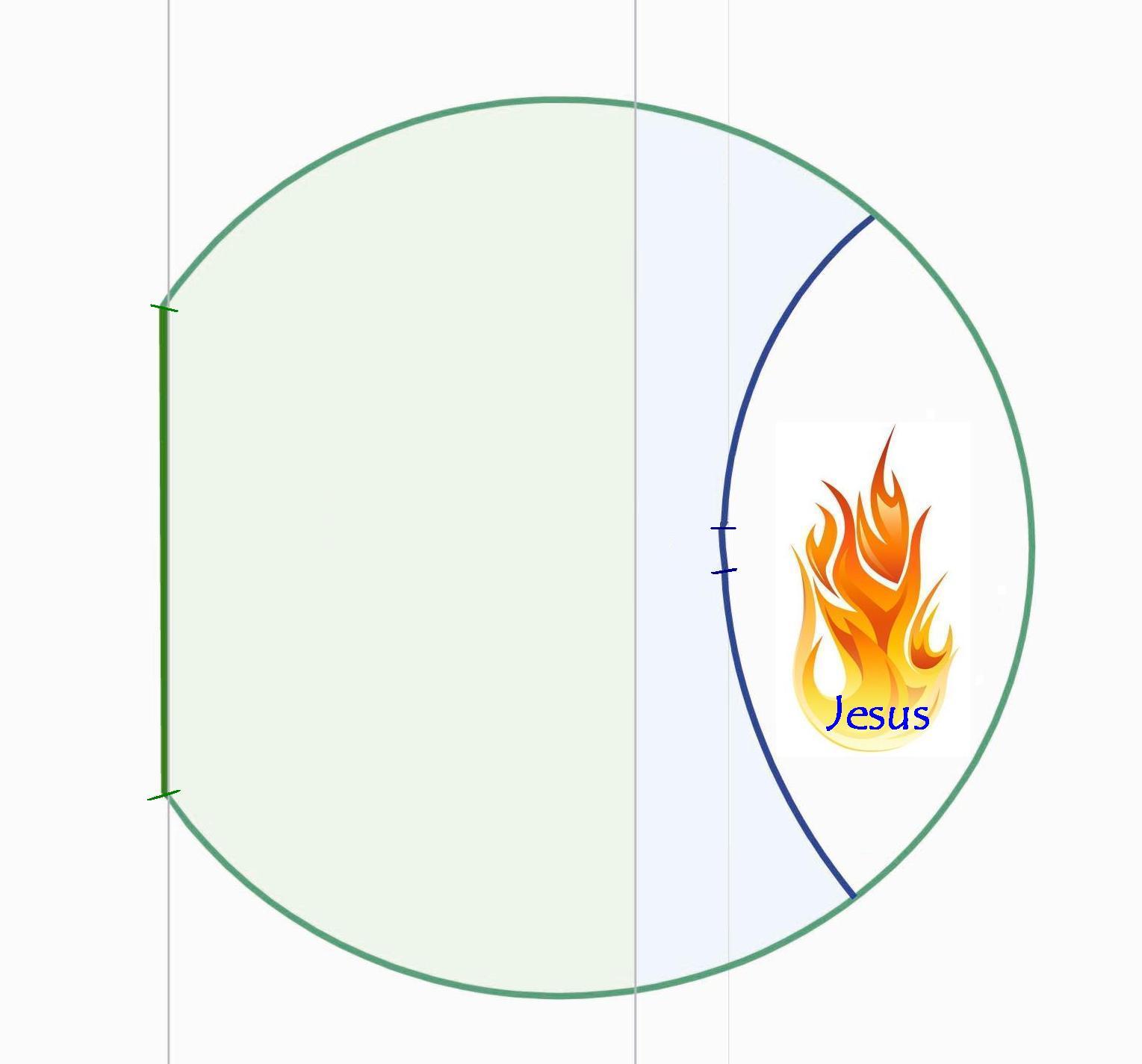
When we enter in our heart, what do
we see inside of it?
We have 3 areas where we can be:
1- A green area (see the previous diagram):
this area is the place where we are when we are in ourselves, immersed in our
thoughts and feelings.
2- A blue area: this area symbolises
the effort we make in order to move toward Jesus-God, dwelling inside of us: we
knock on Jesus’ door, we ask the Holy Spirit to allow us inside, in order to be
with Jesus.
3- A white area: this area is where
Jesus is. This is His Kingdom, where He introduces us, putting us in direct
contact with the Fire of His Love. (see the diagram below)

Therefore, during the day, and
during prayer we can be:
I- Outside of our heart (see the
diagram below: the heart to the left)
II- Inside of our heart: in the
green area
III- Asking Jesus to enter in Him
IV- Dwelling in Jesus, with the Fire
of His Love

As you can see, we are not
necessarily “dwelling in Jesus”. This is why Jesus invites us insistently:
‘dwell in Me, as I dwell in you’.
We can easily understand that if we
“dwell in Jesus” our daily acts/work will be different. It is from that Meeting
inside of us with Jesus that we draw Energy, Light and Love for our daily life.

This is why Jesus says ‘without Me
you can do nothing’ (John 15:15)
‘Dwell in my Love’ (John 15:9)
Jean is a French Catholic Theologian, specialised in Spiritual Formation, with more than twenty-five years of experience with Consecrated and Lay people. He obtained his Bachelors in Philosophy and his Masters in Spiritual Theology from Toulouse (France), and the Teresianum (Rome). He is presently completing his Ph.D. in Spiritual Theology at the Angelicum (Rome). Jean’s formation was greatly enhanced by the discalced Carmelite Fathers.
He has lectured in Spiritual Theology in different universities with a practical focus. Many articles, studies and books have been published internationally. In 2003, Jean founded the "School of Mary" which offers formation in Spiritual Life, many video courses being available at www.schoolofmary.org . Lectio Divina and Contemplative Prayer are amongst the most important forms of prayer addressed.
Jean gives Spiritual Direction on a regular basis and also gives retreats. He is married, has a daughter and is based in London.
Tuesday, 25 December 2012
65: Jesus is born in our heart
There are three Christmas Masses: midnight, dawn and
during the day. Not only we are allowed to attend them and but we are invited
to receive Communion during these 3 Masses.

The three masses of Christmas tell us of three births
of God’s Son:
1- His birth at Bethlehem. Luke 2:1-14.
2- His birth in our hearts. Luke 2:15-20.
3- His birth in eternity (the only begotten of the
Father). John 1:1-18.
You’ll certainly guess that I might have a greater
interest in the “dawn Mass”. It is a more “interior” perspective about
Christmas. It alludes to Jesus’ birth in our hearts.
By our
Baptism, Jesus is born in our heart. As a small seed, He’ll grow in us until He
reaches the fullness of His height. That moment could be considered as a fuller
“birth of Jesus in our hearts” or, if you will, the equivalent of what the
Mystics called the “Spiritual Marriage” with Jesus. Remember what saint Paul
claimed: “it is not me who live, Christ lives in me”.
Christmas
is as well about personal spiritual life: let us look inside and watch out
Jesus in us.
Who
better than Mary can give birth to Jesus? Who can carry Him in the fullness of
His hight and bear the intensity of His Divinity? Mary only can do it. We need
both: the Son of God, offering Himself to us as the biggest and deepest gift,
and Mary, the “capacity” to handle that divine weight in us.

Let us
invite Mary in the cradle of our heart so she can come. She comes carrying
Jesus in her. She is the best “space” we can offer to God so He can come and
dwell in us.
Saint
Thérèse of the Child Jesus once said that before Communion she invites Mary to
dwell in her heart, so when she receives Jesus, the Host, He’ll think that He
is dwelling in her. To me, it looks like the best way to receive Jesus in us.
Jean is a French Catholic Theologian, specialised in Spiritual Formation, with more than twenty-five years of experience with Consecrated and Lay people. He obtained his Bachelors in Philosophy and his Masters in Spiritual Theology from Toulouse (France), and the Teresianum (Rome). He is presently completing his Ph.D. in Spiritual Theology at the Angelicum (Rome). Jean’s formation was greatly enhanced by the discalced Carmelite Fathers.
He has lectured in Spiritual Theology in different universities with a practical focus. Many articles, studies and books have been published internationally. In 2003, Jean founded the "School of Mary" which offers formation in Spiritual Life, many video courses being available at www.schoolofmary.org . Lectio Divina and Contemplative Prayer are amongst the most important forms of prayer addressed.
Jean gives Spiritual Direction on a regular basis and also gives retreats. He is married, has a daughter and is based in London.
Wednesday, 12 December 2012
62: The practical use of the Dogma of the Immaculate Conception #2
 |
| Immaculate Conception |
(continuation of previous post)
To me, the historical context of the proclamation of the Dogma of the Immaculate Conception of Mary is very important in order to understand it fully, and we should strive to understand the “political”, practical, thread in it.
To me, the historical context of the proclamation of the Dogma of the Immaculate Conception of Mary is very important in order to understand it fully, and we should strive to understand the “political”, practical, thread in it.
Again,
being specialised in “Spiritual Theology”, I am essentially interested in the
practical spiritual impact of the Proclamation of a Dogma, any Dogma.
First: what is a “Dogma”?
The
word “Dogma” we use, is a word inherited from the Greek Philosophers. A dogma for them is a universal principle which founds and justifies a specific practical
conduct, and which can be formulated in one or in several propositions. A Dogma
(especially amongst the Stoic Philosophers) is like a sentence of practical
wisdom that one will meditate, ponder upon, and put into practice: it
essentially impacts the daily life.
The use
of the word “dogma” crossed from the cultural philosophical use amongst the
Greeks to early Christians.
- Was
that an error? Would that have meant a deviation of the right understanding of
Jesus’ message?
- I am
not sure it is the case. Let us have a closer look.
For early
Christians (the first centuries), the “dogmas” were something very practical. It
appears as well to be the same for the non-Greek christians: the Apostles themselves who
were Semites.
A very early example of the implicit use of the idea
of a “dogma”
See
for instance how saint Matthew in his gospel presents the Trinity as a “Dogma”,
i.e. as something to put into practice. The Sermon on the Mount (Matthew
5-7) is the Great Charter (Carta Magna) of the newly baptised. Remember we are baptised (i.e.
immersed) in each Person of the Trinity. In the Sermon of
the Mountain, saint Matthew dedicates a section for each person of the Trinity:
Mt 5:17-48 is offered to put the Son
into practice, Mt 6 is to help us put the Father into practice, and Mt 7 is for us to put the Holy Spirit into
practice. Each Person is a “dogmata”, not a sentence thought, but a Person
in whom we are supposed to meditate upon, to enter, to be immersed in.
“Being
Baptised” meant simply that the Father did Baptise (immerse) us, in the
Trinity.
- How would
this happen?
- For
the first Generation, God the Father was considered to have like two hands: st
Irenaeus says that the Son and the Holy Spirit are the Hands of the Father
(remember that Irenaeus is disciple of the disciple of saint John). So “Baptism”
would be seen as follows:
The Father takes us in His Hands and holds us tight:
as a result we shouldn’t escape from His hands. How? But a set of practices
that would help us remain immersed (baptised) in the Son, in the Father and in
the Holy Spirit (in that order, see 2 Co 13:13).
To “be Baptised” for the first generation of Christians implied to
put into practice the Three Divine Persons of the Trinity. The “Dogma” of the
Trinity was practical and vital.
Therefore
for the Catechesis of the first Christians (i.e. the Sermon of the Mountain), a
whole chapter was dedicated to approach each Person of the Trinity in a
practical way.
For a
mnemonic reason, remember that each hand has 5 fingers, so you’ll find the 5
points (one per finger) to remember about the Son in Mt 5 and the same for the
Holy Spirit: five sections in Mt 7.
Easy
to count, easy to remember, easy for meditation, easy to put into practise. The
whole “Greater Charter” (Carta Magna)
of Christianity, i.e. the Dogma of the Trinity, is all comprised in this Sermon,
the Sermon of the Mountain.
The historical background of the dogma
- Would
dogmas change?
- Obviously:
no.
- Would
we have new dogmas?
- Obviously:
no.
- So
why do we have “new” dogmas?
- We
don’t. We just proclaim a truth as a “dogma” when we see it, after a long
development, under a clearer light. (Theological note: Even if it is the Pope who proclaims a Dogma, the proclamation is an act of all the Church, as you'll see below, the Pope makes a consultation first in order to "sense" the "feeling of the faithful". The infallibility of the Pope draws its principle from the infallibility of the Church and not vice-versa.)
I
would ad to that last reply something important to my eye: a Dogma, as we just
said, has a direct practical use to it. It is not “one more truth to proclaim”,
it is one more thing to put into
practise, one more thing we already put into practise but the use of which
today is much more urgent, this is why it is underlined by the Faithful, the
Church, the Pope.
- So
why that urge to proclaim Mary as the “Immaculate Conception”?
- This
is exactly my point: the historical context of the proclamation is very
important to understand the reason and mainly its application in daily life.
Let us
remember few facts that will help us situate historically the “proclamation” of the Immaculate Conception of Mary by Pope Pius IX:
 |
| Pius IXth |
1- Pope
Pius the IXth is witnessing the end of the “Middle Age” political system,
and the new spirit of the French Revolution invading the spirit of the Italians
and most of Europe.
2-
These changes are quite drastic and, with all the good will of the Pope, are seen
and felt as a threat to the normal order of things.
 |
| Pellegrino Rossi |
3- The Pope’s life is under serious threat. His Prime Minister, Pellegrino Rossi, has been assassinated (15th of November 1848), the Swiss Guards are disarmed, making the Pope to a prisoner in his palace.
Then on the 24th of November 1848, the Pope then escapes in disguise as a regular priest to Gaeta,
in the Kingdom of the Two Sicilies
leaving Rome to the radicals and the mob.
4- At
Gaeta, in a very small crypt, the Pope prays during 9 months. He had a great
devotion to Mary under the name of the “Immaculate Conception”. (You can visit
the Church (“Santissima Annunziata”) and the crypt also called “Cappella d’Oro”)
 |
| Cappella d'Oro in Gaeta where Pius IX prayed for 9 months |
It is
during this time that the Pope formed the decision to start the process of
consultation that will lead later to the declaration of the Dogma of the
“Immaculate Conception”. He published
his Encyclical Letter, “Ubi Primum”,
the 2nd of February 1849 to the bishops of the Catholic Church
asking them for opinion on the definition of a dogma on the Immaculate
Conception of the Virgin Mary.
The Pope remained in Gaeta till the 4th
of September 1849.
Time of total distress
The Pope’s
Prime minister is killed, his life is under threat, he has to escape, and he
does it in disguise. This tells us the
degree of distress the Pope is in.
It is
quite obvious that the only practical help he could find was in Mary, not only
that, but “Mary the Immaculate Conception”. In a situation of darkness, of
total darkness, where the future of the Church is under serious threat, the
traditional political order is upside down and threatened to disappear, where
evil is trying to kill… the Pope turns in prayer to the Immaculate, the only
Creature after Jesus that was never defeated by Evil. We can say that the Pope
found the solution for his distress.
Do you
see the practical, spiritual and political situation in which is born the
desire to proclaim solemnly Mary as the “Immaculate Conception”?
He is
in fact declaring that he found The Solution for his distress, he wants to
present the solution, and he wants to say what happened to him and how she
helped him.
He
wants to say that this is the will of God to put in the Centre of the Church
the First Sign of His Victory, the New Eve, the one that was never defeated by
Evil. She is at the heart of the Church, real source and proof of Hope that God
gave us.
You’ll
notice that in the definition of the Immaculate Conception, it is said that
this “grace”/ privilege comes directly from Jesus’s salvation, from Jesus’
Cross. I like to see Her, first Saved Person, and mother, with Him, of all the
saved, I like to contemplate Her coming out of His Side, New Eve, totally pure.
The
first sign of Jesus’ victory on the Cross is Mary. The prototype of all the
Saved people, is Mary.
The
mother and the “Mould” of all the saved, is Her as well. She generated the
Head, and generates each person in the Body.
God
put this Sign (the Immaculate) right
in the centre of his Church. Mary is the only one who believed (see previous
posts), Mary is the Prototype of Jesus’ Disciple and follower (see previous
posts).
All of
us, like the Pope and like that moment in the history of the Church, we reach the darkest point in our spiritual
journey, and we all lift our eyes, in the darkness, to the Star of the Sea, Mary, the
Only Immaculate Point in the Dark Sky, “gift of Jesus for us”, “capacity to
believe” given by Him to us.
The role of Immaculate in the “Dark night of the
spirit”
Now
this is more technical here. According to saint John of the Cross, the “Dark
night of the spirit” is the deepest and final purification the faithful should
go through before reaching the “Union with Jesus” (See his book "The dark night", especially the second part). You might recognise it in
the “Great trial” mentioned in the book of Revelation (Rev 9:14-17) or find it in
a more plain way in: what the Apostles (or any Jesus’ follower) have to go through
when Jesus is about to start his Passion: all your hopes about the Messiah-Saviour
will vanish, all your life, your spiritual life seems to go and disappear in
the land of oblivion.
 |
| Ven. Fr. Marie-Eugène |
Now, a great catholic Master, the Venerable Fr Marie-Eugene of the Child Jesus OCD (1894-1967) (his process of Beatification is on the verge of reaching completion), in his great book “I want to see God”, says that Mary plays a fundamental role in this crucial moment were everything in our “spiritual life” seem to disappear. He quotes saint Louis-Marie Grignon de Montfort, saying that the presence of Mary all together 1- makes that time of deep purification lighter, more bearable, and 2- is essential for this turning point in our spiritual life (the deep purification). In fact, for the first time, we are called to make a pure act of Faith, and in order to do so, we learn to use “Mary’s faith”, or better said: we ask her to “believe for us”. In doing so, we let her grow in us, and transform our spirit at the image of hers, being now for the first time capable of “believing as she believes”.
We are
then starting to follow “the only one who believed in the Resurrection”, “the
one around whom the distressed apostle gathered in order to draw from her the
pure faith in Jesus”.
In a
way, pope Pius the IXth is saying to us: in these great times of
distress, the Church continues not with the strength of papacy, or any human strength,
but through the help God put in Mary, the Immaculate. God had his victory in
her, and is offering to each one of us this same Victory, by putting Mary in
the centre of Jesus’ faithful. Mary said “Yes” to God in the darkest moment of
history (when Jesus is dead): she believed in the Resurrection; and God gives
us her “Yes” so we can use it and overcome the darkness. (Note: John-Paul II made all this very clear during his Pontificate)
Does
it make more sense now to believe that Mary is Immaculate Conception? Do we see
better how practical is that “dogma”?
Jean is a French Catholic Theologian, specialised in Spiritual Formation, with more than twenty-five years of experience with Consecrated and Lay people. He obtained his Bachelors in Philosophy and his Masters in Spiritual Theology from Toulouse (France), and the Teresianum (Rome). He is presently completing his Ph.D. in Spiritual Theology at the Angelicum (Rome). Jean’s formation was greatly enhanced by the discalced Carmelite Fathers.
He has lectured in Spiritual Theology in different universities with a practical focus. Many articles, studies and books have been published internationally. In 2003, Jean founded the "School of Mary" which offers formation in Spiritual Life, many video courses being available at www.schoolofmary.org . Lectio Divina and Contemplative Prayer are amongst the most important forms of prayer addressed.
Jean gives Spiritual Direction on a regular basis and also gives retreats. He is married, has a daughter and is based in London.
Subscribe to:
Posts (Atom)