Showing posts with label dwelling in Christ. Show all posts

Friday, 31 October 2014

116: Reenergise Yourself

It is very interesting to see that some psychoanalysts describe the difficulties of souls (depression, neurosis,...) as a drop in energy level or simply a lack of energy. Of course they don't mean physical energy but soul-energy. I will not discuss this position, but I just find it interesting to note the way it is described by psychoanalysts as: a drop or lack of soul-energy. If we are not feeling well, sometimes we say that we don't have the “drive”, or that we have lost the “drive” to do something. In my humble view, often we are not psychologically ill, we are just psychologically undernourished. In certain cases both seem to engender the same results.

What is more striking is the passage from St Paul in his letter to the Ephesians: "Draw your strength from the Lord and from his mighty Power" (Ephesians 6:10), where a more literal translation would be: “energise yourselves ”. How? Through the Lord... reconnecting with the Lord.
Prayer is a real connection with the Lord where we receive his Power, his energy, his guidance: the Holy Spirit. Prayer is not optional. Prayer reconnects us with our roots, like the trunk of a tree is reconnected with its roots, in order to receive water (sap). Of course in prayer the motivation is not merely to feel better. When I pray it means I spend time with Jesus, to be with Him, and I do it with purity of intention, for his sake alone.

The connection with Jesus occurs from day one, from the day we reply to Jesus' Call, and start to follow him from close. I don't wait to become united with Jesus in order to draw energy from him. That would be Jesus seen as Goal (Jesus-the-Goal), Jesus accessed in fullness. But from day one, Jesus-the-Way adapts himself to my needs, lowers himself and his way of interacting with me, gives me an adapted food - spiritual milk - so I can grow. He offers his support. I try to remain in contact with him as much as I can. He gives me His Spirit who transforms me, step by step, so I start to switch from being guided by earthly drives to being guided by the Holy Spirit's Drive and Energy. "Draw your dynamism from the Lord and from his mighty Power" (Ephesians 6:10).

Therefore it is very important to connect with Jesus, to receive our Energy and Guidance from Him. If the lamp is not plugged into the mains, no electricity will flow. The same applies in our relationship with Jesus: no light, no love, no drive will flow if we do not connect with Him.


Another image of that "connection" with Jesus: Jesus yearns to gather us “as a hen gathers her brood under her wings”. Imagine yourself like a little chick, under the warm protective wing of Jesus, seen as a hen. This image is very warm, very cuddly. It is impressive to see it used by God himself.

When we are gathered under the warm protective wings of Jesus-Hen, what do we get? Comfort, strength, direction, being centred,... This means that we are called to be as close as this to God - here on earth, we are called to have such a relationship with Jesus.

Is this optional? Isn't it vital? Your energy levels depend on it!

Saturday, 23 February 2013

71 : Jesus says to you : « Dine with Me »


The Risen Lord says to each one of us, incessantly : « Behold, I stand at the door and knock. If anyone hears my voice and opens the door, I will enter his house and dine with him, and he with me. » (Rev 3 :20)
Where is Jesus standing? Where in us the door He is knocking at is situated?
By our Baptism, Jesus takes our heart as His dwelling place. He is dwelling in the deepest part of our heart.
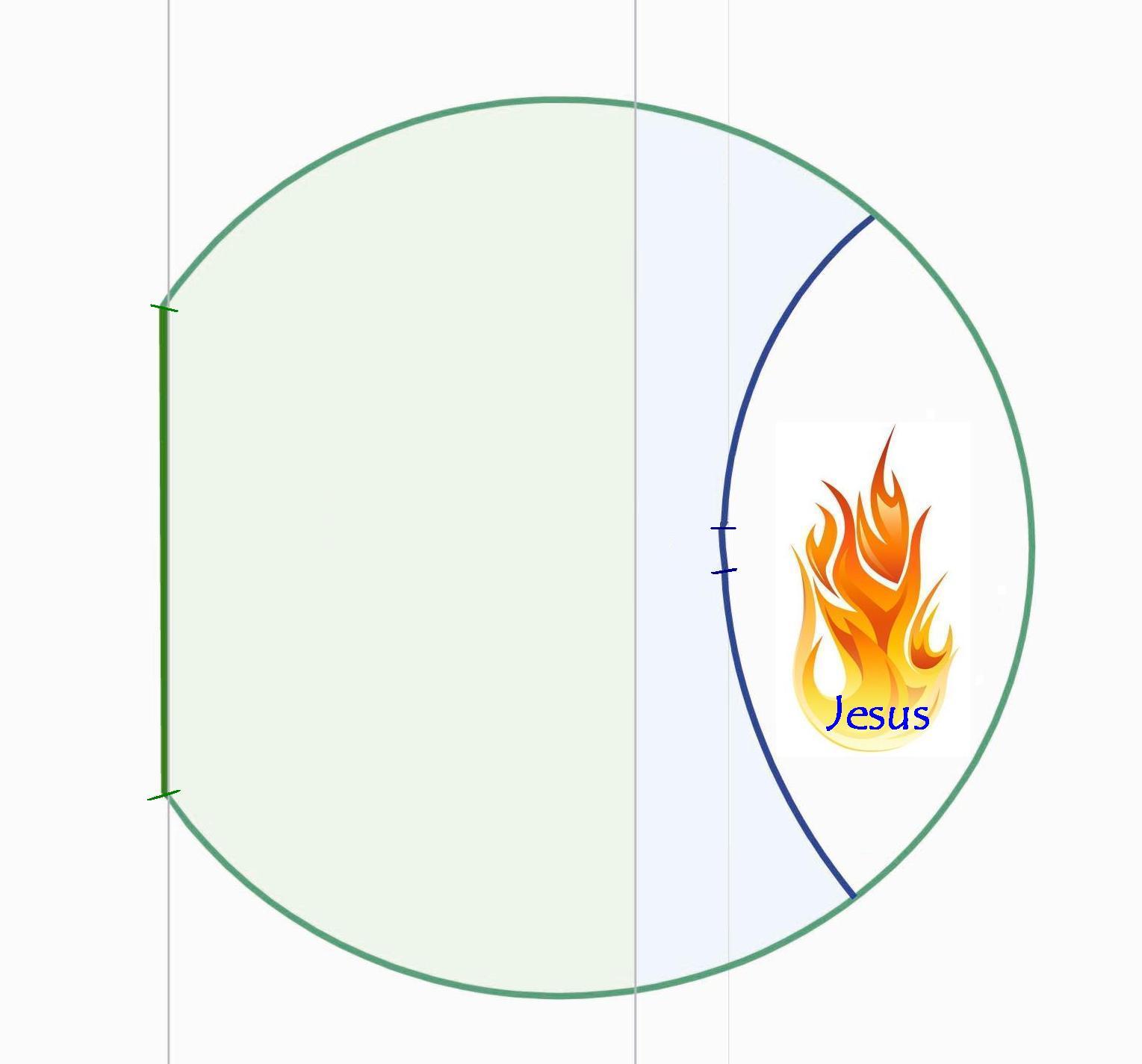
If our heart is like a Circle, Jesus is abiding in its deepest part (see on the diagram below the area in oval, with the Fire/Jesus in it).
Jesus, is in the deepest part of my heart knocking at the door. On the diagram, you can see the little door between the oval area and the rest of the circle (blue and green area).
Therefore, we might be “in our heart” but not necessarily “in Jesus” (see the diagram below).
Now, do I hear Him, from inside, knocking at my door ?
He speaks to me without an audible voice, He invites me to give myself to Him unconditionally; so He will be able to let me in, and "dine with me": giving Himself to me. He Himself is the Divine Food of that Sacred Dinner. 
Do I understand that the handle of the door is on my side? This is why He is knocking. I am the only one who can open the door. He will not force the door of my freedom. It is by giving myself to Him that I open the door. He will not impose Himself. He awaits patiently… sometimes for years…
The door opened, we enter and dwell in Jesus
Jesus: “Do you want to give yourself to Me today, and in every minute, like a little child?”
Let us meditate upon these words, ponder…. and decide (to give/offer ourselves to Him).

Jesus says: “By doing that (giving yourself to Me), you open the Door immediately and I let you in. Come to Me and abandon yourself in My arms, unconditionally.”

“By doing that my "Door" as well opens immediately: I let you in, I give myself to you, I pour My Spirit in you, nourish you in a Divine “Dinner”.”
The door opened
“From time to time, keep repeating the offering of yourself, in order to REMAIN with Me, in Me.”
When you are with Me, keep calling Me, gently, with my Name: JESUS.”
"I take your heart in My Hands"
“Come inside, where I dwell, and Dine with Me.”

Sunday, 3 February 2013

68 : How to 'dwell in Jesus'

Jesus says to us: 'Dwell in Me as I dwell in you' (John 15:4) How can we dwell in Him ? How does He dwell in us?
First let us see where and how Jesus dwells in us?
By our Baptism, Jesus takes our heart as His dwelling place. He is in the deepest part of our heart.
We can visualise our heart like a Circle. Jesus is in the deepest part of it.
When we enter in our heart, what do we see inside of it?
We have 3 areas where we can be:

1- A green area (see the previous diagram): this area is the place where we are when we are in ourselves, immersed in our thoughts and feelings.

2- A blue area: this area symbolises the effort we make in order to move toward Jesus-God, dwelling inside of us: we knock on Jesus’ door, we ask the Holy Spirit to allow us inside, in order to be with Jesus.

3- A white area: this area is where Jesus is. This is His Kingdom, where He introduces us, putting us in direct contact with the Fire of His Love. (see the diagram below)
Therefore, during the day, and during prayer we can be:

I- Outside of our heart (see the diagram below: the heart to the left)
II- Inside of our heart: in the green area
III- Asking Jesus to enter in Him
IV- Dwelling in Jesus, with the Fire of His Love
As you can see, we are not necessarily “dwelling in Jesus”. This is why Jesus invites us insistently: ‘dwell in Me, as I dwell in you’.

We can easily understand that if we “dwell in Jesus” our daily acts/work will be different. It is from that Meeting inside of us with Jesus that we draw Energy, Light and Love for our daily life.
This is why Jesus says ‘without Me you can do nothing’ (John 15:15)

‘Dwell in my Love’ (John 15:9)

Monday, 7 January 2013

66: This Little Child Is Our Temple

Saint John is his Gospel presents Jesus as our real Temple: “But the Temple he had spoken of was his Body” (John 2:21). The author of the Letter to the Hebrews mentions the same thing (see He 9). 

- What is a temple?
A temple is a place where we find three things: God, worshipers, and the action of worship.
A Temple is a privileged place, where one can meet God directly, where one can see Him, listen to Him and offer something to Him. A Temple is a place to dwell in, in order to get closer to God.

- Is it about any temple?
It is about the Temple of Jerusalem. In this Temple, God in person was dwelling and direct worship was possible.

- How the Temple of Jerusalem was made?
The Temple of Jerusalem is made at the image of the real Temple: Jesus. We see it first with Moses who is instructed to build the temple at the image of what he was offered to see in heaven (Exodus 25.9, 40 Acts 7:44, Hebrews 8:5). “Moses was warned when he was about to build the tabernacle: “See to it that you make everything according to the pattern shown you on the mountain.” (He 8:5)

Saint Paul says that God saw us in Him, conceived us in His Thoughts, before creation. “For he chose us in him before the creation of the world to be holy and blameless in his sight, in love” (Ephesians 1:4). We can say that God saw His Body, His Temple, from all Eternity, before Creation.

We can then say the following: when God sent us His Son He sent us our Temple.
This little baby (born in the manger) is your Temple, the place where you are invited to dwell, for the rest of your life and for all your eternity.

This means that when we stop like the Magi in front of the little boy, in the arms of his mother, we should be able to see much more than a simple baby.
How can we have this deeper vision, this penetration in the mystery of this little boy? We really need the Holy Spirit in order to “see” in Him our own final dwelling place.

How many times saint Paul uses the word “in Christ”! In fact we need to be “in Christ”, to dwell “in Him”.

Thank you dear God, because you opened for us your Home... You want us to dwell in You. You sent us our Temple, our final Mansion. This is such an amazing Gift, an amazing plan for each one of us!

The Magi saw deeper in this little baby. Therefore they offered Him:
Gold: all the utensils in the Temple that dealt with God were made in Gold. The little boy is God, being THE Temple, God dwelt in Him.
Incense: the worship, praise, adoration and sacrifice in the Temple are carried with incense, symbol of the prayer that ascends to God.
Myrrh: relates to the victim that is offered to God: the body and soul of Jesus, our real Temple.
I invite you to meditate and ponder (spend time) on the fact that, through the Incarnation, God, in the little Child Jesus God, is offering us our House and our Temple.

"Blessed are those you choose
and bring near to live in your courts!
We are filled with the good things of your House,
of your holy Temple."
(Psalm 65:4)


Yes, in Jesus, this little baby, we find plenty of "good things", we find all what we need. Here is a wonderful passage taken from saint John of the Cross, second book of the Ascent of the Mount Carmel. In the following amazing and unique passage, saint John of the Cross makes God the Father speak to each one of us who is seeking consolation, light, guidance and happiness:


"If I have spoken all things to thee in My Word, Which is My Son, and I have no other word, what answer can I now make to thee, or what can I reveal to thee which is greater than this? Set thine eyes on Him alone, for in Him I have spoken and revealed to thee all things, and in Him thou shalt find yet more than that which thou askest and desirest. For thou askest locutions and revelations, which are the part; but if thou set thine eyes upon Him, thou shalt find the whole; for He is My complete locution and answer, and He is all My vision and all My revelation; so that I have spoken to thee, answered thee, declared to thee and revealed to thee, in giving Him to thee as thy brother, companion and master, as ransom and prize. For since that day when I descended upon Him with My Spirit on Mount Tabor, saying: "This is My beloved Son, in Whom I am well pleased; hear ye Him" (Mt 17:5), I have left off all these manners of teaching and answering, and I have entrusted this to Him.

Hear Him; for I have no more faith to reveal, neither have I any more things to declare. For, if I spake aforetime, it was to promise Christ; and, if they enquired of Me, their enquiries were directed to petitions for Christ and expectancy concerning Him, in Whom they should find every good thing (as is now set forth in all the teaching of the Evangelists and the Apostles);
but now, any who would enquire of Me after that manner, and desire Me to speak to him or reveal aught to him, would in a sense be asking Me for Christ again, and asking Me for more faith, and be lacking in faith, which has already been given in Christ; and therefore he would be committing a great offence against My beloved Son, for not only would he be lacking in faith, but he would be obliging Him again first of all to become incarnate and pass through life and death. Thou shalt find naught to ask Me, or to desire of Me, whether revelations or visions; consider this well, for thou shalt find that all has been done for thee and all has been given to thee - yea, and much more also - in Him.


6. If thou desire Me to answer thee with any word of consolation, consider My Son, Who is subject to Me, and bound by love of Me, and afflicted, and thou shalt see how fully He answers thee.

If thou desirest Me to expound to thee secret things, or happenings, set thine eyes on Him alone, and thou shalt find the most secret mysteries, and the wisdom and wondrous things of God, which are hidden in Him, even as My Apostle says: "In this Son of God are hidden all the treasures of wisdom and knowledge of God" (Col 2:3). These treasures of wisdom shall be very much more sublime and delectable and profitable for thee than the things that thou desiredst to know. Herein the same Apostle gloried, saying: That he had not declared to them that he knew anything, save Jesus Christ and Him crucified. (1 Co 2:2) And if thou shouldst still desire other Divine or bodily revelations and visions, look also at Him made man, and thou shalt find therein more than thou thinkest, for the Apostle says likewise: "In Christ dwelleth all the fullness of the Godhead bodily" (Col 2:9)." (Ascent of Mount Carmel, II,5-6)
The Jerusalem Temple, made at the image of Jesus
and how we enter in Him until we reach His Divinity.


Friday, 26 October 2012

52: P Pio, the Stigmata and Jesus' Passion


Two days ago I was watching a film on P Pio. P Pio is the first Priest to receive the Lord's Stigmata (His 5 physical wounds: 2 hands, 2 feet, and the side) . For 50 years, he lived what in fact was lived by the Lord during few hours: His Holy Passion.
What a mystery! Jesus comes amongst us, in us, through us, and lives again and again His Unique and unrepeatable Passion.

The amazing thing with P Pio is that what was very common during the first 3 Centuries of Christianity, but lived for only few hours or maybe few days, he lived it for 50 years! I mean by that what the Martyrs went through: participating into the Passion of the Lord, or better said, as the accounts of the Martyrs point it out: Jesus comes in the Martyr and suffers again and again, in His "Mystical Body", His Passion (please do delve in the early accounts of the Christian Martyrs). Martyrs are the Passion of Jesus extended in time.

Some might think that these things are a bit “too much”, or a “catholic deviation”. Well, not really. Remember that saint Luke, in his second work, the Act of the Apostles, when he mentions the first Martyr (Stephen), he takes great care of showing him following the steps of Jesus, almost dying like Jesus (Acts chapter 7): being persecuted, martyred to death, and forgiving his murderers. Saint Luke shows us that if Jesus is seated that the Right Hand of the Father, He is in His "Mystical Body" as well, on earth, continuing his suffering, His Passion and His work of salvation. Salvation has been done once and for ever on the Cross. But this unique Passion has to reach people and in order to do so, Jesus wants us to help Him, to give Him space and time (give Him our existence), so He can come in us, and continue to live His Mystery and His Salvation. There are no two (or more) salvations, there is only one. But this only one needs to reach all humans; and this relies on us. This is why Jesus says (see John 15): be in Me and Me in you, so you can “do” something. The only “action” of the Lord is “to save”. So, in order to let Him save through us, we need to dwell in Him and Him in us.

P Pio is just an example of what should be normal for us. I don't mean that we all have to receive the visible stigmata, but there is plenty to delve in as for "sufferings" in order to help Jesus. Some might still doubt that and would like to allow it only for few exceptions. This is wrong. You may go back to the series of 11 diagrams describing the total length of our Spiritual Journey of growth (please click here). You'll notice that, in the end of our journey, in the descending curve, all of us are invited to “participate to the Passion of the Lord". Note that there is another moment, much before this one, where we meet and benefit from the Passion of the Lord, in order to be purified: this would be in the ascending curve (see the Diagram).

Remember saint Paul, and please consider carefully what he says, because he went through the same journey: “I do not live, but Jesus lives in me”, “I complete in my flesh what lacks in the Passion of Jesus, for the Church His body”, and as well: “I carry in my body the stigmata of Jesus” (Ga 6:17).
I am sure you noticed that powerful expression: “the stigmata of Jesus” (in Greek saint Paul says: “Stigmata”). For people who still doubt that, let us read this long passage of saint Paul. Please do read it, having in mind P Pio, all his life, the 50 years baring the Stigmata of Jesus:

But we have this Treasure in jars of clay to show that this all-surpassing Power is from God and not from us. We are hard pressed on every side, but not crushed; perplexed, but not in despair; persecuted, but not abandoned; struck down, but not destroyed.
We always carry around in our body the Death of Jesus, so that the Life of Jesus may also be revealed in our body. For we who are alive are always being given over to death for Jesus’ sake, so that His life may also be revealed in our mortal body. So then, death is at work in us, but Life is at work in you.
It is written: “I believed; therefore I have spoken.” Since we have that same spirit of faith, we also believe and therefore speak, because we know that the one who raised the Lord Jesus from the dead will also raise us with Jesus and present us with you to himself. All this is for your benefit, so that the grace that is reaching more and more people may cause thanksgiving to overflow to the glory of God.” (2 Co 7,7-15)

This passage in itself deserves a long commentary. Don't you think?

Wednesday, 20 June 2012

The 'Act of oblation': 3 questions

Few days ago (9th of June 2012), I did post the 'Act of Oblation of saint Thérèse of the Child Jesus'. See here 'text 1'. In the 'comment', Lee posted 3 questions. Thank you very much Lee. Since your questions are very important and the 'act of oblation' is of utmost importance, I choose to address them here in a separate post and not as a reply to a comment.

Question 1: What is the full significance of the word 'oblation'? What is it trying to capture? What is its full meaning? Is it “offering up your heart”? I would love for you to expand on this!

Reply: 'oblation' here is the translation of the French 'offrande'. Thérèse could have used the french word 'oblation'. She preferred 'offrande'. 'Offrande' is 'to offer', 'offering', which is: giving. She'll rightly define the act of love this way: 'to love is to give everything and to give oneself to God'. You see, she very easily switched from 'offering' to 'giving'.
Since God created us and created us free, this means that:
1- We are free
2- We possess ourselves
God chooses not to possess us. This is why and how we can love: we have something we can give...
Remember, the definition of the Sacrament of Marriage: the mutual gift of each of the parties (the Groom and the Bride). 'Mutual git of': this is love: each one gives himself (as a gift) to the other one.
God possesses everything, except us, human beings, created 'at His Image and Likeness'. He doesn't need us to offer Him what He already possesses. The dearest being on earth for God is the Human being, but He doesn't possess him. He left him free, free to love or not, to give himself or not. He can't force the human being to love Him.
We do own the dearest thing in the eyes of God, the thing that pleases Him the most: ourselves. Offering Him the only 'thing' He doesn't have pleases Him enormously!
The very act of offering ourselves is an act of Love.

Now, another question might rise: what is to 'offer ourselves'?

Reply: Let me give you a first example to open the way: sometimes we can worry a lot about an issue, ok? We feel, and know that we are 'carrying that problem in us'. It can be very heavy indeed, even though it is in the soul. And then, while we are praying, God comes and asks us to 'entrust' Him that problem. We feel that it requires from us an act of detachment. It might cost us a lot to do this inner act, because we do possess a lot our problems. Then, we reach the point where we end up by offering, entrusting, putting in His Hands the Problem.

Well in this case it was a problem that we were offering. Now imagine all ourselves, our past, present, future, our body, soul, spirit, all what we possess, all what we are, all our richness, talents, the graces received. They are not 'problems' but they are elements to which we could be attached to. And God knows how it might cost sometimes to offer ourselves to Him. Sure, one can very easily admit that in order to do so, we need to things:
1- to know Him a little bit more than just a superficial knowledge of God, it requires a bit of experience of Him.
2- a big trust in Him, and trust comes from experiencing His overwhelming love.


Question 2: Well, it made me think of two things:
a. In the Mass, when we are invited to “Lift up our hearts to the Lord” (you have mentioned this part of the Mass before). I understand that the Mass is an oblation, an offering, but would this part of the Mass be reminding us of/ and our opportunity to practice our oblation to God?

b. It made me think of “prayer of the heart” - could this be seen a kind of oblation/offering up our hearts? 


Reply: Definitely the Mass in an oblation/offering. During the Mass, we offer ourselves to God, as God offers/gives Himself to us. Definitely 'lift up your heart' is a reminder for us to offer ourselves. Without hesitation, I would consider all these acts being exactly the same: to love - to offer ourselves - to lift our heart to Jesus (seated at the right Hand of the Father) – the Prayer of the heart.
The base of all is in fact the 'power' we receive in Baptism to offer ourselves to God: the priesthood of the faithful. We are united to Him, this is why He gives us a share in His Priesthood. We can then, as priests in Christ, offer ourselves to God, and offer Christ to the Father. We can offer our brothers and sisters, the entire world to God.
All the faithful are invited to participate [spiritually] to the Mass. In order to do so, they have to exercise their priesthood (not to be mixed with the Priesthood of Ordained Ministers).
An offering presupposes:
  1- A Priest (that offers, elevates),
  2- An Altar (the leaning point),
  3- A Victim (to offer)
  4- A Fire (to burn, elevate, transform).
In Christ-Priest we are priests. The Altar is Christ himself as well. His capacity, in the Trinity (He is at the Right hand of the Father), to offer, direct the offering to the Father. He is the rock, the fulcrum. The Victim here to offer is ourselves. The Fire is the Holy Spirit, the Merciful Love of God.


You find here all our way to enter in the Mass, especially its second part ('lift up your heart'), the Offertory where, with the bread and wine, we offer all our life to God, and later as well, in Jesus, the Host, we offer ourselves to the Father in the Fire of the Holy Spirit. Remember in the Third Eucharistic prayer we have: 'May He [the Holy Spirit] make of us an eternal offering to you”.

The prayer of the heart, is that same exercise of lifting up our heart (as saint Paul invites us to do, or Jesus by saying: 'dwell in me'), but repeated gently, extended in a period of time. But it should become our final destination. This is when we are united to Jesus in 'spiritual marriage'.

Question 3: Also, St Therese refers to the oblation as “one single act of perfect love”:
 "In order to live in one single act of perfect Love, I offer myself as a victim of holocaust to your merciful Love, asking you to consume me incessantly…"


What do you think she means by “one single act” and this act being an act of “perfect love”? Do we too need to offer ourselves up as “victims of the holocaust of love” in order to enter into this single act of perfect love?

Reply: This is an obvious double question that one asks when he/she reads Thérèse's Act: what is “one single act” and what is “perfect love”.
I was just saying, above, that we should extend the time of dwelling in Christ. Remember the offering means that He comes and takes us and immerses us in Him. So as a result, we dwell in Him. And dwelling in Him (one, two, three minutes, or sometimes, an hour or more, it depends on Him and on our degree of transformation in Him).... means that He outpours the Holy Spirit in us. This is why it is of the utmost importance to practice the prayer of the heart: we allow God to give himself to us, transforming us in Him.
one single act”, one single active act... she wants to remain in Him, active, as much as possible. Yes, 'Love attracts our love'. I would rather say: a heart beating style of “single act”. In the sense that it is not a simple passive position, it is a burning position, and, even if it is long lasting, it has a form of a heart beating. Remember saint Paul speaks about the “movements” of the Holy Spirit deep in us saying: “the Spirit Himself intercedes for us with unspoken groaning” (Romans 8:26). The "groaning" is repetitive. So it is not static but dynamic.

I would then say that we start by not having it 'one continuous active immersion in Jesus' (one single act). We come out of the immersion, so we do repeat the act of offering. Day after day, we grow spiritually, we are transformed in Him, then we are invited to reach that hight of a "continuous act" or "one act".

The act of 'pure love': I would be here more prudent. I would consider the “pure act of love” as the act that fulfils the conditions mentioned above (Priest, Victim, Fire, Altar..), and the most important one is to lean on Jesus himself only, on His merits as Thérèse takes time to explain in the long long introduction to the Act of Oblation (all what precedes the last paragraph of the specific act of offering). This means that we need to have the “Altar” (and not to lean on ourselves), and the Power of the Holy Spirit (not our capacity of lifting in the air (not in the water)).
Let me here show you another passage where she explains it:

A scholar has said: “Give me a lever and a, fulcrum and I will lift the world.”. What Archimedes was not able to obtain, for his request was not directed by God and was only made from a material viewpoint, the saints have obtained [36 v] in all its fullness. The Almighty has given them as fulcrum: HIMSELF ALONE; as lever: PRAYER which bums with a fire of love. And it is in this way that they have lifted the world; it is in this way that the saints still militant lift it, and that, until the end of time, the saints to come will lift it.” (End of Manuscript C)

Of course you might argue: - she is not speaking of the Prayer of the Heart, but the prayer of intercession. - Well, no, it is absolutely the same. And they are both about lifting. “a soul that is burning with love cannot remain inactive” reminds us Thérèse. Therefore, the more Charity grows in us, the more God entrusts us automatically more brothers and sisters. Therefore, the Prayer of the heart becomes a power apostolic weapon of conquest. (we might come back to this apostolic aspect of the Prayer of the heart)

Now your last question: “Do we too need to offer ourselves up as “victims of the holocaust of love” in order to enter into this single act of perfect love?”

Reply: It is like asking me: is it necessary to practice the “Prayer of the heart” in order to reach that “single act of perfect love”? Well yes, it helps, because of the outpouring of the Holy Spirit that happens during that time of immersion in God. But it is not the only means. It is one leg, the other is Lectio divina, the proof of love: 'if one loves Me, he will put into practices my commandments' (John 14:23).

________

Letter 197
From Thérèse to Sister Marie of the Sacred Heart
J.M.J.T.Jesus
September 17, 1896
Dear Sister, I am not embarrassed in answering you… How can you ask me if it is possible for you to love God as I love Him?...If you had understood the story of my little bird, you would not have asked me this question. My desires of martyrdom are nothing; they are not what give me the unlimited confidence that I feel in my heart. They are, to tell the truth, the spiritual riches that render one unjust, when one rests in them with complacence and when one believes they are something great. ... These desires are a consola­tion that Jesus grants at times to weak souls like mine (and these souls are numerous), but when He does not give this consolation, it is a grace of privilege. Recall those words of Father: "The mar­tyrs suffered with joy, and the King of Martyrs suffered with sadness." Yes, Jesus said: "Father, let this chalice pass away from me." Dear Sister, how can you say after this that my desires are the sign of my love?... Ah! I really feel that it is not this at all that pleases God in my little soul; what pleases Him is that He sees me loving my littleness and my poverty, the blind hope that I have in His mercy.... That is my only treasure, dear Godmother, why would this treasure not be yours?...Are you not ready to suffer all that God will desire? I really know that you are ready; therefore, if you want to feel joy, to have an attraction for suffering, it is your consolation that you are seeking, since when we love a thing the pain disappears. I assure you, if we were to go to martyrdom together in the dispositions we are in now, you would have great merit, and I would have none at all, unless Jesus was pleased to change my dispositions.Oh, dear Sister, I beg you, understand your little girl, understand that to love Jesus, to be His victim of love, the weaker one is, without desires or virtues, the more suited one is for the workings of this consuming and transforming Love. ... The desire alone to be a victim suffices, but we must consent to remain always poor and without strength, and this is the difficulty, for: "The truly poor in spirit, where do we find him? You must look for him from afar," said the psalmist. ... He does not say that you must look for him among great souls, but "from afar," that is to say in lowliness, in nothingness.... Ah! let us remain then very far from all that sparkles, let us love our littleness, let us love to feel nothing, then we shall be poor in spirit, and Jesus will come to look for us, and however far we may be, He will transform us in flames of love....Oh! how I would like to be able to make you understand what I feel!... It is confidence and nothing but confidence that must lead us to Love.... Does not fear lead to Justice (1)?... Since we see the way, let us run together. Yes, I feel it, Jesus wills to give us the same graces, He wills to give us His heaven gratuitously. "Oh, dear little Sister, if you do not understand me, it is because you are too great a soul.. .or rather it is because I am explaining myself poorly, for I am sure that God would not give you the desire to be POSSESSED by Him, by His Merciful Love if He were not reserving this favor for you.. .or rather He has already given it to you, since you have given yourself to Him, since you desire to be consumed by Him, and since God never gives desires that He can­not realize. ...Nine o'clock is ringing, and I am obliged to leave you.' Ah, how I would like to tell you things, but Jesus is going to make you feel all that I cannot write....I love you with all the tenderness of my GRATEFUL little childlike heart.Thérèse of the Child Jesus rel. carm. ind.(1) To strict justice such as it is portrayed for sinners, but no this Justice that Jesus will have toward those who love Him.

______________

I hope this helps.